

Why Your Choice of Tire Brand Matters More Than You Think
Tires are the only part of your vehicle that actually touches the road. Every input you make — steering, braking, accelerating — is filtered through four contact patches roughly the size of an adult hand. That means the brand stamped on your sidewall has more influence on your safety, fuel economy, ride comfort, and stopping distance than almost any other component in your car.
After analyzing decades of independent tire tests (TÜV, ADAC, AutoBild, Tire Rack, Consumer Reports), warranty data, and real-world durability studies, nine manufacturers consistently rise above the rest. They aren't the cheapest, but they are the ones professional drivers, OEM engineers, and competitive racing teams trust when failure isn't an option.
This guide covers all nine in depth, ranks them across five core performance pillars — safety, performance, efficiency, quality, and innovation — and ends with a comparison table you can use to pick the right brand for your driving style.
The Five Pillars Every Premium Tire Brand Must Master
Before getting into the brands themselves, it helps to understand what separates a «good» tire from a world-class one. Top-tier manufacturers compete on five dimensions:
- Safety — Wet braking distance, hydroplaning resistance, emergency lane-change stability.
- Performance — Dry grip, cornering precision, high-speed stability, steering response.
- Efficiency — Rolling resistance and its impact on fuel economy or EV range.
- Quality — Tread life, build consistency, defect rate, sidewall durability.
- Innovation — R&D spend, patents, new compounds, sustainable materials, smart-tire tech.
The brands below each lead on at least one of these pillars — and the very best lead on several.
1. Michelin (France) — The Gold Standard for Total Tire Performance
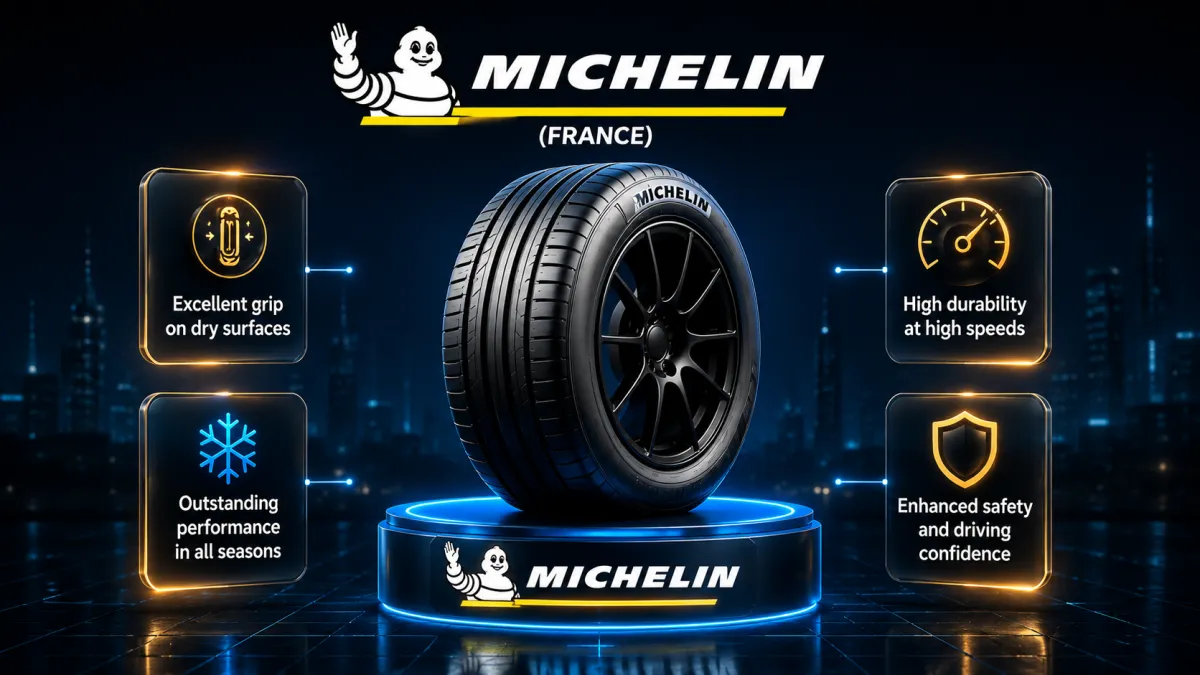
Founded: 1889 in Clermont-Ferrand · Signature strength: Optimal road contact and long tread life
Michelin is, by almost any objective measure, the most decorated tire brand in the world. The company invented the radial tire in 1946, a single innovation that reshaped the entire industry. Today its tires win independent tests with remarkable consistency, especially in wet braking, treadwear, and rolling resistance.
What makes a Michelin different is its EverGrip and MaxTouch construction, which engineers the contact patch to wear evenly across the tread's life. A Michelin tire at 70% wear behaves much more like a new tire than its competitors at the same wear level — a critical advantage for safety as the tire ages.
Best for: Drivers who keep their cars long-term, premium SUV and sedan owners, EV drivers who want long-range performance tires. Watch for: Premium price point — typically the most expensive tier on the shelf. Iconic lines: Pilot Sport 4S, Primacy 4, CrossClimate 2, Pilot Sport EV.
2. Bridgestone (Japan) — The High-Speed Stability King
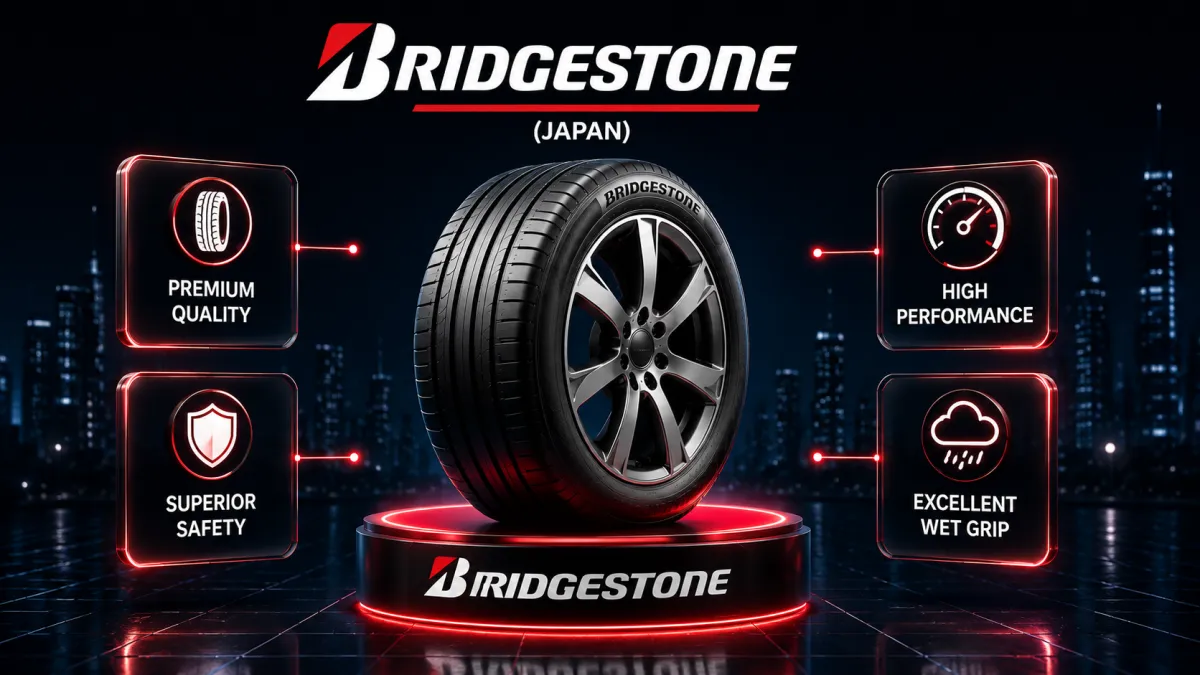
Founded: 1931 in Kurume · Signature strength: Stability at high speed and OEM dominance
Bridgestone is the largest tire manufacturer in the world by revenue and the dominant OEM supplier for performance vehicles, including Formula 1's tire era contracts and current MotoGP. Its engineering culture is famously conservative — Bridgestone tires are tuned for predictable behavior across a huge range of conditions rather than chasing a single performance peak.
The NanoPro-Tech compound technology, developed in Tokyo, refines the polymer-filler interaction at the molecular level. The result is reduced rolling resistance without sacrificing wet grip — a trade-off most manufacturers struggle with.
Best for: Highway commuters, performance sedan owners, drivers who prioritize composure at autobahn speeds. Watch for: Some entry-level Bridgestone lines (Ecopia, Turanza T005) significantly outperform others; check independent tests for the specific model. Iconic lines: Potenza Sport, Turanza 6, Blizzak WS90, Alenza 001.
3. Continental (Germany) — The European Safety Benchmark
Founded: 1871 in Hanover · Signature strength: Wet-weather braking and ADAC test wins
If you read European tire tests — ADAC, AutoBild, TCS — you'll notice the same pattern: Continental almost always finishes in the top three, and frequently in first place. The brand has built a reputation as the safety-first choice, particularly for shortest wet braking distance, a metric where it has led the industry for nearly a decade.
Continental is also a quiet leader in smart tire technology. Its ContiSense and ContiAdapt research projects are pioneering tires that adjust contact patch shape and report wear data in real time — technology that's already trickling into OEM contracts with German luxury manufacturers.
Best for: Drivers in rainy climates, families prioritizing safety, German-car owners (often factory-fitted). Watch for: Slightly firmer ride than some competitors — Continentals favor precision over plush comfort. Iconic lines: PremiumContact 7, SportContact 7, WinterContact TS 870, CrossContact ATR.
4. Goodyear (USA) — The All-Season Workhorse
Founded: 1898 in Akron, Ohio · Signature strength: All-season versatility and aviation-grade engineering
Goodyear is the largest North American tire manufacturer and supplies tires to NASA, NASCAR, and most US commercial aviation. That breadth gives the company a unique advantage: technology developed for extreme applications cascades into consumer products.
Goodyear's Assurance line in particular has set the benchmark for all-season passenger tires in the US market, balancing dry handling, wet grip, light-snow capability, and tread life better than nearly any competitor at its price point. The brand's investment in soybean-oil-based compounds also gives it one of the more credible sustainability stories in the industry.
Best for: Drivers across four-season climates, light truck and SUV owners, fleet operators. Watch for: True winter performance still trails dedicated winter brands — buy Eagle Enforcer or Ultra Grip for serious snow. Iconic lines: Eagle F1 Asymmetric 6, Assurance WeatherReady 2, Wrangler Territory, Eagle Sport All-Season.
5. Pirelli (Italy) — The Performance and Fuel-Economy Specialist
Founded: 1872 in Milan · Signature strength: UHP (ultra-high-performance) and fuel-efficiency leadership
Pirelli is the official tire supplier of Formula 1, and that DNA defines the entire brand. Its P Zero family is fitted as original equipment on more high-end supercars than any other tire on earth — Ferrari, Lamborghini, McLaren, Bugatti, and Aston Martin all specify custom Pirelli compounds for their flagship models.
Less obvious is Pirelli's leadership in low rolling resistance. Its Cinturato range is consistently among the top-rated tires for fuel economy in EU labeling, helping ICE drivers save fuel and EV drivers gain range. Pirelli also pioneered the «marked tire» concept (MO for Mercedes, N0 for Porsche, AO for Audi), letting OEMs specify a tire tuned to each chassis.
Best for: Sports-car and supercar owners, performance EV drivers, drivers chasing maximum fuel economy. Watch for: Soft compounds wear faster — UHP Pirellis are not long-life tires by design. Iconic lines: P Zero (PZ4), Cinturato P7, Scorpion Verde, Sottozero 3.
6. Dunlop (United Kingdom) — Heritage Performance with Year-Round Confidence
Founded: 1889 in Dublin (UK heritage) · Signature strength: Balanced all-season performance and motorsport pedigree
Dunlop is one of the oldest tire brands in the world and is now part of the Sumitomo Rubber group with strong manufacturing presence across Europe and Asia. Its Sport BluResponse and SP Sport Maxx lines have a long history of strong AutoBild and ADAC test results, particularly for the price/performance ratio.
The brand's racing heritage is legitimate — Dunlop has won at Le Mans, the Isle of Man TT, and World Superbike repeatedly. That trickles down into a tire range that holds up well in spirited driving without demanding flagship pricing.
Best for: Performance-minded drivers on a sensible budget, motorcycle riders, classic car enthusiasts. Watch for: Product line varies significantly by region (Dunlop branding is licensed differently in North America vs. Europe vs. Japan). Iconic lines: Sport Maxx RT 2, SportSmart TT, Winter Sport 5, Grandtrek AT3.
7. Hankook (South Korea) — The Premium Challenger
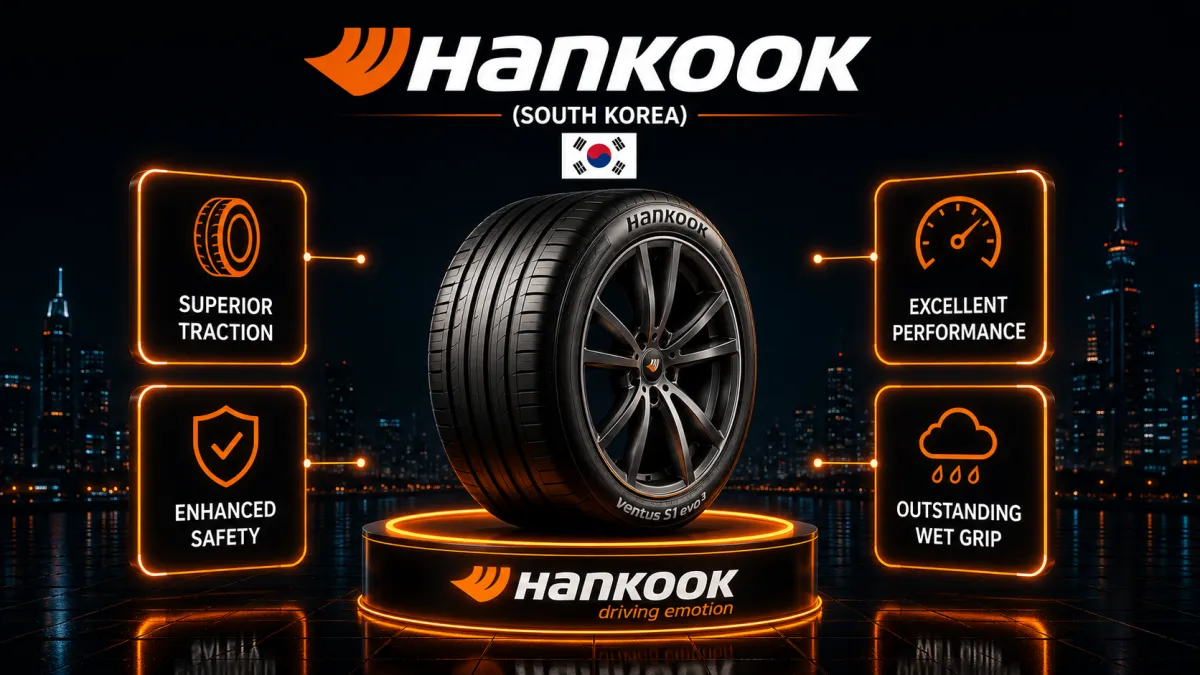
Founded: 1941 in Seoul · Signature strength: Advanced compounds at value pricing
Hankook is the fastest-growing major tire brand of the past two decades and now supplies OEM tires to BMW, Mercedes-Benz, Audi, Porsche, and Tesla. That OEM acceptance from Europe's most demanding chassis engineers tells you almost everything you need to know about how far Hankook has come from its budget-tire origins.
Its Ventus and Kinergy lines use advanced rubber compounds — specifically high-silica formulations and bio-based oils — that deliver wet grip and durability genuinely competitive with brands costing 30–40% more. Hankook also leads the industry in EV-specific tire development, with the Ventus iON range designed from scratch for instant-torque electric vehicles.
Best for: Value-seekers who don't want to compromise on performance, EV drivers, BMW/Tesla owners. Watch for: Premium Hankook lines (Ventus S1 evo3, iON) are world-class; budget lines are merely competent. Iconic lines: Ventus S1 evo3, Kinergy 4S2, Ventus iON, Winter i*cept evo3.
8. Yokohama (Japan) — The Engineering Purist
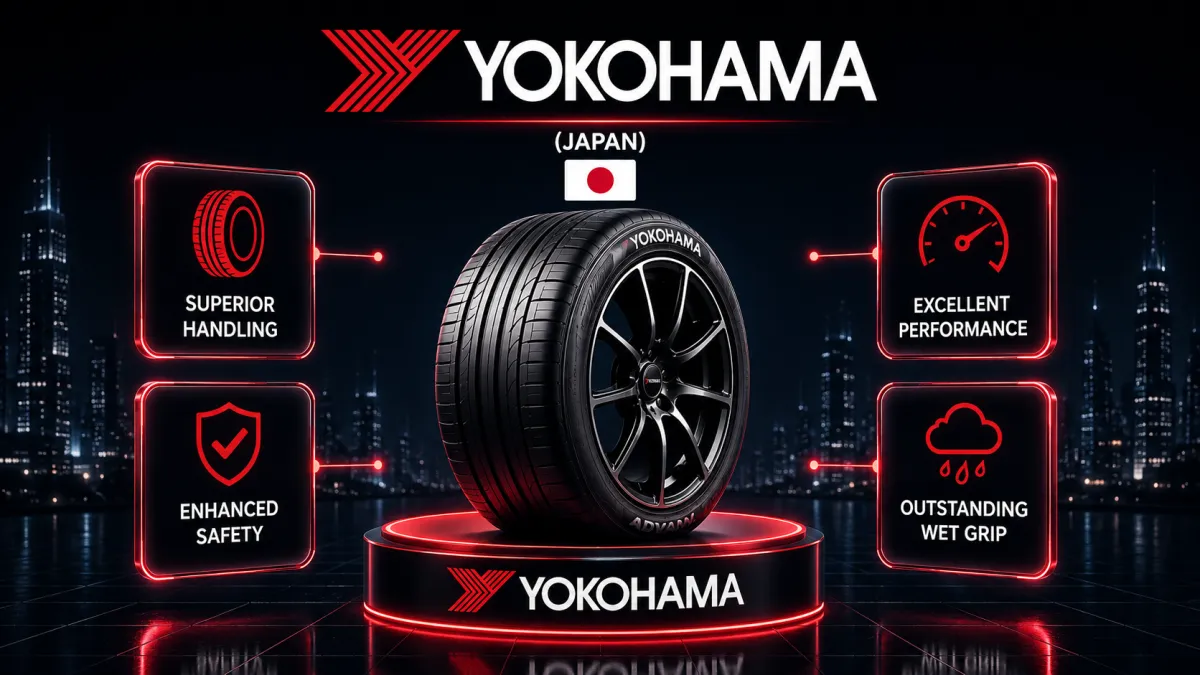
Founded: 1917 in Yokohama · Signature strength: Innovative compounds and motorsport-derived technology
Yokohama is a relatively quiet brand in mainstream consumer marketing but a giant in technical circles. Its ADVAN lineage is one of the most respected performance tire families in the world, used in JGTC, Formula Drift, and time-attack competition at the highest level.
The company's BluEarth range pioneered the use of orange-oil-based compounds — a genuine industry innovation that reduces petroleum dependency while improving wet grip. Yokohama's manufacturing tolerances are also famously tight, which translates into exceptional roundness, balance, and noise consistency tire-to-tire.
Best for: Track-day enthusiasts, drivers who care about engineering substance over marketing, eco-conscious buyers. Watch for: Less retail visibility outside Japan and the US than the European giants. Iconic lines: ADVAN Sport V107, ADVAN A052, BluEarth-GT AE51, Geolandar A/T G015.
9. BFGoodrich (USA) — The All-Terrain and High-Speed Specialist
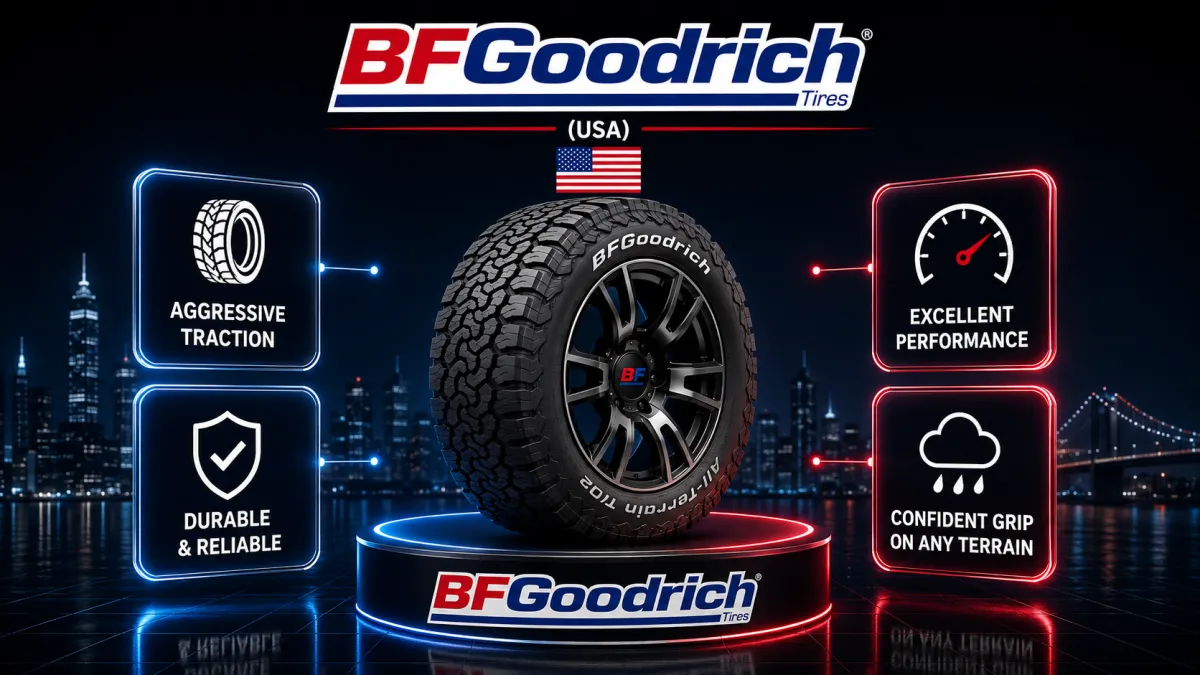
Founded: 1870 in Akron, Ohio · Signature strength: Off-road dominance and wet grip
BFGoodrich (a Michelin Group brand since 1990) occupies a unique niche: it builds some of the best all-terrain and mud-terrain tires on the planet, while also producing serious street-performance tires with high stability at speed and outstanding wet grip. The KO2 and newer KO3 All-Terrain are legendary among overlanders, Baja racers, and military fleet operators.
For street drivers, the g-Force family — particularly the Rival S 1.5 and Sport Comp-2 — offers genuine track-capable performance at sub-flagship pricing. BFGoodrich is also one of the few brands to consistently win the Baja 1000, an endurance event that essentially destroys every component on a vehicle.
Best for: Truck, Jeep, and SUV owners, overlanders, track-day amateurs. Watch for: Aggressive tread patterns are louder than highway-focused tires — expect road noise on long trips. Iconic lines: All-Terrain T/A KO3, Mud-Terrain T/A KM3, g-Force Comp-2 A/S, Advantage T/A Sport LT.
| Brand | Founded | Best-Known For | Tread Life | Wet Grip | Dry/Performance | Fuel Efficiency |
|---|---|---|---|---|---|---|
| Michelin France | 1889 | Long life + total balance | ★★★★★ | ★★★★★ | ★★★★☆ | ★★★★★ |
| Bridgestone Japan | 1931 | High-speed stability | ★★★★☆ | ★★★★☆ | ★★★★★ | ★★★★☆ |
| Continental Germany | 1871 | Shortest wet braking | ★★★★☆ | ★★★★★ | ★★★★★ | ★★★★☆ |
| Goodyear USA | 1898 | All-season versatility | ★★★★☆ | ★★★★☆ | ★★★★☆ | ★★★★☆ |
| Pirelli Italy | 1872 | UHP + fuel economy | ★★★☆☆ | ★★★★☆ | ★★★★★ | ★★★★★ |
| Dunlop UK | 1889 | Balanced all-season | ★★★★☆ | ★★★★☆ | ★★★★☆ | ★★★★☆ |
| Hankook South Korea | 1941 | Premium value, EV focus | ★★★★☆ | ★★★★☆ | ★★★★☆ | ★★★★☆ |
| Yokohama Japan | 1917 | Compound innovation | ★★★★☆ | ★★★★☆ | ★★★★★ | ★★★★☆ |
| BFGoodrich USA | 1870 | All-terrain + high speed | ★★★★☆ | ★★★★★ | ★★★★☆ | ★★★☆☆ |
Which Brand Fits Which Driver? A Practical Buyer's Matrix
| If you drive… | The strongest match is… | The runner-up is… |
|---|---|---|
| A luxury sedan or premium SUV | Michelin | Continental |
| In heavy rain or wet climates | Continental | Michelin |
| A sports car or supercar | Pirelli | Bridgestone |
| Long-distance highway routes | Bridgestone | Michelin |
| A four-season family vehicle | Goodyear | Dunlop |
| An EV (range matters most) | Michelin (Pilot Sport EV) | Hankook (Ventus iON) |
| Mixed road/off-road / overlanding | BFGoodrich | Goodyear (Wrangler) |
| On a tighter budget but want quality | Hankook | Yokohama |
| Track days and spirited weekends | Yokohama (ADVAN) | Pirelli (P Zero) |
How Tire Brands Are Tested (and What You Should Look For)
Independent testing is the single best filter when shopping for tires. The most credible test programs are:
- ADAC (Germany) — Considered the global gold standard for all-season and winter tests.
- AutoBild (Germany) — Largest summer and winter shootouts each year.
- TÜV SÜD — Independent engineering body that audits tire performance claims.
- Tire Rack (USA) — Real-world consumer testing with comparable methodology.
- EU Tire Label — Mandatory rating for rolling resistance, wet grip, and noise on every tire sold in the EU.
When evaluating a tire, prioritize wet braking distance above almost everything else — a few meters difference at 80 km/h can be the gap between a near miss and an accident.
Common Buyer Mistakes (From Someone Who's Seen Hundreds)
- Buying on price alone. A €40 saving per tire is meaningless if your stopping distance grows by 5 meters in the rain.
- Ignoring the manufacture date (DOT code). Tires older than 5–6 years degrade even if unused. Check the four-digit code on the sidewall.
- Mixing brands across axles. This can destabilize ESC and ABS systems. Always replace in matched pairs at minimum.
- Skipping winter tires below 7°C. Even premium summer tires lose 30–50% of their grip in cold temperatures — compound, not tread depth, is the issue.
- Over-inflating to "save fuel". You will gain ~1% economy and lose roughly 20% of your contact patch. Use the placard pressure.
Which is the best tire brand in the world overall?
For most drivers, Michelin is the strongest all-round choice — it consistently leads in tread life, wet braking, and rolling resistance across independent tests. Continental is a near-equal alternative if wet-weather safety is your single highest priority.
Are premium tire brands really worth the extra money?
Yes, in almost every measurable way. Premium tires typically last 20–30% longer, brake 3–7 meters shorter in the wet at highway speed, and reduce fuel consumption by 2–5%. Over the tire's lifespan, the «premium» cost is usually offset by fuel savings alone.
What's the best tire brand for an EV?
Michelin Pilot Sport EV
and Hankook Ventus iON are the two purpose-built leaders. Both use reinforced sidewalls to handle EV weight, low-noise foam liners for cabin quietness, and low-rolling-resistance compounds to maximize range.
How long should a quality tire last?
A premium all-season tire from any brand on this list should deliver 60,000–100,000 km (40,000–60,000 miles) depending on driving style, alignment, and rotation discipline. Performance summer tires are intentionally shorter-lived — typically 30,000–50,000 km.
Are Chinese or budget tire brands safe?
The gap is closing, but it has not closed. Independent tests still show meaningful differences in wet braking, high-speed stability, and consistency. For city driving at low speeds the difference is small; for highway, motorway, or emergency situations the difference can be significant.
Final Verdict
The «best tire brand» depends entirely on what you're trying to optimize for — there is no single right answer. That said, three brands consistently set the standard the rest of the industry chases:
- Michelin — for the buyer who wants the best across every metric and intends to keep the car.
- Continental — for the buyer who weights safety and wet-weather performance above all else.
- Bridgestone — for the buyer who wants OEM-grade composure and high-speed predictability.
Below that top tier, Pirelli, Goodyear, Dunlop, Hankook, Yokohama, and BFGoodrich all have specific use cases where they genuinely beat the leaders. Match the brand to your actual driving — not the marketing — and you'll get more safety, more economy, and more enjoyment out of every kilometer.