
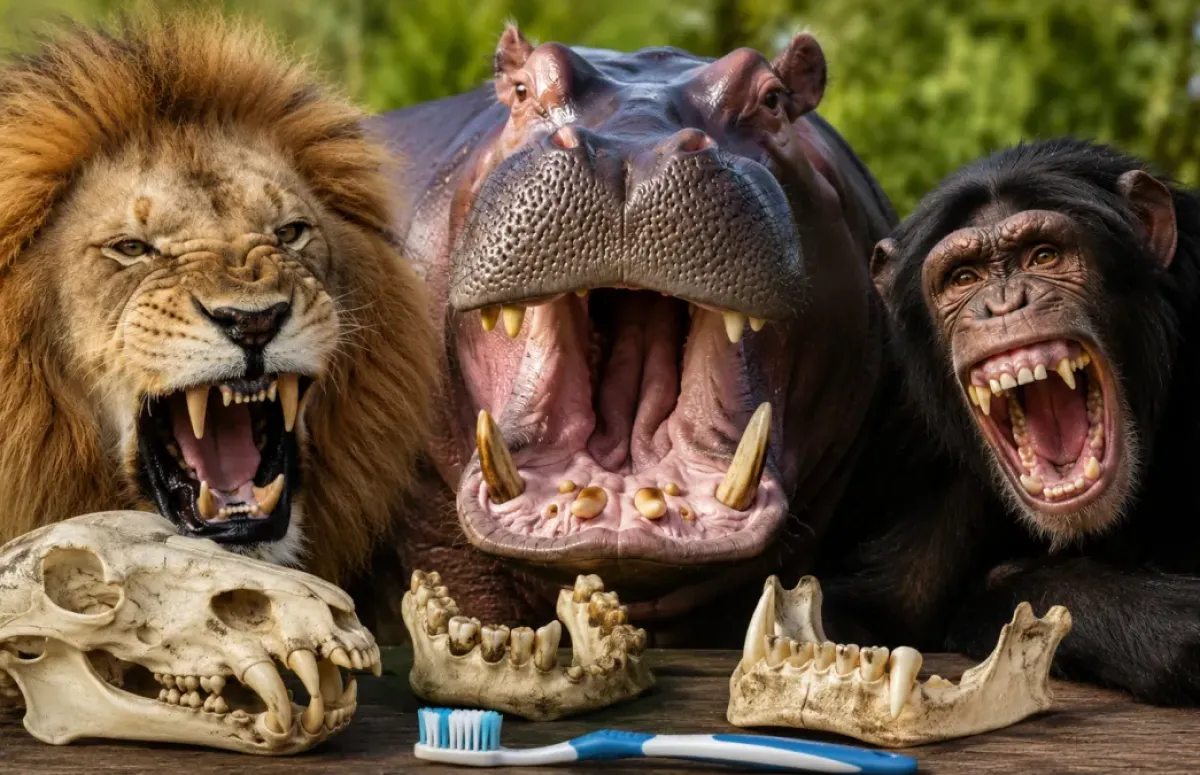
Most of us were told as children that brushing twice a day is non-negotiable. Yet wolves, lions, and elephants seem to manage just fine without a toothbrush or a tube of fluoride paste. What's going on? The answer reveals something surprising about the modern human diet — and the evolutionary trap our teeth are stuck in.
The Myth Worth Clearing Up First
Before diving into the science, let's address a common misconception: wild animals do not have perfect teeth.
Lions develop broken canines. Wolves suffer from periodontal disease. Elephants literally die when their final set of molars wears down — starvation follows because chewing becomes impossible. Dental problems in the wild are common; they're just less visible because animals rarely survive long enough for the damage to accumulate, and they certainly don't visit dentists.
The more accurate question is: Why do modern humans suffer from tooth decay at dramatically higher rates than wild animals — even with daily brushing?
Thousands Are Buying This Portable Cooler Instead of an Air Conditioner — Here's Why
1. Diet Is the Dominant Factor
This is where the real story lies.
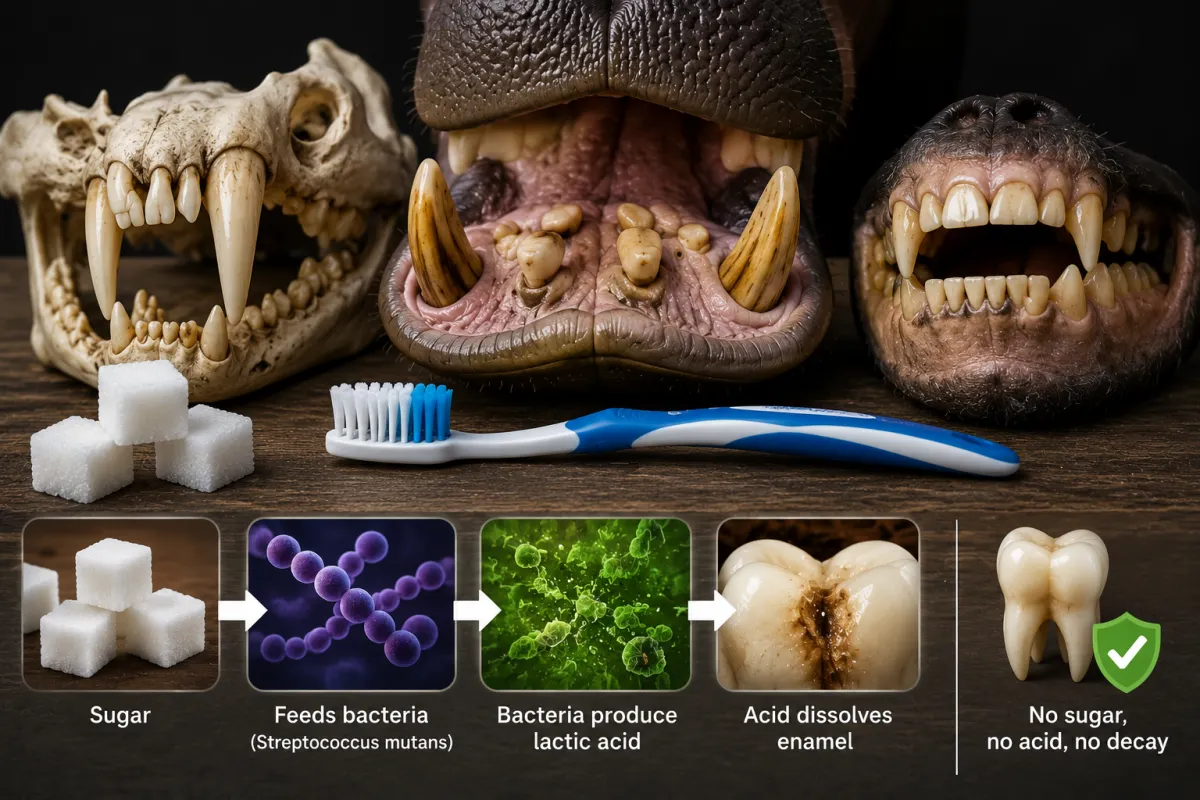
Tooth decay is caused not by neglect, but by a specific chain reaction: sugar feeds oral bacteria (primarily Streptococcus mutans), which produce lactic acid, which dissolves tooth enamel. No sugar, no acid, no decay.
- Carnivores — wolves, lions, big cats — consume virtually zero carbohydrates or sugars. Their enamel is rarely exposed to the acid cycle at all.
- Herbivores — horses, cows, elephants — eat natural plant sugars, but the high fiber content of raw vegetation acts like a mechanical brush, scrubbing teeth surfaces continuously during chewing.
- Modern humans consume processed sugars and refined carbohydrates dozens of times per day, feeding bacteria in repeated cycles that enamel simply cannot withstand.
The archaeological record confirms this dramatically. Studies of pre-agricultural human skulls — from populations that lived as hunter-gatherers more than 10,000 years ago — show near-zero rates of dental caries. No toothbrushes. No dentists. Almost no cavities. The shift to farming, and later to industrial food processing, is what broke the relationship between humans and healthy teeth.
2. Saliva Composition Differs Across Species
Saliva is the body's first line of dental defense. It contains enzymes like lysozyme and peroxidase that attack oral bacteria, and bicarbonate that neutralizes acid after meals.
Carnivores — particularly dogs and cats — have saliva with a notably higher pH and more potent antibacterial enzyme activity than humans. Their oral environment is simply more hostile to the bacteria that cause decay.
Human saliva has the same toolkit, but the sheer volume of sugar passing through the mouth overwhelms the buffering capacity, especially in a modern diet where eating events happen continuously throughout the day.
3. Mechanical Self-Cleaning Through Chewing
Wild animals chew differently. Gnawing on raw bone, tearing through hide, or grinding coarse fibrous grasses creates significant mechanical abrasion across tooth surfaces — effectively dislodging plaque and food particles with every meal.
Processed human food is soft by design. It lodges between teeth, sits against enamel, and ferments. There is no mechanical cleaning happening. The toothbrush exists precisely to compensate for what the modern diet no longer does naturally.
4. Number of Tooth Sets — A Fundamental Biological Difference
Humans are diphyodonts: we grow two sets of teeth over a lifetime — baby teeth and permanent teeth. That's it. A human adult relies on the same 32 teeth from roughly age 12 until death, potentially 70 or 80 years later.
Most other mammals follow the same two-set pattern, but many species have evolved workarounds:
- Crocodilians replace their teeth up to 50 times throughout their lives.
- Sharks are polyphyodonts — they produce new teeth in a continuous conveyor system, replacing each tooth every 1–2 weeks. A single shark may generate over 20,000 teeth in a lifetime.
- Elephants cycle through six sets of molars sequentially. When the sixth set wears down, the animal faces starvation — which is why dental wear is ultimately one of the leading causes of natural elephant mortality.
- Horses and cattle have hypsodont (high-crowned) teeth specifically adapted to a lifetime of grass grinding — enamel is deep and wears slowly over decades.
Humans evolved in an environment where food was tough, lifespan was short (roughly 35–45 years for hunter-gatherers), and the permanent dentition was adequate for the expected wear. Modern longevity and modern food have completely outpaced the original design spec.
5. Lifespan Masks the Damage
A wolf in the wild lives 6 to 8 years. A lion rarely survives past 16. Many wild animals simply do not live long enough for chronic dental decay to manifest the way it does in humans who live into their 70s and 80s.
Domestic animals — dogs, cats, horses — kept on processed diets and living long lives under human care show rates of periodontal disease strikingly similar to their owners. Veterinary dentistry has become a significant field precisely because longevity combined with an unnatural diet produces the same outcome in pets as in people.
The lesson from wildlife isn't to skip brushing. It's that the most effective dental intervention isn't the toothbrush — it's what goes in your mouth before the toothbrush is ever needed.
Comparison: Dental Health Across Species
| Species | Diet Type | Sugar Exposure | Natural Cleaning | Tooth Sets | Decay Risk |
|---|---|---|---|---|---|
| Modern human | Processed omnivore | Very high | Minimal | 2 | Very high |
| Pre-agricultural human | Hunter-gatherer | Near zero | Raw fiber | 2 | Very low |
| Wolf / wild dog | Carnivore | None | Bone chewing | 2 | Low |
| Domestic dog | Processed kibble | Low–moderate | Partial | 2 | Moderate |
| Lion / big cat | Carnivore | None | Meat and bone | 2 | Low |
| Horse / cow | Herbivore | Natural only | Continuous fiber | 2 (hypsodont) | Low |
| Elephant | Herbivore | Natural only | Vegetation grinding | 6 sequential | Moderate (wear) |
| Crocodile | Carnivore | None | Aquatic, self-cleaning | Up to 50 | Very low |
| Shark | Carnivore | None | Saltwater + replacement | Unlimited | Minimal |
Do wild animals ever get tooth decay?
Yes — it is well documented across species including lions, wolves, bears, and primates. The difference is frequency and severity, which correlates directly with sugar intake and lifespan, not dental hygiene habits.
Why did prehistoric humans have better teeth than modern humans?
Pre-agricultural humans ate a diet with no refined sugars and very little starch. Their teeth were exposed to far less acid-producing bacterial activity. Archaeological studies consistently show cavity rates close to zero in hunter-gatherer populations.
Is brushing teeth really necessary?
For anyone eating a modern diet, yes. Brushing mechanically removes the plaque biofilm that would otherwise sit against enamel and produce acid continuously. It compensates for the mechanical cleaning that a raw, fiber-rich diet would otherwise provide.
Why do domestic dogs and cats get dental disease?
Because they live long lives and eat processed food. Both factors closely mirror human conditions. Veterinary dental disease rates in pets mirror human rates more than wildlife rates.
Which animal has the best teeth in the world?
Sharks are often cited because they continuously replace teeth throughout life — a polyphyodont system that makes decay essentially irrelevant. Crocodilians follow a similar pattern with up to 50 replacement cycles.
What is the root cause of human tooth decay?
The primary cause is dietary sugar feeding Streptococcus mutans bacteria, which produce enamel-dissolving lactic acid. Frequency of sugar exposure matters as much as quantity — constant snacking keeps enamel under sustained acid attack.