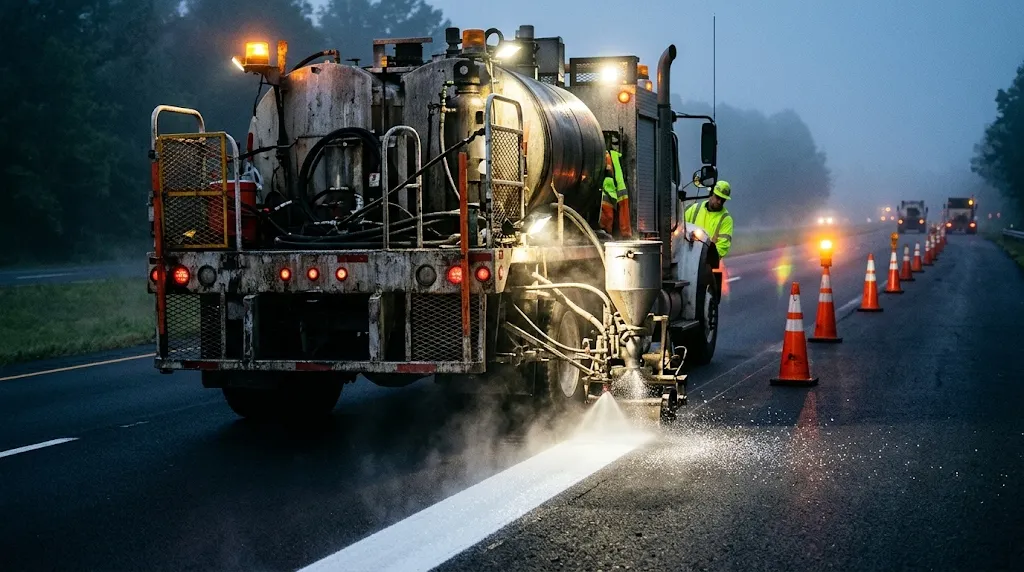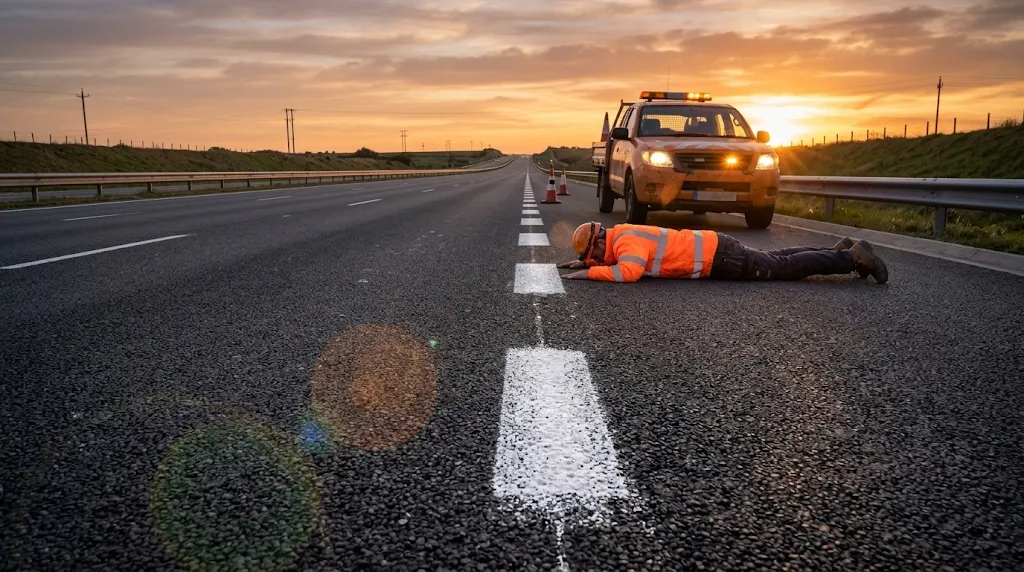

Every driver cruising along an American interstate at sixty-five miles per hour swears the dashed white lines separating lanes are tiny two-foot sticks of chalk. In reality, federal highway regulations mandate that every single white dash measures a staggering ten feet long—longer than the roofline of most family sedans.
The Chalk Lines on Interstate 35
I was driving north on Interstate 35 out of Des Moines, Iowa on a clear Tuesday morning with my brother-in-law, Kevin, who spent twenty-four years working as a highway traffic design engineer for state transportation departments across the Midwest. We were cruising in the right lane at seventy miles an hour behind a grain tanker. I pointed out through the windshield at the dashed white lines separating our lane from the passing lane. I told Kevin they looked like little two-foot sticks of white chalk painted onto the dark asphalt. Kevin laughed so hard he tapped the steering wheel with his palm. "Every single driver in America thinks those white stripes are two feet long," he said, adjusting the rearview mirror. "People look out their side window and swear they could step right over one. But if we pulled this truck onto the shoulder right now and laid a tape measure down on the pavement, that single white stripe is exactly ten feet long. And the empty black gap between that stripe and the next one? That's thirty feet of plain asphalt."Gas Stations Barely Make Money on Gas. The Real Profit Engine Is the Snack Aisle
Kevin pulled off at a quiet rest stop near Ames, Iowa to show me how the numbers actually work. We walked along the outer perimeter access lane where the state highway patrol parked their cruisers. "Look at the federal rulebook," Kevin explained, pulling a digital copy of the Federal Highway Administration's manual on his tablet. "Federal standard 655 mandates that every broken line on an American highway must follow a strict four-to-one ratio: ten feet of paint, followed by thirty feet of empty skip. That means from the start of one white stripe to the start of the next stripe is exactly forty feet of road."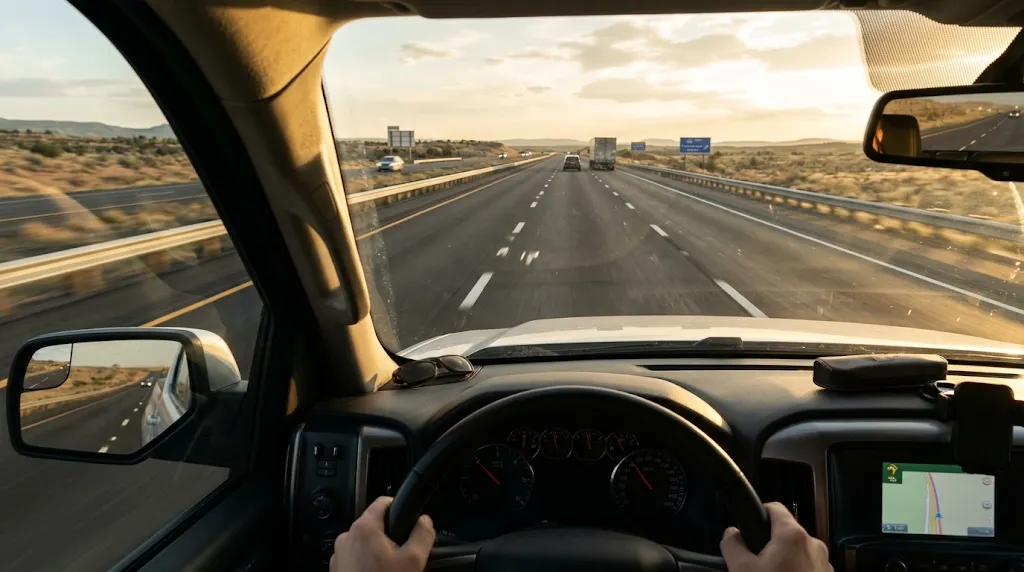
Why Sixty-Five Miles Per Hour Shrinks Ten Feet of Paint
To the human brain sitting behind a steering wheel at sixty-five miles per hour, that forty-foot cycle collapses completely. "Human eyes aren't built for high-speed motion," Kevin told me as eighteen-wheelers roared past on the interstate. "When you're walking across a parking lot at three miles an hour, your brain has plenty of time to process depth and length accurately. But when you're hurtling down an interstate at seventy miles an hour, you're traveling over one hundred feet every single second." At that speed, your peripheral vision blurs. Your optic nerves cannot process individual details close to the front bumper. Instead, your brain automatically shifts its focus hundreds of yards down the road to scan for brake lights and stalled vehicles. In that foreshortened perspective, a ten-foot line of paint looks tiny. College psychology departments in Ohio ran tests asking hundreds of licensed motorists to estimate the length of a highway dash. Over ninety percent of drivers estimated the lines were between two and four feet long. When researchers had participants walk up to an actual ten-foot stripe on a closed runway, people were stunned by how massive the paint really was. | Highway Speed (MPH) | Feet Traveled Per Second | Dashes Passed Per Second | Perceived Stripe Length | Actual Federal Standard | | :--- | :--- | :--- | :--- | :--- | | **35 MPH (City Boulevard)** | 51.3 ft / sec | ~1.3 Dashes / sec | Looks 4 to 5 feet long | Exactly 10 feet of paint | | **55 MPH (Two-Lane Route)** | 80.7 ft / sec | ~2.0 Dashes / sec | Looks 2 to 3 feet long | Exactly 10 feet of paint | | **70 MPH (Interstate Highway)** | 102.7 ft / sec | ~2.5 Dashes / sec | Looks under 2 feet long | Exactly 10 feet of paint | | **80 MPH (Rural Highway)** | 117.3 ft / sec | ~2.9 Dashes / sec | Optical motion flicker | Exactly 10 feet of paint | "Why don't road crews just paint shorter stripes if they look so small anyway?" I asked him while we walked back to the truck. Kevin shook his head. "Because at seventy miles an hour, safety requires visual continuity," he explained. "If transportation departments painted actual two-foot stripes, they would flash past your tires like a strobe light. A driver's eyes would get exhausted after twenty minutes of night driving, triggering sensory fatigue and motion sickness. A ten-foot dash gives human eyes enough solid contrast to track lane position effortlessly."