



Why the United States Fell Behind in High-Speed Rail
The United States helped invent the modern railway age.
In the 19th century, America's rail network expanded across the continent, connecting cities, industries, and communities. By the early 20th century, the country possessed one of the largest rail systems on Earth.
Yet today, the world's wealthiest nation has almost no true high-speed rail network.
Meanwhile, China operates more than 45,000 kilometers of high-speed rail, Japan pioneered the technology with its famous Shinkansen, and European nations continue expanding rail links between major cities.
So what happened?
Why did the country that once led railway development fall so far behind in high-speed rail?
The answer lies in a combination of geography, politics, economics, urban planning, and historical decisions made after World War II.
The Turning Point: America's Post-War Highway Revolution
The story begins after World War II.
During the war, future U.S. President Dwight D. Eisenhower observed Germany's Autobahn network and recognized the strategic value of modern highways.
After becoming president, Eisenhower championed what would become one of the largest infrastructure projects in history: the Interstate Highway System.
The Federal-Aid Highway Act of 1956 launched a nationwide effort to connect the United States through thousands of miles of modern highways.
Suddenly, America wasn't building for trains anymore.
It was building for cars.
The Rise of the Automobile
The timing couldn't have been better for American automakers.

Companies such as:
- Ford Motor Company
- General Motors
- Chrysler
were dominating the global automotive industry.
As highways expanded, car ownership exploded.
Americans embraced:
- Personal mobility
- Suburban living
- Long-distance road travel
- Car-centered urban development
Passenger rail gradually became viewed as an outdated mode of transportation.
Why take a train when you could drive anywhere?
This mindset fundamentally reshaped transportation policy for decades.
Why High-Speed Rail Works Better in Europe and Japan
Many people compare America to countries such as:
- Japan
- France
- Spain
- Germany
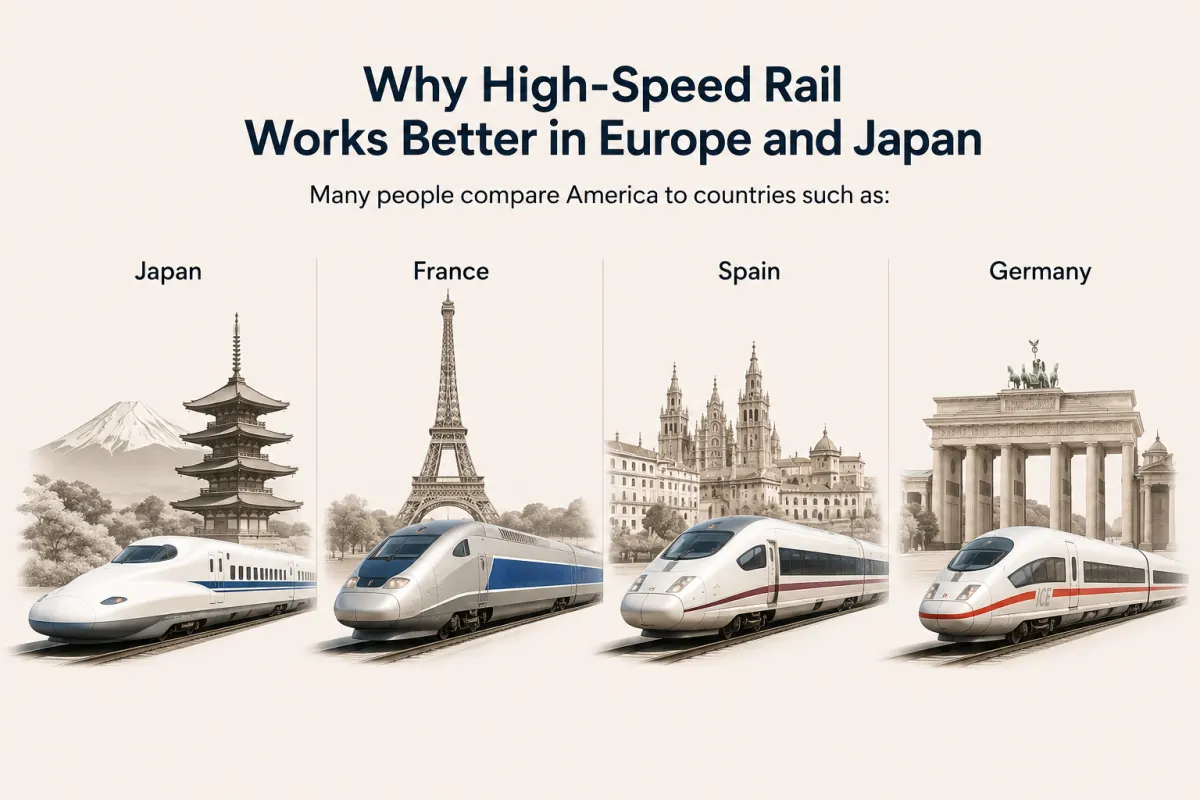
But these comparisons often ignore a crucial difference:
Population Density
High-speed rail performs best when:
| Factor | Ideal Condition |
|---|---|
| Population | Dense |
| Cities | Close Together |
| Travel Distance | 100–500 Miles |
| Land Costs | Moderate |
| Urban Design | Transit-Oriented |
Japan and much of Europe meet these conditions perfectly.
Major cities are relatively close together.
Millions of people travel between them daily.
As a result, trains can operate profitably while offering a faster and more convenient alternative to driving.
America's Geography Creates a Different Challenge
The United States is enormous.
Many metropolitan regions are not concentrated around a single dense urban core.
Take the San Francisco Bay Area as an example.
The city itself has fewer than one million residents, but millions more live throughout the surrounding region.
This suburban development pattern is common across America.
Unlike Europe, where the population is concentrated around historic city centers, American populations are spread across vast metropolitan areas.
This creates a major challenge:
Building a high-speed rail station in downtown San Francisco doesn't automatically serve the millions living dozens of miles away.
Passengers often still need cars to complete their journeys.
The Land Ownership Problem
One of the biggest obstacles to building high-speed rail in America is land acquisition.
In many countries, governments possess broad authority to secure land for national infrastructure projects.
The United States operates differently.
Most land surrounding major metropolitan areas is privately owned.
Building a new high-speed rail corridor often requires:
- Purchasing expensive land
- Negotiating with thousands of property owners
- Conducting environmental reviews
- Resolving legal disputes
Each step adds years and billions of dollars to project timelines.
The result is some of the highest infrastructure construction costs in the world.
Why Existing Railroads Can't Simply Be Upgraded
The answer is surprisingly complicated. Most American rail infrastructure was developed and is still owned by private freight rail companies.
Unlike many countries where rail corridors are publicly controlled, U.S. railroads largely operate as private businesses.
That means high-speed passenger rail projects must negotiate with freight operators, acquire additional land, and redesign infrastructure to accommodate faster trains.
In many cases, building an entirely new line becomes necessary.
The Political Battle Over High-Speed Rail
Infrastructure projects in the United States rarely move quickly.
Unlike centralized governments that can approve and construct projects rapidly, the U.S. system involves:
- Federal agencies
- State governments
- Local governments
- Courts
- Regulatory bodies
- Private stakeholders
Every major project faces scrutiny from multiple directions.
A proposal may receive state approval yet still struggle to secure federal funding.
This fragmented decision-making process often delays large transportation projects for years—or even decades.
The Industries That Benefit From the Status Quo
High-speed rail does not exist in a vacuum.
It competes directly with established industries.
1. Oil Companies
Americans consume enormous quantities of gasoline through daily commuting and long-distance travel.
More driving means more fuel consumption.
2. Automobile Manufacturers
Car companies benefit when transportation remains centered around personal vehicle ownership.
3. Airlines
Many domestic flights connect cities that would be ideal candidates for high-speed rail service.
Routes such as:
- Los Angeles → Las Vegas
- Los Angeles → San Francisco
- Dallas → Houston
could potentially shift significant passenger traffic from airplanes to trains.
These industries possess substantial economic and political influence.
Why Building High-Speed Rail Is So Expensive in America
Several factors contribute to exceptionally high construction costs:
| Cost Driver | Impact |
|---|---|
| Land Acquisition | Extremely High |
| Environmental Reviews | Significant |
| Legal Challenges | Frequent |
| Labor Costs | High |
| Engineering Standards | Strict |
| Utility Relocation | Expensive |
| Local Opposition | Common |
Projects that may cost a fraction of the price in Asia often become dramatically more expensive in the United States.
This financial reality discourages large-scale rail expansion.
California's High-Speed Rail Experiment
The most ambitious high-speed rail project in modern American history is occurring in California.
The goal:
Connect:
- San Francisco
- Los Angeles
with a modern high-speed rail system.
Supporters argue it could transform transportation across the state.
Critics point to rising costs, delays, and political challenges.
Regardless of the outcome, California's project highlights the broader difficulties America faces when attempting to build large-scale rail infrastructure.
Why China Built High-Speed Rail So Quickly
The contrast with China is striking.
Today, China operates the world's largest high-speed rail network.
Several factors contributed to this growth:
| China | United States |
|---|---|
| Centralized Planning | Decentralized Decision-Making |
| Easier Land Acquisition | Complex Property Rights |
| Faster Approvals | Lengthy Reviews |
| National Strategy | State-by-State Projects |
| Strong Government Control | Multiple Stakeholders |
This doesn't mean China's approach is universally better.
It simply means the country can execute large infrastructure projects far more rapidly.
The Future of High-Speed Rail in America
Despite decades of delays, interest in passenger rail is growing.
Rising traffic congestion, environmental concerns, and population growth are forcing policymakers to reconsider transportation priorities.
Several projects are under development, including:
- Brightline West
- California High-Speed Rail
- Texas Central proposals
Whether these projects will spark a true high-speed rail revolution remains uncertain.
But for the first time in decades, America appears willing to revisit a transportation technology it largely left behind.
Does the United States have any high-speed rail?
Yes. The Acela service in the Northeast Corridor is America's fastest passenger rail service, although it operates at lower speeds than many European and Asian high-speed systems.
Why is high-speed rail more successful in Europe?
European cities are generally closer together, more densely populated, and easier to connect through rail networks.
Why doesn't America simply use existing rail tracks?
Most existing rail corridors are privately owned freight routes that are not designed for dedicated high-speed passenger operations.
Will the United States build more high-speed rail?
Several projects are currently under development, but costs, politics, and land acquisition remain major obstacles.