
The Bizarre 1932 Western Australian Desert Conflict
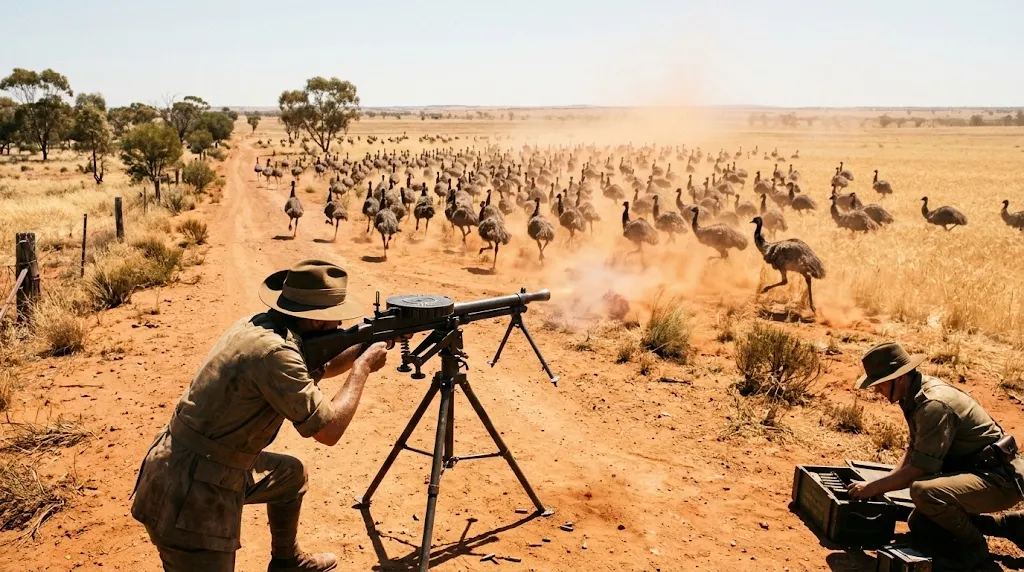
In early November 1932, an Australian army artillery officer named Major G.P.W. Meredith stood on a sun-baked red dirt road in the Campion district of Western Australia, staring down the barrels of two heavy Lewis automatic machine guns. Beside him, two gunners from the Royal Australian Artillery wiped sweat from their foreheads, their khaki wool tunics caked in dust.
Mounted in the back of an open Ford motor truck, the gunners were waiting for the enemy to emerge from the dry eucalyptus scrub.
Their enemy was not a rebel militia or an invading foreign naval fleet. Their enemy was twenty thousand wild emus.
It remains one of the strangest and most humiliating military campaigns in modern history: the Great Australian Emu War.
1859 Australia Rabbit Disaster: How 24 European Hares Overran an Entire Continent
Soldier Settlers and the Great Depression Wheat Crisis
The trouble started right after the First World War. When thousands of Australian veterans returned home from the trenches of Gallipoli and France, the Australian government offered them tracts of marginal farmland in the arid wheat belt of Western Australia. The men cleared the native scrub, dug irrigation ditches, and planted fields of spring wheat under the blazing sun.
Then the Great Depression struck in 1929, collapsing wheat prices to pennies a bushel. Just as the struggling soldier-settlers were trying to harvest what little grain they had left, twenty thousand wild emus arrived from the interior desert.
Emus are flightless birds standing six feet tall and weighing up to one hundred and twenty pounds. Every spring after breeding, they migrate from the arid central deserts toward the coast in search of water and green vegetation.
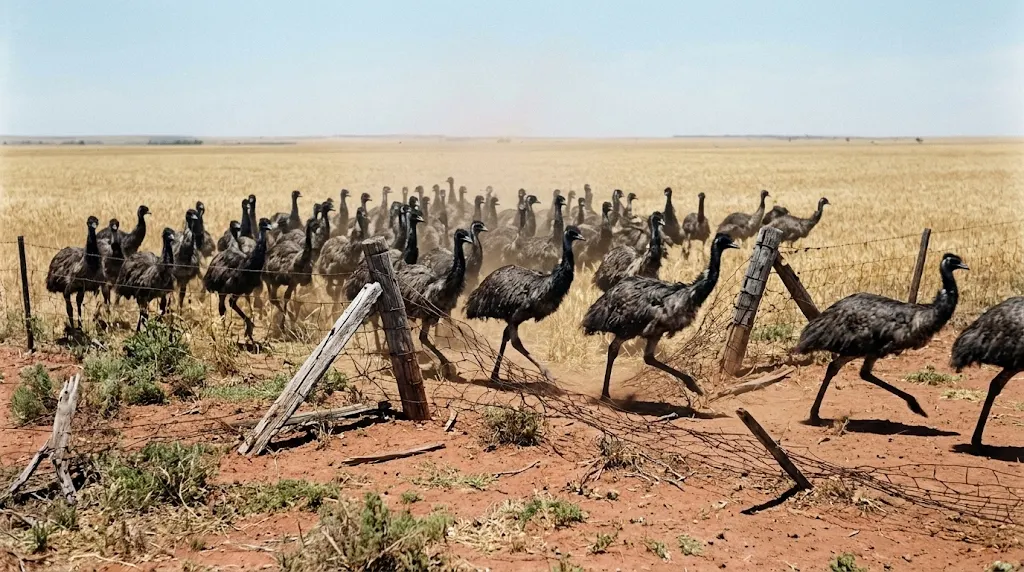
When the emus discovered the newly cultivated wheat belt, they realized they had stumbled into paradise. The fields offered clear water dams, sweet ripening wheat stalks, and fence-protected paddocks. The birds did not merely eat the grain; they trampled entire crops into the dirt and ripped giant gaps through the government rabbit-proof netting fences, allowing wild rabbits to pour in behind them and finish off the remaining roots.
Two Lewis Machine Guns and Ten Thousand Rounds
Desperate and facing starvation, a delegation of decorated ex-soldier settlers traveled to Perth to meet with the Minister of Defence, Sir George Pearce. Having fought in the First World War, the settlers did not ask for farming subsidies or food rations. They asked for machine guns.
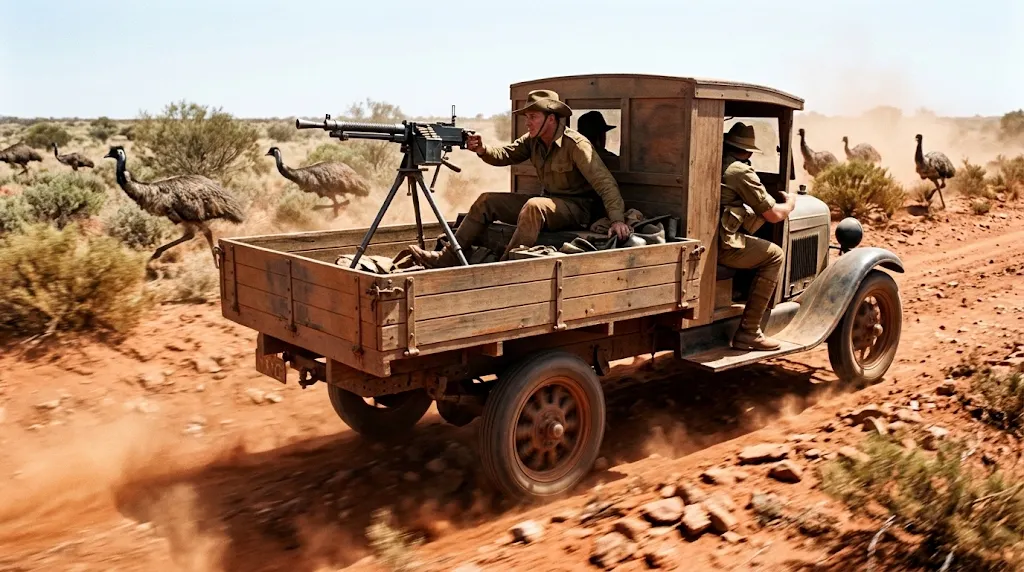
Pearce agreed, seeing a chance for live-fire army training and good publicity. He ordered Major Meredith to lead a detachment of artillerymen armed with two Lewis automatic guns and ten thousand rounds of ammunition.
The soldiers believed the campaign would be over in forty-eight hours. They assumed that large, flightless birds crowded into open paddocks would make trivial targets for rapid-fire military weapons firing five hundred rounds per minute.
They were completely wrong.
Scattering at Forty Miles an Hour Across Scrub
On November 2, 1932, Meredith's men spotted a flock of fifty emus near Campion. When the birds moved into range, the gunners opened fire. But the birds did not bunch together like sheep. The moment the first bullets kicked up red dust, the flock scattered in every compass direction at forty miles per hour.
Each emu sprinted erratically, zig-zagging through the stumps and scrub like a feathered commando. The heavy guns soon jammed in the red dust, and when the smoke cleared, fewer than a dozen birds lay dead.
Two days later, Meredith set an ambush near a local dam where over a thousand emus were drinking quietly. The soldiers waited until the flock was within a hundred yards before opening fire. After killing barely a dozen birds, the gun jammed again, and the flock disappeared into the scrub.
Official Military Dispatch (Major G.P.W. Meredith, 1932): "If we had a military division with the bullet-carrying capacity of these birds, it would face any army in the world. They can face machine guns with the invulnerability of tanks."
Meredith was astonished by the birds' tactical speed and resilience. Emus could take direct hits and keep running for miles on their powerful three-toed legs. Meredith wrote in his official military dispatch: "If we had a military division with the bullet-carrying capacity of these birds, it would face any army in the world. They can face machine guns with the invulnerability of tanks."
Frustrated, Meredith mounted a Lewis gun to the cab of a Ford truck to chase the birds across the open plains. But the truck bounced violently over rocks and tree stumps, making accurate aiming impossible, and the emus easily outpaced the vehicle across rough terrain.
| Campaign Aspect | Royal Australian Artillery | Wild Emu Population |
|---|---|---|
| Armed Forces | Major Meredith + 2 gunners | Estimated 20,000 birds |
| Weaponry & Speed | 2 Lewis machine guns (500 rpm) | 3-toed muscular legs (40 mph) |
| Tactical Response | Ambush at dams and truck chases | Instant radial scattering under fire |
| Campaign Outcome | Troops recalled by Parliament | Total tactical victory; crops saved later by bounties |
Parliamentary Humiliation and the Bounty System
By November 8, after firing thousands of rounds with almost nothing to show for it, the Australian Parliament recalled the military unit amid national laughter. The emus had defeated the Australian Army.
Back in Canberra, politicians debated the embarrassing fiasco on the floor of the House of Representatives. Member of Parliament A.E. Green sarcastically asked whether medals were going to be struck for the military personnel who took part in the campaign, while another member suggested the emus should receive campaign honors since they had won every engagement.
Meredith tried a second deployment a week later with fresh ammunition crates, but the birds had already learned the range of the machine guns. Flock sentries watched the gunners from distant ridgelines, signaling the main mob to scatter whenever a military vehicle approached within five hundred yards.
Local farmers shook their heads in amusement as the soldiers departed. The settlers had spent years observing the birds and understood that an emu's tiny brain was wired purely for desert survival: acute long-distance eyesight, explosive acceleration, and an uncanny ability to split up under fire so that no predator could focus on a flock.