


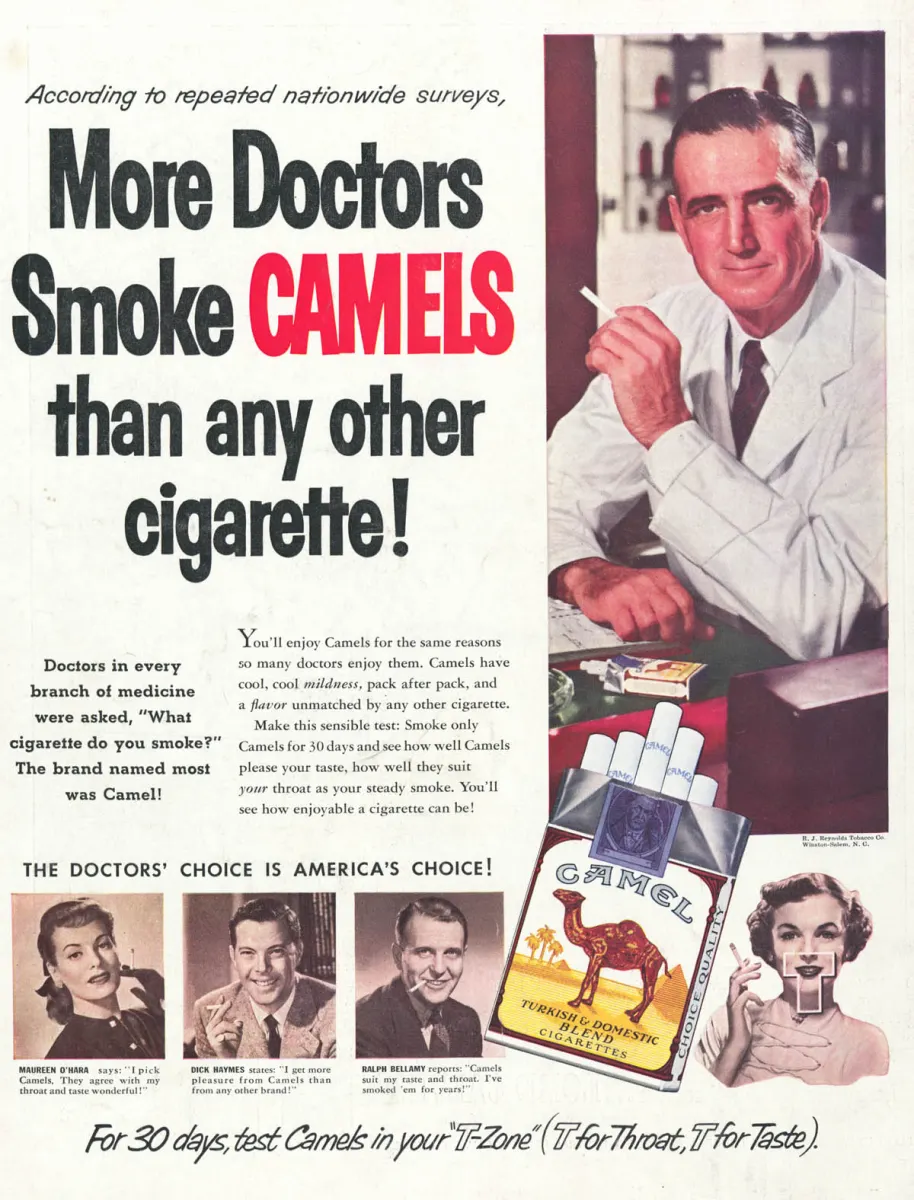
Today, seeing a doctor promote a cigarette brand seems almost unimaginable. Yet during the 1940s, millions of Americans regularly encountered advertisements suggesting that physicians preferred Camel cigarettes over any other brand.
One of Camel's most famous advertisements boldly claimed:
«More Doctors Smoke Camels Than Any Other Cigarette.»
At the time, the campaign was enormously successful and helped create one of the most recognizable advertising strategies of the 20th century. But Camel's story began decades before doctors appeared in its advertisements.
Read More


The Birth of an American Icon
Camel was introduced in 1913 by the American tobacco company R. J. Reynolds Tobacco Company in Winston-Salem, North Carolina.
At the beginning of the 20th century, many smokers still rolled their own cigarettes, and the packaged cigarette market was relatively young. Company founder Richard Joshua Reynolds sought to create a unique product by blending Virginia tobacco, Burley tobacco, and Turkish tobacco.
The brand's name, Camel, was inspired by its use of Turkish tobacco. During that era, products associated with the Middle East and Egypt were considered exotic and appealing to American consumers.
Camel quickly became one of the first cigarette brands to be distributed and advertised nationwide in the United States.
The Marketing Campaign That Sparked Curiosity
One of Camel's most innovative achievements was its launch campaign.
Days before the product officially reached store shelves, newspapers across America began publishing a mysterious message:
«The Camels Are Coming.»
No explanation was offered.
The unusual campaign generated widespread curiosity, prompting people to wonder what the message meant. By the time Camel was officially introduced, millions of Americans were already familiar with the name.
Marketing historians often cite this campaign as one of the earliest and most successful teaser advertising campaigns in American history.
Within its first year, Camel sold hundreds of millions of cigarettes and quickly established itself as a major force in the tobacco industry.
Why Camel Turned to Doctors
By the late 1930s and early 1940s, public concerns about smoking and health were beginning to emerge.
Tobacco companies needed a way to reassure consumers, and few figures were more trusted than doctors.
As a result, cigarette manufacturers increasingly incorporated physicians into their advertising campaigns.
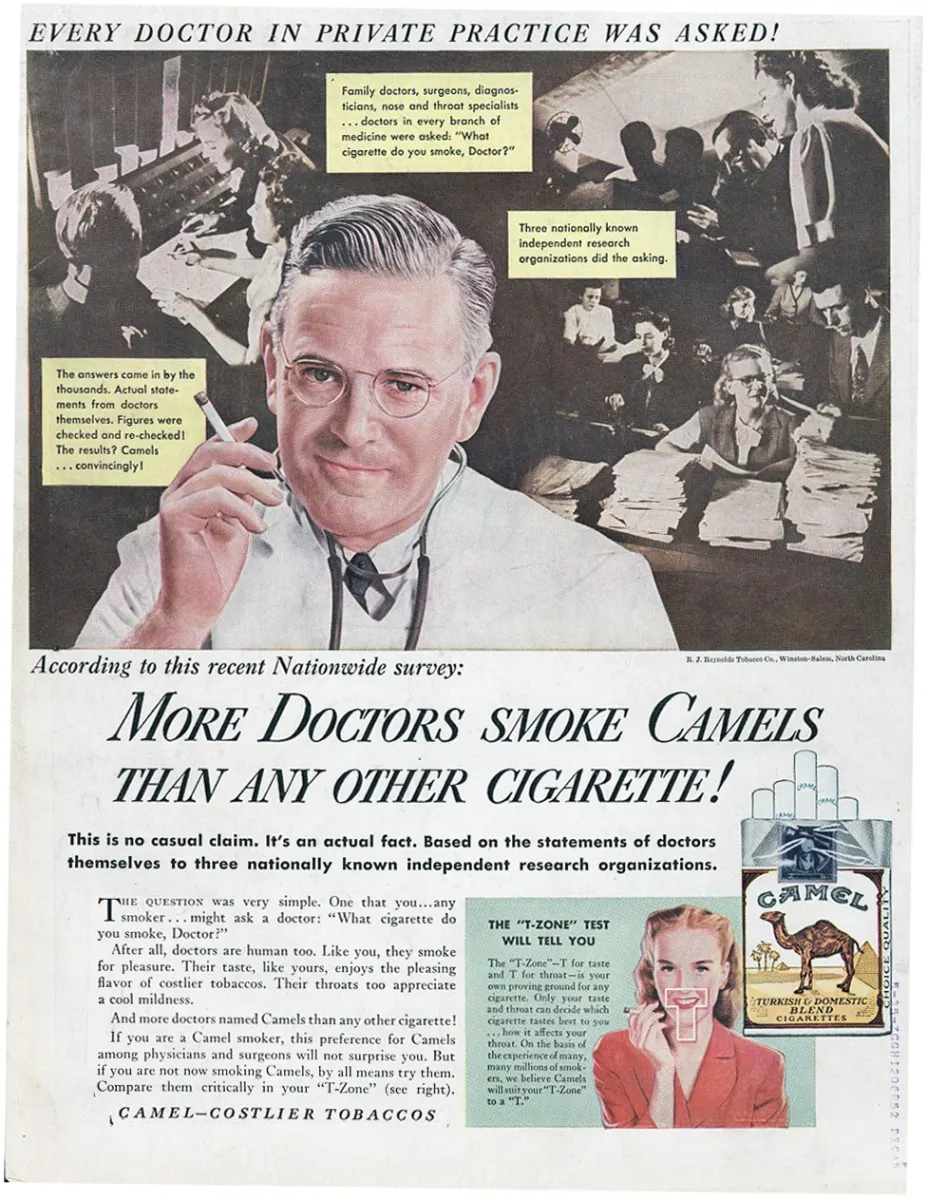
Interestingly, the doctors featured in these advertisements were rarely real physicians. Medical ethics at the time discouraged doctors from endorsing commercial products, and physicians risked professional consequences if they openly participated in advertising.
Instead, tobacco companies often used actors dressed as doctors to portray idealized medical professionals—wise, experienced, caring, and trustworthy.
The message was simple but powerful:
If doctors chose Camel, then Camel must be safe.
The Famous "More Doctors Smoke Camels" Campaign
Between 1940 and 1949, R. J. Reynolds launched what would become one of the most famous advertising campaigns in tobacco history.
Advertisements repeatedly claimed that more doctors smoked Camel cigarettes than any other brand.
To support the claim, the company sponsored surveys conducted at medical conventions. In some cases, physicians were given complimentary packs of Camel cigarettes before being asked which brand they preferred or carried with them.
While these methods would be heavily criticized by modern standards, they helped create persuasive marketing messages during the 1940s.
Many advertisements also told stories about physicians and medical students. One recurring series followed a young man as he pursued a career in medicine, from medical school to opening his own practice.
These storylines portrayed doctors as hardworking, family-oriented, and selfless individuals, further strengthening the public's trust in the Camel brand.
From Market Leader to Public Health Controversy
For decades, Camel remained one of the best-selling cigarette brands in the United States and around the world.
However, scientific research during the 1950s and 1960s increasingly linked smoking to lung cancer and other serious diseases. As evidence mounted, public health officials began warning consumers about the risks associated with tobacco use.
The image of cigarettes as a doctor-approved product quickly faded.
Advertisements that once inspired confidence gradually became examples of how marketing can shape public perception despite incomplete scientific understanding.
Who Owns Camel Today?
More than a century after its launch, Camel remains one of the world's most recognizable cigarette brands.
In the United States, Camel is manufactured and marketed by R. J. Reynolds Tobacco Company. International rights to the brand are owned by Japan Tobacco International (JTI), which acquired them in 1999.
Today, Camel products are sold in numerous countries through the manufacturing and distribution networks of JTI and R. J. Reynolds.
R. J. Reynolds employs approximately 4,000 people and remains one of the largest tobacco manufacturers in the United States.
A Legacy Beyond Cigarettes
The enduring legacy of Camel is not simply its tobacco products but the advertising campaigns that helped shape consumer culture throughout the 20th century.
Images of doctors recommending cigarettes now serve as powerful reminders of a very different era—one in which public trust could be leveraged to promote products that would later become associated with significant health risks.
For historians, marketers, and media researchers, Camel advertisements remain fascinating examples of how advertising can influence public opinion and consumer behavior.
More than a century after its debut, Camel continues to be remembered not only as a cigarette brand but also as one of the most influential case studies in the history of modern advertising.