
The Tree That Became a British Landmark
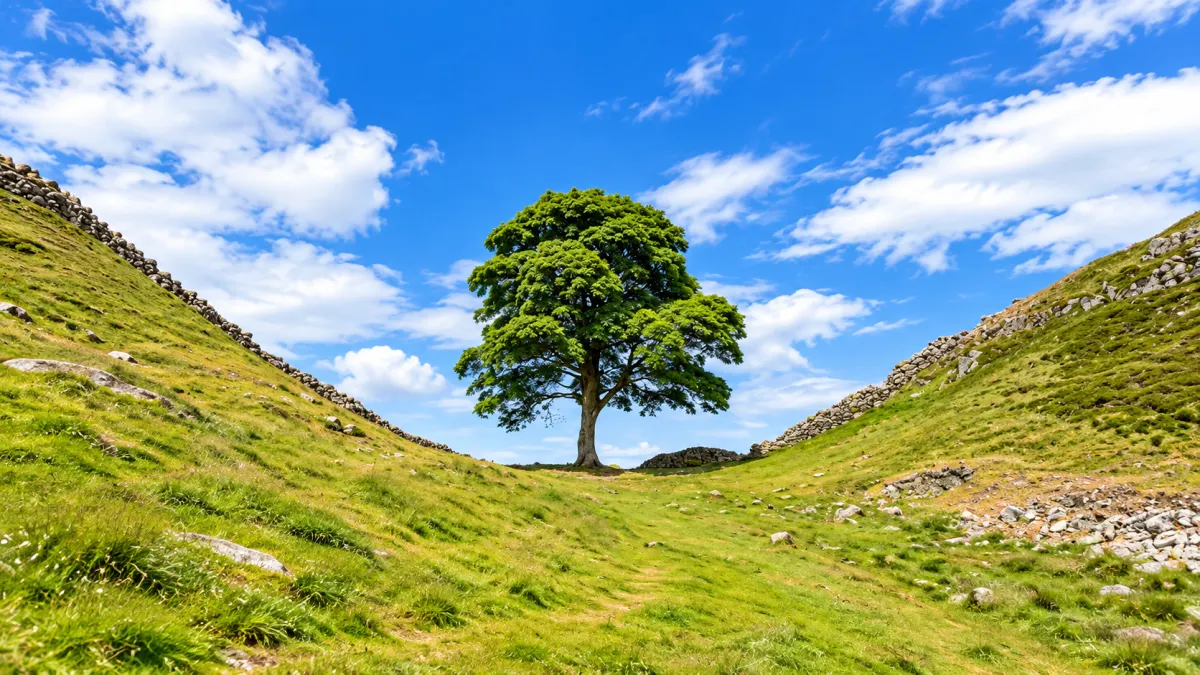
For more than a century, a single sycamore tree stood in a natural dip beside Hadrian’s Wall in Northumberland, England.
Known as the Sycamore Gap Tree, it became one of Britain's most recognizable natural landmarks. Its unusual position between the ancient Roman wall and the surrounding landscape made it a favorite subject for photographers, walkers and visitors.
The tree was also featured in the 1991 film Robin Hood: Prince of Thieves, helping introduce the striking landscape to an even wider audience.
But in September 2023, the landmark suddenly disappeared.
Read More


What Happened to the Sycamore Gap Tree?
During the night of September 27–28, 2023, the tree was deliberately cut down with a chainsaw.
The incident shocked people across Britain and attracted international attention because the tree had become closely associated with the landscape around Hadrian's Wall.
The felling also caused damage to part of the historic wall nearby.
The tree was not simply a piece of vegetation in a field. Its distinctive location had made it a recognizable symbol of the Northumberland landscape.
That is why its disappearance was felt so strongly by people who had visited the site and by those who knew it through photographs and film.
The People Responsible Were Eventually Sentenced
The investigation eventually led to two men being convicted of criminal damage in connection with the felling of the tree and damage to Hadrian's Wall.
In July 2025, Daniel Graham and Adam Carruthers were each sentenced to four years and three months in prison at Newcastle Crown Court.
The conclusion of the criminal case, however, did not mark the end of the Sycamore Gap story.
In fact, something unexpected was already happening at the site.
New Shoots Began Growing From the Stump
After the tree was cut down, the remaining stump was carefully monitored.
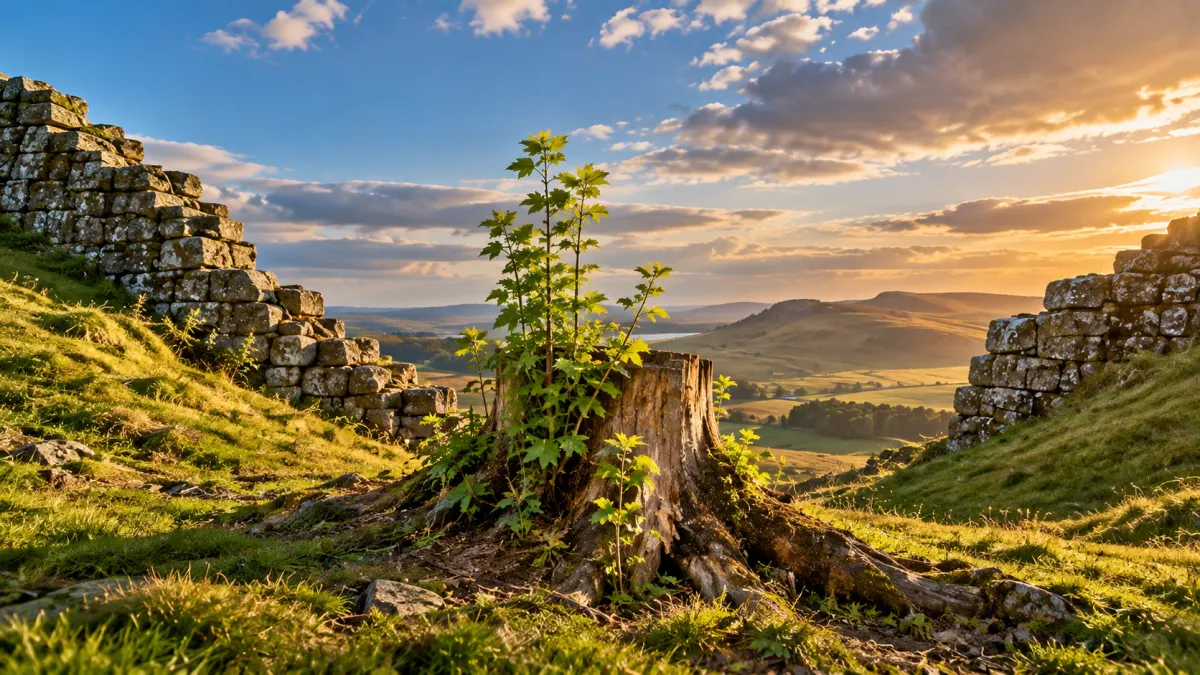
The National Trust later reported new growth emerging from the base. Its current information says 25 new shoots had emerged, offering the possibility that new trees could develop around the original stump.
This does not mean the original tree simply grew back.
Instead, the shoots are new growth emerging from the surviving root and stump system. Their future development will depend on how they grow and how they are managed over time.
Still, for a tree that appeared to have been completely lost, the new shoots became an important part of the site's continuing story.
49 New Trees Carry the Original Tree's Legacy
The response to the loss of the Sycamore Gap Tree eventually became much larger than the original site.
Seeds collected from the original tree were used to grow new saplings as part of the National Trust's Trees of Hope initiative.
Exactly 49 saplings were selected.
The number was symbolic: the original tree stood approximately 49 feet tall when it was felled, so each new sapling represents one foot of its former height.
The project attracted almost 500 applications from communities and organizations across the UK hoping to receive one of the young trees.
The selected saplings were grown and cared for before being planted in publicly accessible locations.
The New Trees Are Growing in Different Parts of the UK
The 49 saplings are not being planted simply to replace the original tree.
Instead, they are intended to create a wider living legacy.
Some were given to schools, community organizations, hospitals, historic sites and other locations with their own stories of loss, hope or renewal.
The first of the Trees of Hope began being planted during the 2025–26 planting season. The National Trust reported that the young trees had reached around 4 to 6 feet in height before being planted outdoors.
In Wales, for example, one of the saplings was planted at Rhiwbina Primary School in Cardiff in November 2025.
Instead of having one famous tree in one location, its genetic legacy is now being distributed across Britain.
The Story Took Another Turn in 2026
The Sycamore Gap story continued to develop in 2026.
In March, the National Trust launched a public vote involving six shortlisted proposals for a permanent artwork made from wood saved from the original tree.
Two months later, Helix Arts and George King Architects were announced as the winners of the commission for a project called The People's Tree.
The project is intended to use the remaining wood to tell the story of the tree through public participation, sound, architecture and storytelling.
At around the same time, healthy new shoots were confirmed to be growing from the original stump.
So even the physical remains of the tree are now being given a new purpose.
One of the New Saplings Was Stolen
The story took another unexpected turn in June 2026.
One of the Sycamore Gap saplings planted at Wray Castle in Cumbria was stolen only a few months after it had been planted.
According to reports, the sapling had been planted in April 2026 and was believed to have been taken sometime between June 9 and June 16. Cumbria Police appealed for information about the theft.
The incident was particularly striking because the saplings had been created specifically to preserve the legacy of a tree that had already been deliberately destroyed.
Yet the loss of one sapling did not end the wider project. The remaining Trees of Hope continue to grow in locations around the UK.
Why Did One Tree Become So Important?
The story of Sycamore Gap raises an interesting question: why can a single tree become so meaningful to so many people?
Part of the answer lies in its location.
The tree was not simply standing in an ordinary woodland. It occupied a remarkably photogenic position beside Hadrian's Wall, creating a natural frame between the ancient structure and the surrounding hills.
Its distinctive silhouette made it instantly recognizable.
People photographed it, walked to it, visited it with family and friends, and incorporated it into personal memories. The National Trust received thousands of messages, tributes and ideas from members of the public following its destruction.
In that sense, the Sycamore Gap Tree had become more than a tree.
It had become a place.
A Tree Can Disappear, but Its Legacy Can Continue
The original Sycamore Gap Tree is gone as it once stood.
But its story has taken an unusual second life.
There are new shoots growing from the surviving stump. There are 49 young trees descended from the original tree growing in communities across the UK. There is preserved wood being transformed into a new public artwork. And there is an entire landscape continuing to attract visitors.
The result is something that could not have been planned when the original tree was planted more than a century ago.
One tree has effectively become many.
What Will Happen to the Original Stump?
For now, the future of the regrowth at Sycamore Gap remains a story to watch.
The National Trust and Northumberland National Park Authority have been monitoring the new shoots emerging from the stump. The organization says it is hopeful that, if allowed to grow, the shoots could develop into significant new growth around the original stump.
Whether they eventually form a structure resembling the original tree remains to be seen.
That uncertainty is part of what makes the Sycamore Gap story so interesting.
The famous tree cannot simply be recreated.
But something new may grow from what remains.
The Legacy of the Sycamore Gap Tree
The Sycamore Gap Tree became famous because of an extraordinary combination of nature, history, landscape and human memory.
Its destruction turned it into something else: a story about preservation and regeneration.
The 49 Trees of Hope are now carrying its legacy into communities far beyond Hadrian's Wall, while the surviving stump continues to produce new shoots at the original site.
For a tree that was cut down in a single night, its story has proved remarkably difficult to end.
The Sycamore Gap Tree may no longer stand as it once did, but its legacy is still growing.