
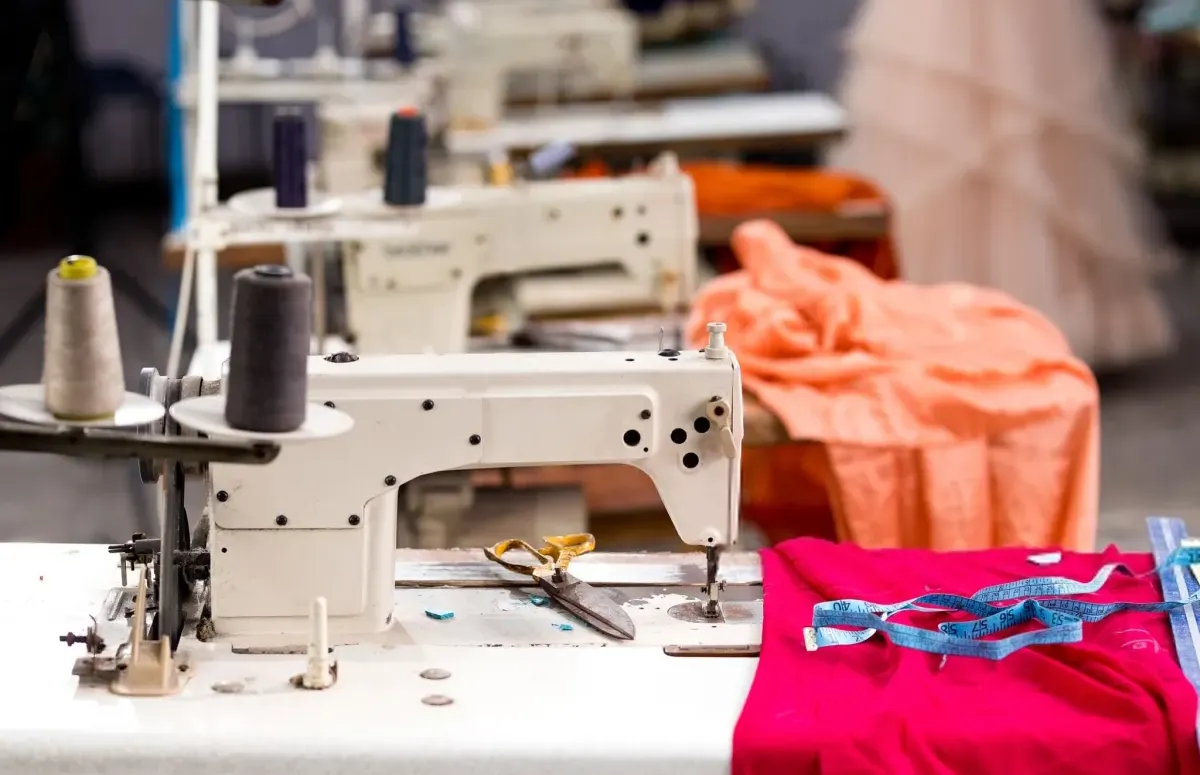
There is a peculiar paradox sitting quietly in garment factories around the world: machines that seem designed to outlive their owners. Walk into a textile workshop in Bangladesh, Vietnam, or Turkey, and you will likely find industrial sewing machines that are 15, 20, even 30 years old — still running, still stitching, still earning money for their operators every single day.
So the obvious question arises: if these machines almost never break down, how exactly do their manufacturers make money?
The answer is a masterclass in industrial business strategy — one that borrows from the playbooks of defense contractors, pharmaceutical companies, and enterprise software vendors all at once.
A $3.6 Billion Industry Built on Machines That Last Decades
The global industrial sewing machine market was valued at approximately $3.6 billion in 2024 and is projected to reach $5.4 billion by 2034, growing at a compound annual growth rate of around 4.3%. The market is dominated by a handful of Japanese giants — most notably Juki Corporation, Brother Industries, and Janome — alongside German precision manufacturers like Pfaff and Dürkopp Adler, and the American legacy brand Singer.
These companies sell machines that, by any honest measure, are extraordinarily durable. A Juki DDL-series lockstitch machine, for example, is capable of running at 5,500 stitches per minute for thousands of hours with minimal maintenance beyond basic oiling. Garment factories report running the same units for 20 to 30 years without major mechanical failure.
This is not an accident. It is a deliberate engineering decision — and a commercially rational one.
Read More
Why They Build Machines That Don't Break
1. The Customer Is a Professional, Not a Consumer
Unlike household sewing machines — which are often purchased once and replaced when newer models arrive — industrial machines are bought by businesses that calculate return on investment to the decimal. A factory owner in Ho Chi Minh City or Dhaka does not buy a machine based on branding or aesthetics. They buy based on cost per stitch over the machine's operational lifetime.
This means durability is not a marketing feature. It is the only feature that matters.
Industrial sewing machine buyers will quickly defect to competitors if a machine requires frequent downtime. In high-volume apparel production, even a few hours of unexpected stoppage translates directly into missed shipment deadlines, financial penalties, and lost contracts. Manufacturers who build unreliable machines simply do not survive in this market.
2. All-Metal Construction as a Core Philosophy
The mechanical simplicity of most industrial sewing machines is striking compared to their consumer counterparts. Where a household machine might include dozens of plastic gears, automatic threading mechanisms, and digital touchscreens, a standard industrial lockstitch machine is mostly cast iron and hardened steel — components that withstand continuous heavy use without the wear patterns that kill plastic components.
Juki, for instance, builds its home machines using the same industrial-grade metal-body philosophy applied to its factory machines, deliberately engineering them to operate without vibration or shifting even after years of constant use. This robust construction is what enables machines to deliver consistent, identical stitch quality even after thousands of operating hours.
3. Mechanical Simplicity Reduces Failure Points
The engineering behind most industrial straight-stitch machines has changed remarkably little since the mid-20th century. The core mechanism — a needle bar, a rotating hook, a feed dog, and a bobbin — contains fewer than a dozen moving parts in any critical load-bearing role. Fewer parts means fewer failure points. The machines are not «smart.» They do not need to be.
So How Do the Manufacturers Actually Make Money?
This is where the business model becomes genuinely interesting. The real revenue structure of industrial sewing machine manufacturers operates across at least four distinct streams — none of which depend on the machine itself wearing out.
Stream 1: Spare Parts and Consumables (The Core Engine)
The closest analog in business history is the printer and ink cartridge model, or what economists call the «razor and blades» strategy — sell the platform at modest margins, then earn sustained revenue from the consumables and accessories that the platform requires.
For industrial sewing machines, the consumables ecosystem is vast:
- Needles — replaced every 6 to 8 hours of heavy industrial use, or after every fabric type change
- Bobbins and bobbin cases — high-precision components subject to regular wear
- Presser feet — specialized attachments for different fabrics and stitch types, with dozens of SKUs per machine model
- Feed dogs, throat plates, and hook assemblies — wear parts replaced on maintenance cycles
- Lubrication oils and cleaning supplies — proprietary formulations recommended by manufacturers
A single factory running 100 machines may spend more on spare parts and consumables over a five-year period than it originally paid for the machines themselves. And critically, Juki, Brother, and the others maintain tight control over spare parts distribution in their core markets, ensuring that certified service networks — not third-party suppliers — handle the majority of this spend.
Juki has even developed a dedicated app-based maintenance platform called JUKI-ShuHaRi, which helps factory managers schedule inspections, track wear indicators, and order spare parts directly through the company's own supply network. The system simultaneously extends machine lifespans (building customer loyalty) and keeps parts purchasing locked within Juki's ecosystem.
Stream 2: Specialized Machine Variants
The industrial sewing machine is not a single product. It is a platform with hundreds of specializations. Major manufacturers offer distinct machine types for:
- Lockstitch (standard garments)
- Overlock and serging
- Flatlock for sportswear
- Buttonhole and button-sew machines
- Bar-tacking for stress points in denim and workwear
- Post-bed and cylinder-bed machines for leather goods, bags, and shoes
- Chainstitch for denim assembly
Each application requires a purpose-built machine. A factory expanding from apparel into upholstery or automotive interiors must purchase new machines for those specific applications — even if the general-purpose machines it already owns are in perfect condition. This application-driven upgrade cycle creates a steady demand pipeline that does not depend on mechanical failure.
Stream 3: After-Sales Service Contracts and Training
Industrial sewing machine manufacturers generate substantial recurring revenue through certified technician networks, maintenance contracts, and factory training programs.
Juki, for example, provides structured training curricula for factory technicians and supervisors — delivered both in-person and via e-learning platforms accessible globally. These programs help operators maximize machine efficiency while simultaneously reinforcing brand loyalty and dependency on the manufacturer's service infrastructure.
For large buyers — multinational apparel factories, branded goods manufacturers, automotive tier-one suppliers — multi-year service agreements are standard practice, providing manufacturers with predictable, high-margin revenue streams that are entirely decoupled from new machine sales.
Stream 4: Automation and Robotics Upgrades
The newest and fastest-growing dimension of the industrial sewing machine business is the transition to computer-controlled and automated sewing systems. Modern machines from Juki and Brother increasingly integrate:
- Direct-drive servo motors for precision speed control
- Automatic thread trimming and tension adjustment
- Computer-controlled stitch programming for complex patterns
- IoT connectivity for real-time factory floor monitoring
- Integration with robotic fabric handling systems
These automation features require factories to upgrade to entirely new machine generations — not because their existing machines have failed, but because the productivity and quality gap between manual and automated sewing has grown too wide to ignore in competitive manufacturing environments.
This upgrade cycle is the single most important growth driver in the industrial sewing machine market today, and it provides manufacturers with their most significant near-term revenue opportunity.
The Paradox Explained: Durability Is the Business Model
What appears at first to be a commercial contradiction — building something so good it never needs replacing — is actually the foundation of a carefully constructed ecosystem.
The industrial sewing machine manufacturers have built something far more valuable than a product. They have built institutional dependency. A factory that has standardized on Juki machines, trained its technicians on Juki systems, integrated its maintenance schedules into JUKI-ShuHaRi, and stocked its parts inventory with Juki components is not going to switch to a competitor because a rival offers a marginally cheaper machine.
The switching cost is enormous. The relationship is sticky. And the manufacturer earns revenue from that factory — through parts, through consumables, through service, through new specialized machines, through automation upgrades — for as long as the factory is in business.
Machines that never break don't hurt the business. They are the business.
Key Players and Their Market Positions
| Manufacturer | Country | Founded | Core Strength |
|---|---|---|---|
| Juki Corporation | Japan | 1938 | Industrial-grade durability, high-speed lockstitch, automation |
| Brother Industries | Japan | 1908 | Versatility, electronics integration, broad product range |
| Pfaff / Dürkopp Adler | Germany | 1862 | Precision engineering, leather and heavy materials |
| Singer Corporation | USA | 1851 | Legacy distribution, entry-level to mid-range industrial |
| Janome | Japan | 1921 | Mid-range industrial and high-end consumer crossover |
| Jack Sewing Machine | China | 1995 | Cost efficiency, energy-saving direct-drive motors |
The Market Outlook
The global industrial sewing machine market, valued at approximately $3.4–3.6 billion in 2024, is expected to maintain steady growth through the decade ahead, with most forecasts placing it between $5.4 billion and $6 billion by 2033–2034. Growth is being driven primarily by:
- Expanding apparel demand in emerging markets, particularly South and Southeast Asia
- Fast fashion production cycles requiring faster, more automated sewing lines
- Automotive industry growth creating new demand for precision non-apparel sewing (car seats, interiors, airbags)
- Technical textiles including medical, aerospace, and protective equipment applications
Asia Pacific remains the dominant region by market share, with India expected to register the highest growth rate through 2030.
How long do industrial sewing machines typically last?
With proper maintenance, industrial sewing machines from major manufacturers like Juki and Brother regularly remain in productive use for 20 to 30 years. Some factory machines from the 1980s and 1990s are still operational today.
Why are industrial sewing machines so much more durable than home machines?
Industrial sewing machines are built with all-metal frames and high-torque motors designed for continuous multi-shift operation. Home machines typically incorporate more plastic components and are engineered for intermittent use, making them less suited to sustained high-volume production.
What are the main revenue sources for industrial sewing machine manufacturers?
Revenue comes from four primary streams: the initial machine sale, ongoing spare parts and consumables, after-sales service contracts and training programs, and upgrades to newer automated or computer-controlled machine generations.
Which companies dominate the industrial sewing machine market?
The global market is led by Japanese manufacturers, primarily Juki Corporation and Brother Industries, alongside German precision brands like Pfaff and Dürkopp Adler. Chinese manufacturer Jack Sewing Machine has grown rapidly as a cost-competitive alternative.
What is driving growth in the industrial sewing machine industry?
Key growth drivers include expanding apparel production in Asia, the automation of garment manufacturing, rising demand from the automotive and technical textiles sectors, and the broader shift from mechanical to computer-controlled sewing systems.
Is the industrial sewing machine market growing?
Yes. The global market was valued at approximately $3.4–3.6 billion in 2024 and is projected to reach $5.4–6 billion by the early 2030s, growing at a compound annual rate of roughly 4–6% depending on the segment.