
 09 November 2026
Europe continues to have one of the highest tobacco consumption rates in the world, despite years of public health campaigns and anti-smoking policies.
According to the latest Eurostat and Special Eurobarometer 2023 data, 24% of people aged 15 and older in the European Union are smokers. While smoking rates have declined slightly since 2017, the reduction has been modest, raising concerns among health experts.
The data also reveals significant differences between European countries, with some nations reporting smoking rates more than four times higher than others.
Read More


Which European Country Has the Highest Smoking Rate?
Bulgaria ranks first in the European Union, with 37% of its population aged 15 and over reporting that they smoke.
The countries with the highest smoking rates in Europe are:
| Rank | Country | Smoking Rate |
|---|---|---|
| 1 | Bulgaria | 37% |
| 2 | Greece | 36% |
| 3 | Croatia | 35% |
| 4 | Romania | 34% |
| 5 | Latvia | 33% |
| 6 | Austria | 32% |
| 7 | Cyprus | 29% |
| 8 | Lithuania | 29% |
| 9 | France | 27% |
| 10 | Poland | 27% |
Eastern and Southeastern European countries continue to dominate the top of the list, reflecting long-standing cultural habits and varying levels of tobacco control policies.
Which European Country Has the Lowest Smoking Rate?
At the opposite end of the ranking is Sweden, where only 8% of adults smoke.
Countries with the lowest smoking rates include:
| Rank | Country | Smoking Rate |
|---|---|---|
| 1 | Sweden | 8% |
| 2 | Netherlands | 11% |
| 3 | Denmark | 14% |
| 4 | Finland | 15% |
| 5 | Ireland | 16% |
Sweden's success is often cited as one of Europe's biggest public health achievements, with smoking rates falling far below the EU average.
Men Smoke More Than Women Across Europe
The gender gap in smoking remains substantial.
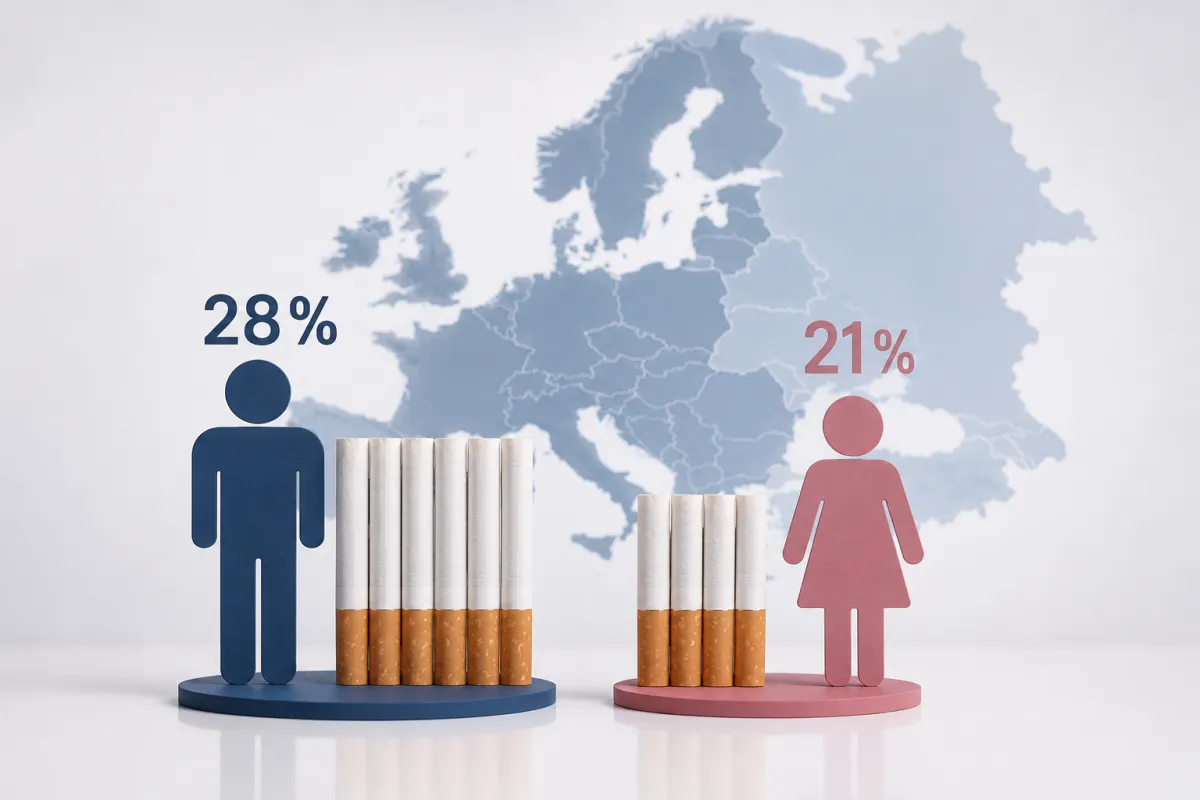
Across the European Union:
- 28% of men smoke
- 21% of women smoke
Among men, the highest smoking rates were recorded in:
- Bulgaria (49%)
- Latvia (48%)
- Lithuania (43%)
Among women, the highest rates were found in:
- Greece (32%)
- Croatia (30%)
- Romania (29%)
These figures highlight significant cultural and behavioral differences across the continent.
Why Are Smoking Rates Higher in Eastern Europe?
Several factors help explain why Eastern European countries continue to report higher smoking prevalence:

Economic Inequality
Research suggests that lower socioeconomic status is strongly associated with higher smoking rates.
Tobacco Culture
Smoking has historically been more socially accepted in many Eastern European countries than in Northern Europe.
Public Health Policies
Countries with higher tobacco taxes, stricter advertising restrictions, and stronger anti-smoking campaigns generally report lower smoking rates.
Can Europe Achieve a Smoke-Free Generation by 2040?
The European Union has set an ambitious goal of creating a «Tobacco-Free Generation» by 2040, meaning less than 5% of the population would use tobacco products.
However, current trends suggest that achieving this target will require significantly stronger tobacco control measures.
One major concern is youth smoking.
In 2023, approximately 22.2% of Europeans aged 15 to 24 were smokers, representing around 10.4 million young people.
The Rise of E-Cigarettes in Europe
While traditional smoking has declined in some countries, vaping has become increasingly popular.
According to Eurostat data, the highest rates of e-cigarette use were recorded in:
- France (6.6%)
- Poland (6.0%)
- Netherlands (5.9%)
Health authorities continue to debate whether vaping serves as a smoking cessation tool or introduces new long-term health risks.
Key Takeaways
- Bulgaria has the highest smoking rate in the European Union at 37%.
- Sweden has the lowest smoking rate at just 8%.
- The EU average smoking rate stands at 24%.
- Men continue to smoke more than women across Europe.
- Eastern European countries generally report higher smoking prevalence.
- The EU's goal of reducing tobacco use below 5% by 2040 remains a major challenge.
As Europe continues its fight against tobacco, the contrast between countries like Bulgaria and Sweden demonstrates that public health policies can have a significant impact on smoking behavior and long-term health outcomes.