
Beneath the Rubber Flaps: The Hidden Physics of Airport Security
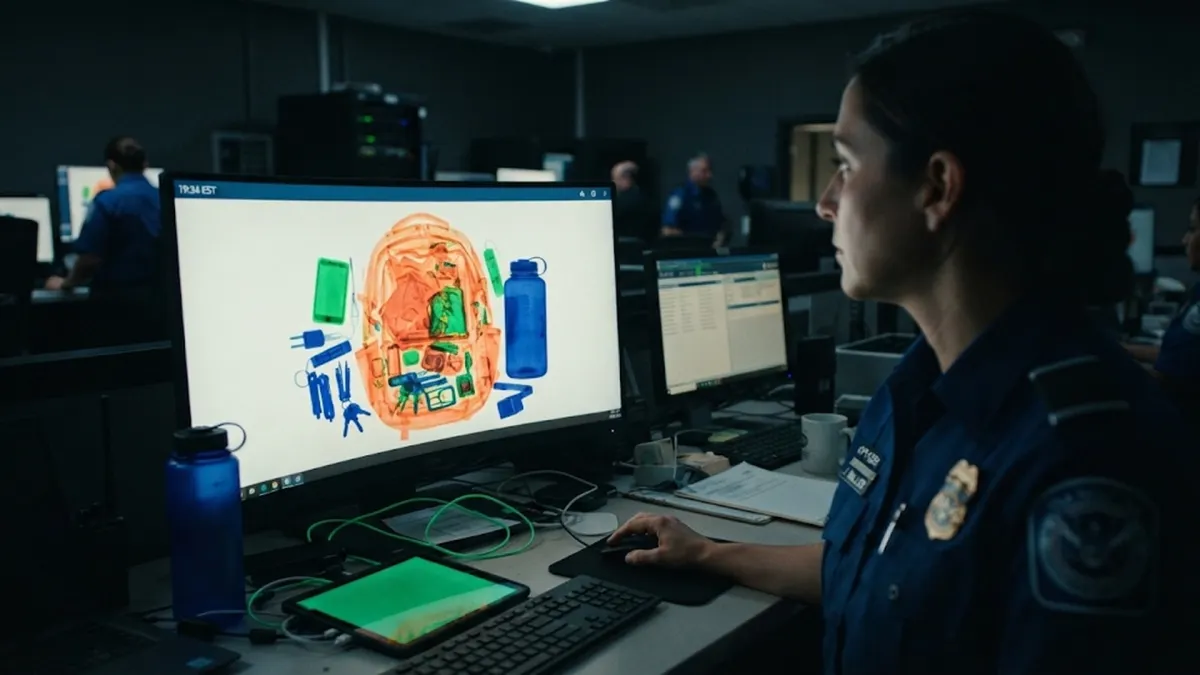
Every time you slide your carry-on luggage onto the airport conveyor belt and watch it disappear behind heavy black lead-rubber flaps, an invisible light show begins. Inside that tunnel, an automated eye peers straight through canvas zippers, nylon socks, and shampoo bottles. On the officer's monitor, the world looks wildly surreal: clothes, sandwiches, and books glow neon orange, soda cans flash vivid green, and laptop chargers burn in deep, electric blue.
Why Cheap Phone Cables Stop Charging (and the Pin 4 Carbon Secret)
1. The Two-Beam Trick: Reading the Periodic Table at Thirty Miles an Hour
Most travelers assume airport scanners work like medical chest X-rays, snapping a simple black-and-white shadow photograph of whatever sits inside your luggage. If security operated on simple shadows, a bottle of mineral water, a paperback novel, and a brick of plastic explosive would look virtually identical: faint gray silhouettes with indistinct edges.
To tell safe household items apart from genuine hazards, modern inspection tunnels rely on a sophisticated technique known as Dual-Energy X-Ray Transmission. Instead of blasting a single burst of radiation, the scanner fires two separate energy beams in rapid succession: a low-energy beam running around 70 keV and a high-energy beam penetrating up to 140 keV.
When X-rays strike matter, two distinct physical reactions occur: the photoelectric effect and Compton scattering. Low-energy photons struggle to get through materials with high atomic numbers, while high-energy photons punch straight through lighter elements. By calculating the exact ratio of absorbed low-energy light to high-energy light, the internal computer measures the effective atomic number (Zeff) of every single object on the belt.
Dual-Energy Core Formula
Comparing high-energy vs. low-energy photon absorption allows real-time calculation of material atomic numbers without opening the zipper.
2. Why Your T-Shirts and Sandwiches Glow Bright Orange
The human eye cannot see X-rays, so scanner software automatically assigns false colors based on which atomic weight tier an object occupies on the periodic table. The color code is universally standardized across international aviation authorities.
The bright, luminous orange that dominates almost every scanned suitcase represents organic materials. In physics, organic simply means substances composed predominantly of light elements: hydrogen, carbon, nitrogen, and oxygen, where the effective atomic number is below Z = 10.
Your cotton jeans, wool sweaters, leather dress shoes, hardback books, bags of potato chips, and wooden luggage tags are all built from carbon-hydrogen chains, making them radiate in vibrant amber and orange hues. Crucially, military-grade plastic explosives like C-4, Semtex, and TNT are also carbon- and nitrogen-dense organic compounds. Whenever an officer sees a dense, thick slab of solid orange with no seams or fabric folds, alarm bells ring immediately.
The Organic Color Alert
Orange indicates light organic elements (Z < 10). Because clothing and high explosives share identical carbon-nitrogen chemistry, software flags unusually dense orange masses for hand searches.
3. Green Inorganics and Cobalt Blue Metals
Materials that sit in the middle of the periodic table, with atomic numbers between ten and eighteen, appear on the security screen as crisp green or teal. These are intermediate inorganics such as aluminum soda cans, silica glass bottles, table salt, bone, ceramic pocket knives, and circuit board substrates.
When the atomic number climbs past eighteen, materials become dense metals: iron, copper, nickel, steel, silver, and gold. The scanner software paints these dense metals in sharp, electric cobalt blue. Handgun barrels, switchblade springs, heavy brass belt buckles, and electrical copper wiring flash in piercing shades of cyan and navy.
If an object is made of ultra-dense lead or thick cast iron, it absorbs virtually every photon from both beams. When zero light reaches the detector crystals on the other side, the software paints that silhouette in opaque, pitch black. A solid black mass is an automatic red flag because security protocols prohibit any opaque "blind spot" from passing onto a passenger aircraft without physical opening.
Three-Tier Color Standard
Orange = Organics & Plastics (Z < 10) • Green = Inorganics & Light Metals (10 ≤ Z ≤ 18) • Blue = Heavy Metals & Wiring (Z > 18)
4. How Scanners Catch Hidden Lithium-Ion Batteries
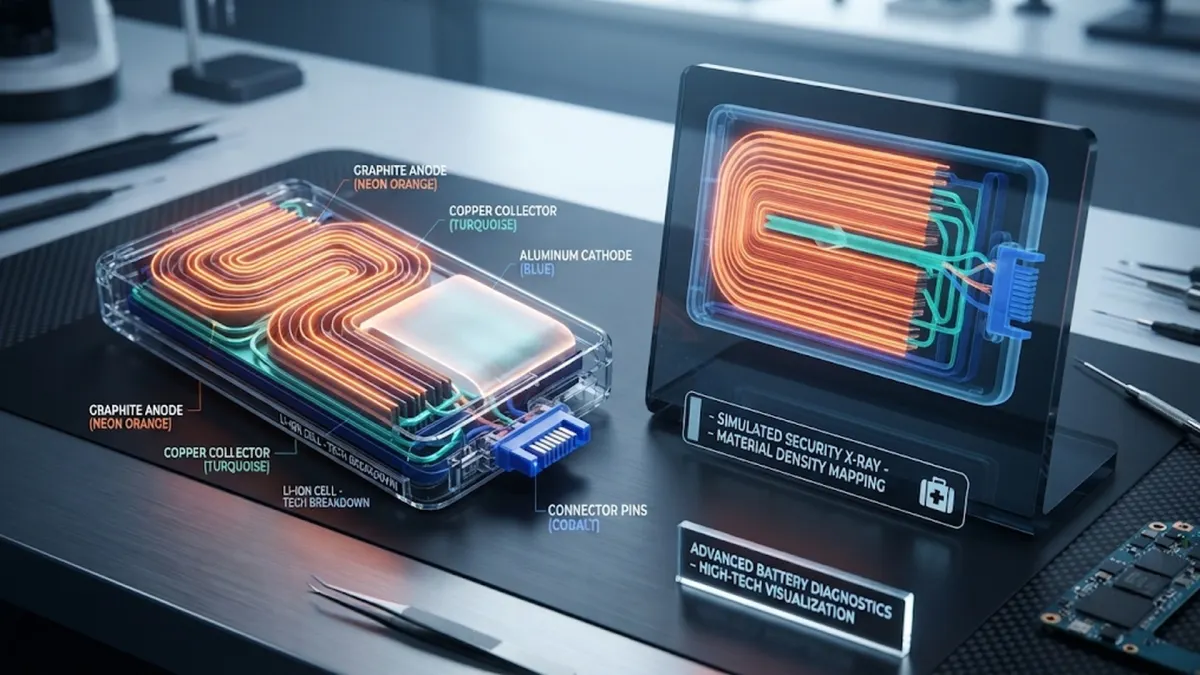
Pure elemental lithium has an atomic number of only three, making it one of the lightest metals in the universe. If a battery were made of pure lithium, an X-ray scanner would view it as a faint, transparent whisper. But modern rechargeable batteries are complex, layered sandwiches.
Inside a lithium-ion cell, sheets of carbon graphite (orange) are coated with lithium cobalt oxide and pressed against ultra-thin sheets of copper and aluminum current collector foils (green and blue). The entire pack is wired to dense solder joints, protection microchips, and steel outer shielding.
On the security screen, a lithium-ion battery displays a distinctive fingerprint: a dense orange chemical sandwich trapped between razor-sharp blue metallic wires and boundary foils. Security algorithms look specifically for this precise multi-layered geometric signature. If a battery is damaged, crushed, or oversized (exceeding airline watt-hour capacity limits), automated threat recognition software highlights the cell in a flashing red diagnostic box.
Battery Thermal Runaway Hazard
Lithium cells combine combustible organic electrolytes with dense metallic oxidizers. Scanners track their layered foil geometry to prevent pressurized thermal runaway events in unpressurized cargo holds.
5. The Computed Tomography Revolution: Goodbye Plastic Bins
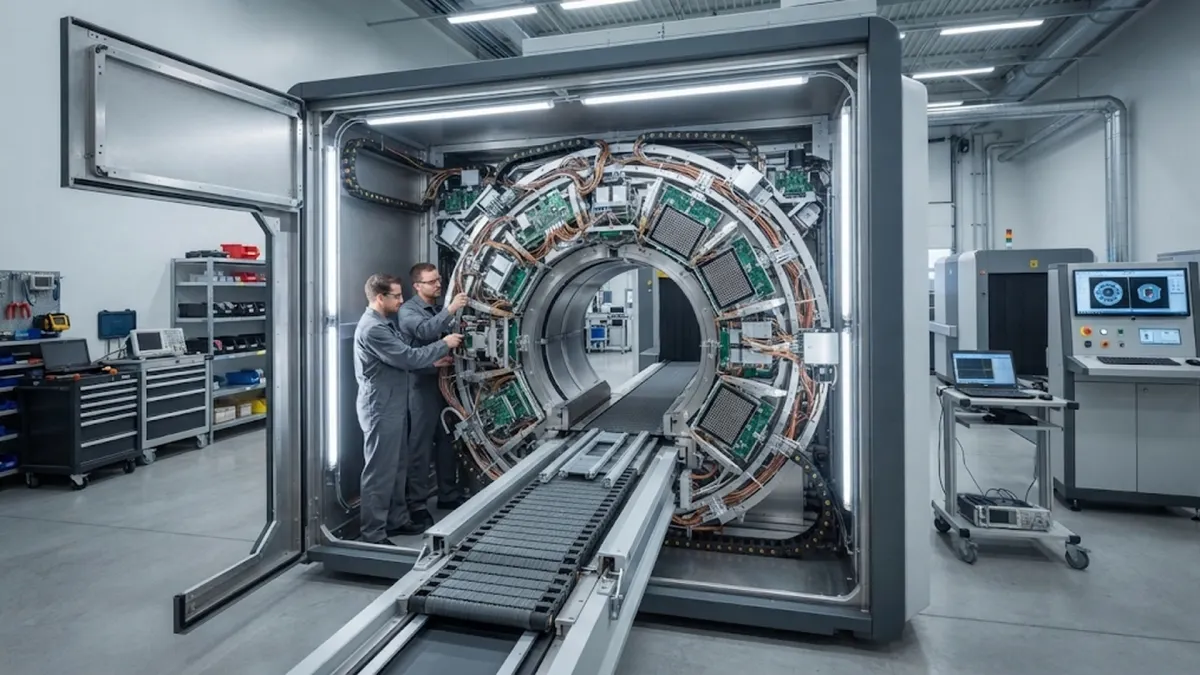
For decades, travelers were forced to unpack laptops and pull out liquid bags because flat 2D X-ray images stack every item on top of each other. A water bottle sitting directly over a tablet computer could easily mask a hidden blade underneath.
Modern checkpoints are rapidly upgrading to medical-grade Computed Tomography (CT) scanners. Instead of stationary beams, CT tunnels spin an X-ray gantry around your bag hundreds of times per second, shooting thousands of volumetric cross-sectional slices. The system constructs a photo-accurate 3D digital model of your luggage in real time.
Officers can use a virtual trackball to rotate your backpack 360 degrees, digitally peel away piles of laundry, and measure the exact cubic density of every liquid container down to the milligram. Because the 3D computer can separate a bottle of contact solution from liquid explosive in three seconds flat, the days of unpacking electronics into plastic gray bins are finally coming to an end.
Next-Gen Checkpoint Verdict
3D volumetric CT imaging slices luggage into thousands of digital layers, letting software unpeel clothes virtually and rendering the old "remove your laptop" rule obsolete.