
The Drifting Airship over Ocean Beach
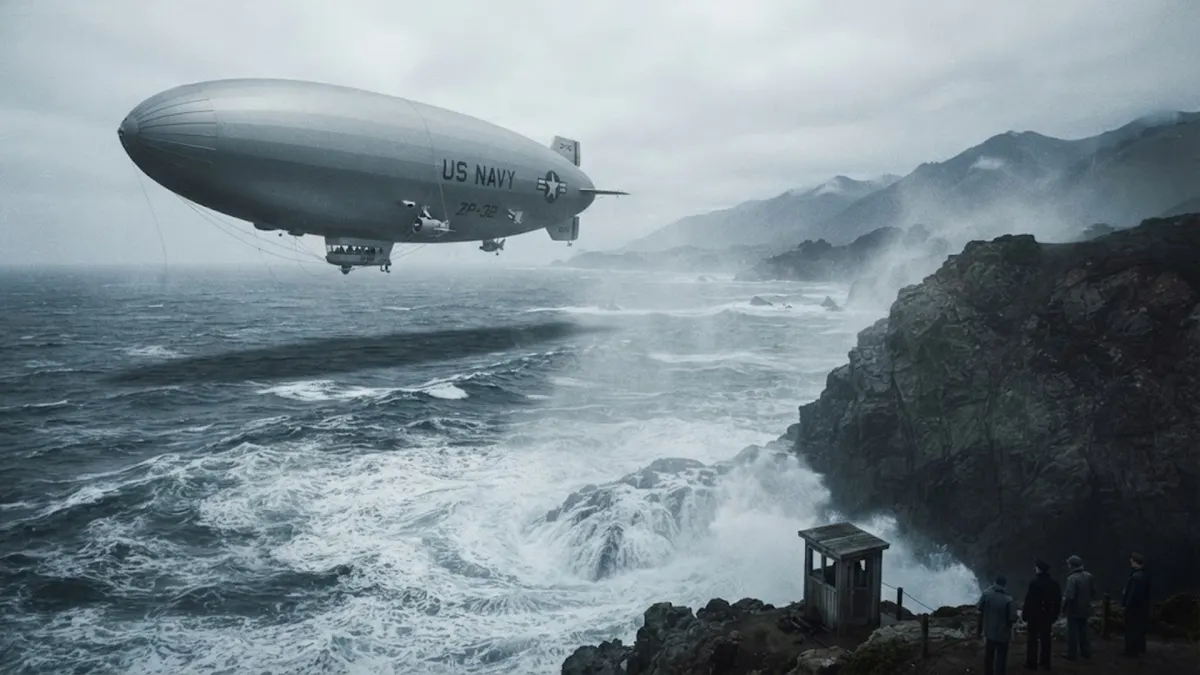
On a foggy Sunday morning in August 1942, bathers and fishermen along Ocean Beach in San Francisco looked up to see a massive grey gasbag drifting silently out of the low maritime fog. It was United States Navy airship L-8, a 150-foot reconnaissance blimp assigned to maritime patrol squadron ZP-32 at Moffett Field. The ship was flying unusually low, its two radial engines idling quietly, and its gondola skimming barely fifty feet above the surf.
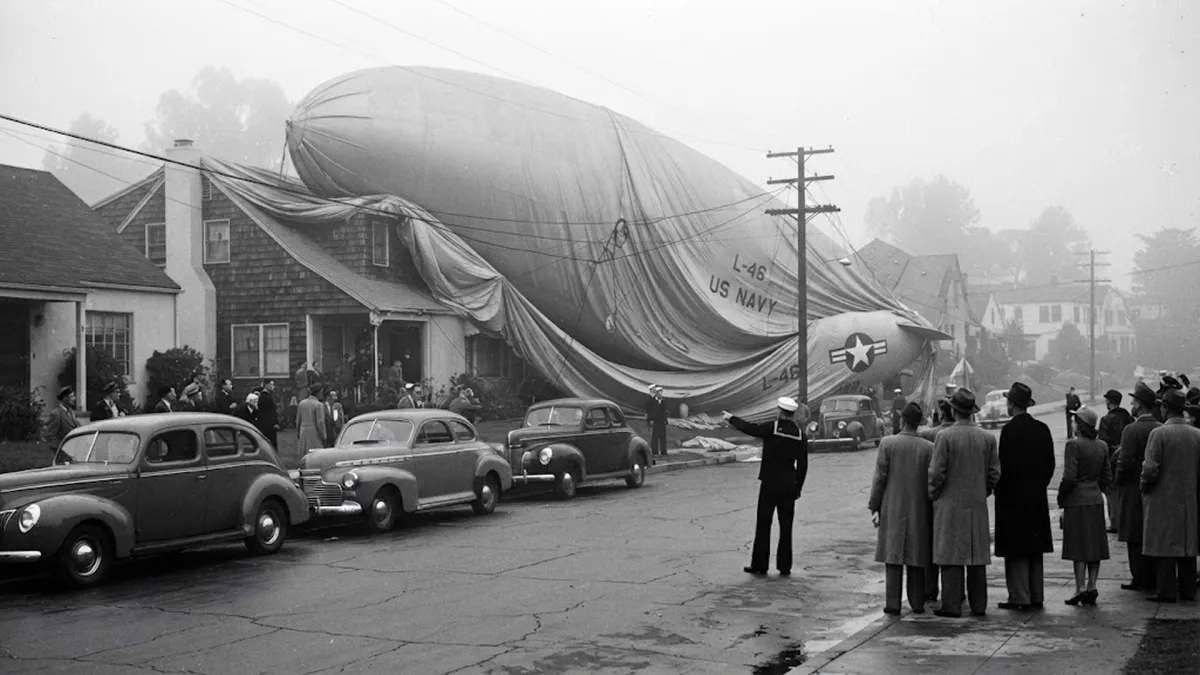
As onlookers watched in bewilderment, the airship drifted inland over the coastal dunes of Daly City. Its sagging envelope scraped across the rooftops of pastel suburban bungalows, clipped a telephone pole, and finally settled gently onto the asphalt of Bellevue Avenue, right between two parked family sedans. Local residents rushed out of their houses with garden shears and fire axes to help any injured sailors trapped inside the cabin.
When the first police officers pulled open the gondola door, they found the cabin completely intact and bone dry. The radio transmitter was switched on and functioning perfectly. The airship's loudspeakers were operational. Three life rafts remained strapped in place, all parachutes were neatly hung in their wall brackets, and two live depth charges were still clamped beneath the fuselage. But the two aviators aboard—Lieutenant Ernest DeWitt Cody and Ensign Charles Adams—had vanished completely without a trace.
Project Azorian: How the CIA Built a Giant Claw to Steal a Sunken Soviet Submarine
The Routine Dawn Patrol out of Treasure Island
I spoke with naval aviation historian and archival researcher Arthur Vance, who spent twelve years analyzing declassified Navy Board of Investigation records at a maritime museum in Vallejo, California. Vance spread out the original hand-scrawled flight log from August 16, 1942.
"Cody and Adams were not rookies," Vance told me, tracing the planned patrol track across the Farallon Islands. "Cody was a decorated Annapolis graduate who had delivered cargo to the USS Hornet for the Doolittle Raid on Tokyo. Adams was an experienced balloon rigger with thousands of hours in lighter-than-air craft. Their orders were simple: fly a routine six-hour anti-submarine sweep across the Golden Gate shipping channel looking for Imperial Japanese submarines."
At 7:38 AM, Cody radioed flight control: "Investigating suspicious oil slick four miles off Farallones." An armed merchant freighter and a civilian fishing vessel in the area observed the blimp circle the slick, drop two smoke flares, and descend to thirty feet to inspect the water. That was the last transmission ever received from L-8.
| Investigation Factor | Physical Evidence at Crash | Navy Board Conclusion | Operational Significance |
|---|---|---|---|
| Emergency Gear | 3 life rafts & 2 parachutes on hooks | Crew did not make planned bailout | Rule out premeditated abandonment |
| Radio Equipment | Operating on standard Navy frequency | No distress call broadcast after 7:38 AM | Indicates sudden or instantaneous event |
| Cabin Door & Safety Latch | Door hooked open; safety bar unlatched | One or both men opened door in flight | Suggests emergency visual inspection or man-overboard |
| Fuel & Ballast | Four hours of fuel; water ballast intact | Craft remained fully airworthy | Blimp flew unmanned for nearly two hours |
The Mystery Inside the Sagging Gondola
The Navy Board of Formal Inquiry opened hearings seventy-two hours later. Navigational charts lay spread across the flight desk, with Cody's field cap resting on the instrument panel. The airship's throttles were set in the idle position, and the ship's batteries were fully charged.
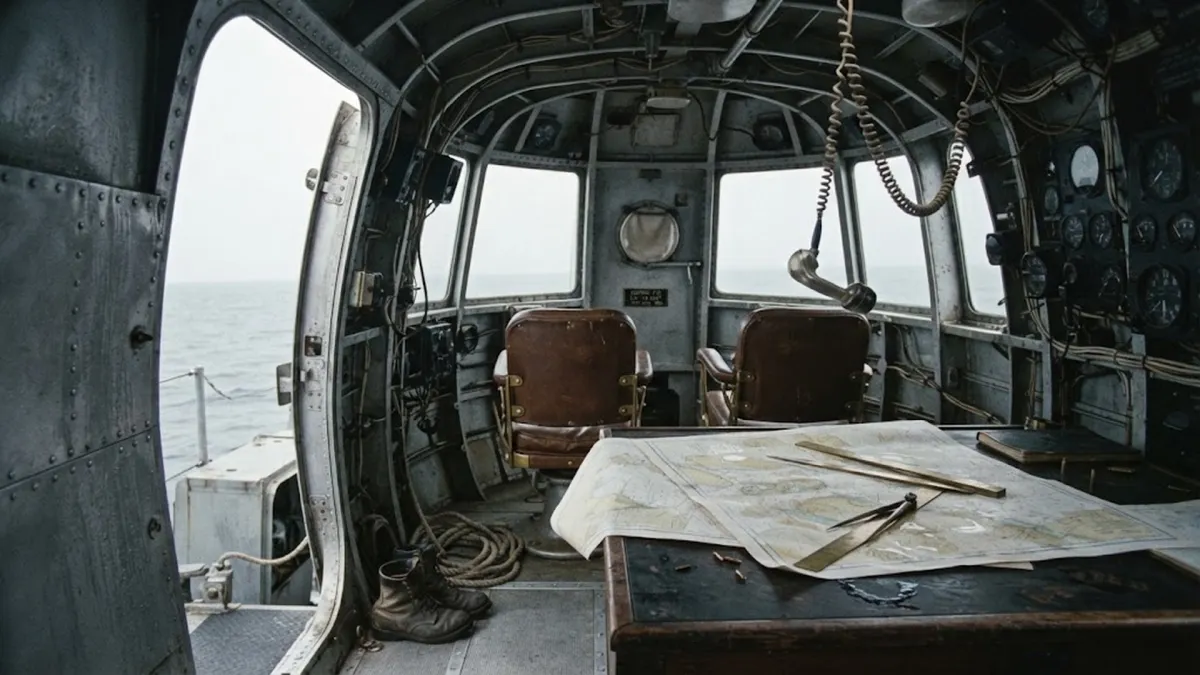
"The only physical anomaly was the cabin door," Vance noted, pointing to an official Navy photograph of the door lock. "The outward-swinging door was latched open with a safety hook, and the exterior safety bar had been dropped. That meant one of the officers deliberately leaned outside the moving aircraft while flying low over the ocean."
The leading forensic theory remains a tragic chain reaction. While hovering low over the choppy waters to examine the oil slick, one crewman may have lost his balance and fallen through the open door into the sea. The second officer, attempting an immediate water rescue or reaching for a flotation device, was likely pulled or tumbled overboard after him, leaving the blimp trimmed, buoyant, and utterly pilotless.
The Naval Board Verdict
In its official declassified findings, the US Navy concluded that both officers were lost at sea in the line of duty, formally stating: "No reason can be assigned for the crew leaving the airship, nor can their disappearance be accounted for by any evidence produced."
The Second Life of the Ghost Blimp
Despite the eerie tragedy, the Navy repaired the torn envelope and damaged propellers. L-8 returned to active service, flying submarine patrol sweeps through the end of World War II before being sold to the Goodyear Tire and Rubber Company in 1950.
For three decades, the former "Ghost Blimp" was refitted as the beloved civilian advertising airship *Mayflower*, filming Super Bowls and Rose Bowl parades across America until its retirement in 1982. Today, its historic control gondola hangs fully restored inside the National Museum of Naval Aviation in Pensacola, Florida.
Aviation Legacy
The Daly City crash remains the only documented incident of an intact military aircraft landing unmanned on a residential street during wartime without injuring a single civilian on the ground.