
The Green Amber Light at Sears Crossing
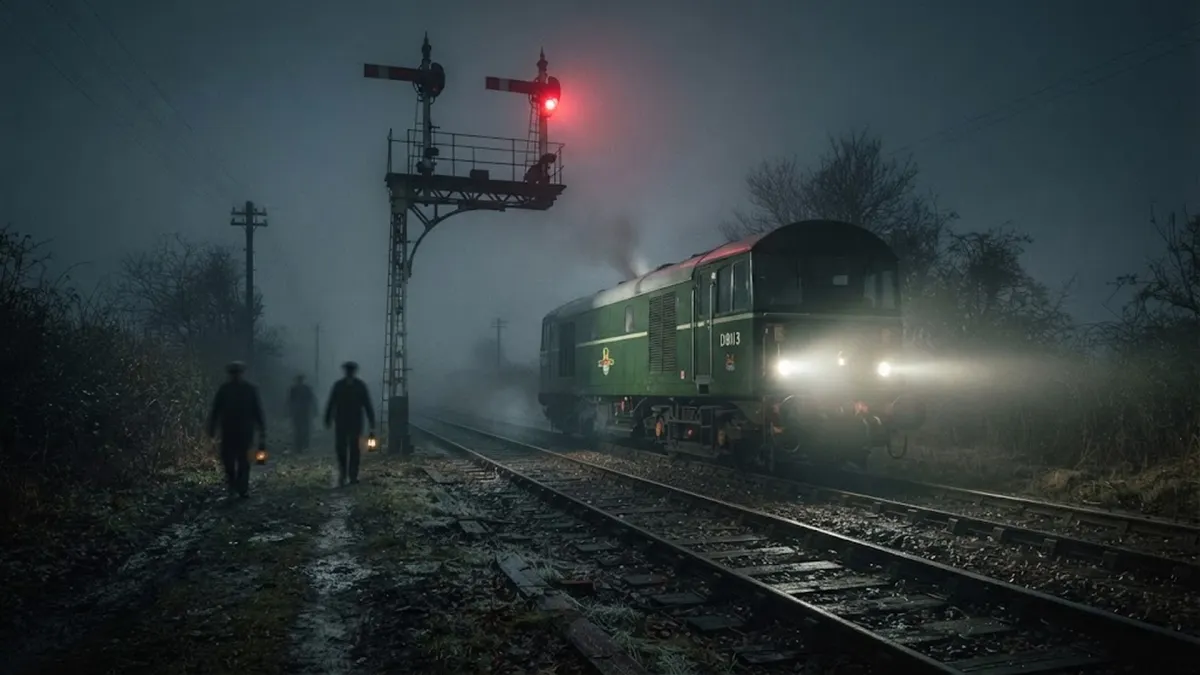
At three in the morning on August 8, 1963, engine driver Jack Mills leaned out the cab window of English Electric diesel locomotive D326, squinting through a patchy blanket of countryside fog near Mentmore in Buckinghamshire. He was hauling the travelling post office train from Glasgow to London's Euston station. Behind him sat twelve carriages containing seventy postal workers sorting parcels and mailbags, including three hundred registered cash packets sent down by Scottish commercial banks following a busy bank holiday weekend.
Suddenly, the trackside signal gantry at Sears Crossing flashed amber, then clicked into a stubborn, solitary red. Mills eased back on the locomotive throttle, tapped the vacuum brakes, and brought the twelve-carriage train to an easy halt across the open farm fields. He turned to his young fireman, David Whitby, and instructed him to climb down onto the dark ballast track to use the trackside telephone to call the railway signalman at Cheddington.
When Whitby reached the cast-iron emergency telephone box fixed to the signal gantry, he found the communication cables sliced cleanly through with heavy wire cutters. A tall figure stepped out from behind a line of wet hawthorn bushes wearing an oily boiler suit and a dark balaclava. Before Whitby could call out, an iron bar struck his shoulder, knocking him down into the railway ditch. Fifteen masked men armed with wooden clubs, pickaxe handles, and iron crowbars swarmed the diesel engine. Within twenty-five minutes, without firing a single bullet, the gang unloaded 120 heavy mail sacks containing 2.6 million pounds in unrecorded banknotes—roughly sixty million pounds in today's currency.
The 1980 Lake Peigneur Disaster: How an Oil Rig Drilled into a Salt Mine and Swallowed a Lake
The Glove over the Signal Lamp
The robbery was an absolute masterclass in railway mechanical manipulation. Scotland Yard detectives initially suspected a massive inside conspiracy involving British Railways signal dispatchers or electrical grid supervisors. But senior forensic detectives visiting Sears Crossing at daybreak found evidence of astonishingly simple, low-tech ingenuity.
The gang, masterminded by London antique dealer Bruce Reynolds and seasoned South London bookmaker Gordon Goody, had surveyed this quiet stretch of railway line for weeks. To force the heavy mail train to stop at the exact crest of a railway embankment where their getaway Austin trucks and Land Rovers sat concealed in an old airfield track, they needed an authentic red light.
"They never tampered with the complex British Railways electrical switching interlocking," explained retired Scotland Yard criminal archive researcher Malcolm Vance. "Instead, a former electrical contractor in the gang walked up the track gantry carrying a common six-volt Ever Ready dry cell battery, a length of twin-flex household wiring, and a dark leather woolen work glove."
The robber slipped the heavy leather glove over the gantry's green signal lens to blind it. Then, he clipped the portable dry-cell battery leads directly across the contacts of the red marker bulb. When Jack Mills rounded the gentle curve at sixty miles per hour, he saw what appeared to be an unquestionable red stop command glowing against the black countryside.
| Investigation Factor | The 1963 Robbery (Buckinghamshire) | Standard Postal Security Norms | Forensic Outcome |
|---|---|---|---|
| Stolen Banknote Value | £2,631,684 in small cash denominations | Normal transit load: £300,000 | Bank holiday weekend cash backlog |
| Track Signal Sabotage | Battery wired to red bulb; glove on green lens | Fail-safe track interlocks | Fooled veteran driver into manual halt |
| Weapons Employed | Iron coshes, wooden clubs, pick handles | No armed guards on postal mail carriages | Zero firearms discharged during heist |
| Hideout Discovery | Leatherslade Farm (27 miles from scene) | Immediate dispersal across London | Fingerprints found on Monopoly board |
The Monopoly Board at Leatherslade Farm
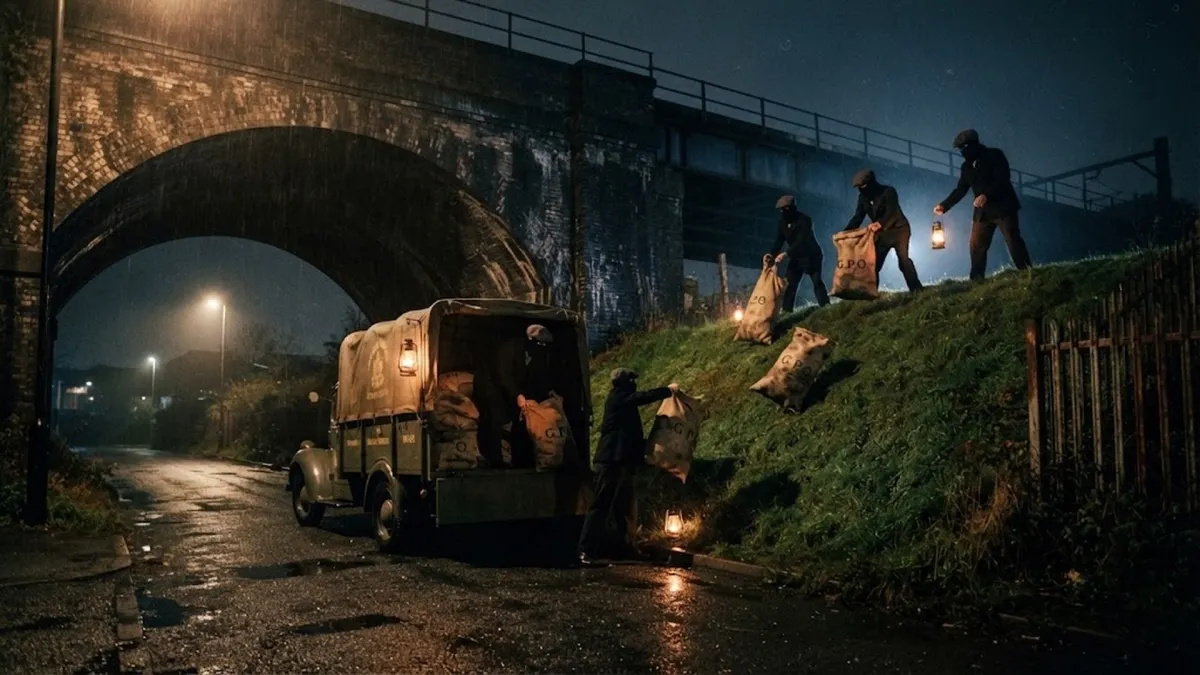
After uncoupling the diesel locomotive and the first two cash carriages from the rest of the passenger coaches, the robbers forced Jack Mills to drive the truncated train a half-mile forward to Bridego Bridge. Working quietly in the dark beneath the bridge arches, a human chain of fifteen men tossed 120 heavy canvas mail sacks into two converted military trucks and an Austin saloon car.
The robbers drove twenty-seven miles cross-country through narrow backroads to a secluded, run-down rural property called Leatherslade Farm, which they had purchased weeks earlier through a London solicitor's alias. Inside the farmhouse, the men popped bottles of champagne, divided the stacks of one-pound, five-pound, and ten-shilling banknotes into neat cardboard boxes, and passed the tense hours playing a game of Monopoly on the floor using bundles of real stolen currency for the property purchases.
The gang's fatal blunder was hiring an acquaintance known in underworld circles as "the cleaner," who was handed several thousand pounds with strict instructions to burn down the entire farmhouse and douse every wooden surface in industrial disinfectant to eradicate forensic clues. The cleaner pocketed the cash and slipped away without ever striking a match. When an alert neighboring cattle herdsman noticed unusual vehicle tracks and shuttered windows five days later, police officers pushed open the unlocked kitchen door.

The Fingerprint Breakthrough
Scotland Yard forensic specialists under Chief Superintendent Jack Slipper dusted the abandoned farmhouse from floor to rafters. They uncovered dozens of immaculate latent fingerprints on empty Heinz ketchup bottles, a canned beer tin, an unwashed saucer, and the cardboard edges of the Monopoly board, directly matching known police records for Bruce Reynolds, Buster Edwards, and Ronnie Biggs.
The Extradition Battles and the Flight to Brazil
Armed with unambiguous palm prints and fingerprint trails from Leatherslade Farm, Scotland Yard detectives rounded up twelve gang members within four months. At the sensational trial in Aylesbury in the spring of 1964, Justice Edmund Davies handed down staggering thirty-year prison sentences to send an uncompromising warning across the British criminal underworld.
Yet the legend of the robbery only expanded with time. Gang member Ronnie Biggs famously escaped from Wandsworth Prison fifteen months later by scaling an exercise yard wall with a homemade rope ladder, dropping into the open roof of a furniture van. Biggs fled to Paris for cosmetic facial surgery, traveled through Australia under assumed names, and eventually settled in Rio de Janeiro, Brazil, where local paternity laws legally blocked British attempts at extradition for over three decades.
Bruce Reynolds evaded international capture for five years, living under lavish aliases across Mexico and Canada before depleting his stolen fortune and returning quietly to England, where detectives quietly arrested him in a rented seaside flat in Torquay in 1968.
Criminology Takeaway
The 1963 Great Train Robbery completely remade high-value transit security throughout Europe. British banks permanently abandoned the practice of shipping unrecorded paper cash on standard passenger railways, sparking the rapid development of reinforced armored road carriers and early computerized inter-bank wire clearances.