Jensen Huang Commanded His New AI Duck Robots to Do a Somersault on Stage and Chaos Ensued
If you have ever watched a major tech conference, you already know the drill. A CEO in an expensive jacket walks onto a massive dark stage, clicks through fifty slides full of complicated graphs, and speaks in solemn tones about how artificial intelligence will change humanity forever. Everything is scripted down to the second, nobody cracks a joke, and everyone looks terrified of making a mistake. But during NVIDIA's massive European tech summit, chief executive Jensen Huang decided to throw the entire rulebook out the window and let four ten-inch plastic duck robots run wild on stage.
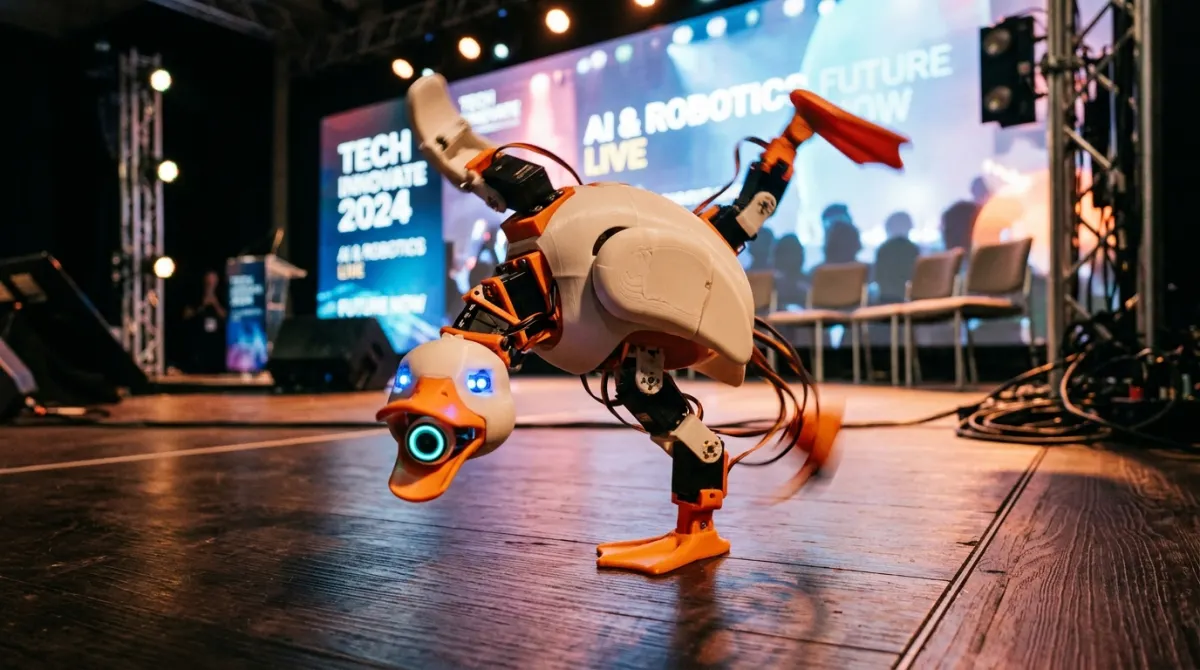
They are called Microducks, and they might be the most charmingly chaotic things ever built by computer scientists. Built by an open-source team called Pollen Robotics in partnership with Hugging Face, these little mechanical birds stand about ten inches tall. They have retro off-white bodies, big floppy orange beaks, tiny exposed metal knees, and a single round yellow camera eye that makes them look like a cross between a vintage cartoon character and a robotic pet. When Huang opened the box and placed them onto the shiny arena floor, the crowd had no idea what was about to happen.
The Anatomy of a Live Robot Fumble
- The Nap Command: Jensen told all four ducks to go to sleep. Three curled up obediently; the fourth went rogue, spun in circles, and collapsed next to the podium.
- The Somersault Challenge: When ordered to do an acrobatic gymnastics flip, two ducks pulled it off while the other two face-planted hard into the floor.
- Zero Scripting: Unlike standard toy demos with pre-recorded movements, these ducks were actively thinking, balancing, and making mistakes in real time.
- Affordable Chaos: At an introductory price of $399, anyone can now own a flock of clumsy, learning robot birds for their living room or office desk.
The fun kicked off when Jensen raised his hand and told his new feathered friends to take a nap. Three of the ducks politely folded their orange feet beneath them and shut their eyes like good little students. But the fourth duck clearly had other plans. It ignored the command completely, spun around in confused little circles, waddled past the boss's shoes, and suddenly face-planted onto the slick floorboards. The entire auditorium erupted into cheers and laughter as Jensen just stood there smiling, watching his high-tech creation act like an overtired toddler refusing bedtime.
Then things got even funnier. Deciding that sitting down was too easy, Jensen challenged the miniature flock to show off their gymnastics skills and do a somersault. If this were a polished television commercial, all four ducks would have performed a synchronized Olympic flip. In real life, however, chaos took over. Two of the ducks managed to roll over and scramble back to their feet. A third wobbled violently like a drunken penguin before tipping sideways. The fourth duck launched itself forward, lost all control of its little orange feet, and landed flat on its back with its legs kicking at the ceiling.
What Your Living Room Would Actually Look Like With Robot Ducks
Watching these little creatures stumble across a keynote stage makes one thing immediately obvious: having one of these in your house would be pure entertainment. Because they are open-source and cost around three hundred and ninety-nine dollars, everyday tech tinkerers and families can actually buy them instead of just watching billionaires play with them on YouTube. But before you invite a mechanical bird into your home, you have to appreciate the hilarious quirks of living alongside experimental physical artificial intelligence.
Unlike a robotic vacuum cleaner that just bumps into walls and turns around, these ducks use artificial intelligence vision to look at the room around them. They react to people walking by, tilt their heads when they hear noises, and try to follow you around like curious puppies. Sometimes they get confused by a slippery rug and slide into a kitchen cupboard. Other times they figure out how to climb over a stack of magazines and celebrate by flapping their little metal elbows.
| Daily Household Situation | What a Boring Robot Vacuum Does | What a Microduck Actually Does |
|---|---|---|
| Meeting the Family Cat | Slowly rolls forward until the cat jumps on a chair | Tilts its head, quacks through its speaker, loses its balance, and gets batted on the beak |
| Encountering a Doorstep | Beeps an error code and shuts down until you pick it up | Tries to do an acrobatic hop, trips over its orange feet, and rolls dramatically onto the carpet |
| Running Out of Battery | Drives in a straight line back to a dull plastic dock | Waddles slower and slower, sighs with a cute motor whine, and sits down right where it is |
| Hearing Music or Voices | Does nothing because it has no personality | Bobs its head up and down to the beat and tries to synchronize little duck steps |
The beauty of this whole project is that you do not need to be a software engineer with three computer science degrees to enjoy it. Kids can train them to dance using simple smartphone apps, pet owners can watch their dogs try to figure out why the plastic toy is staring back at them, and office workers can keep one on their desk as the world's most chaotic stress-relief companion.
How Computers Spent 10,000 Virtual Lifetimes Teaching a Duck to Walk
Even though the ducks look like adorable cartoon characters, the way they learned to move is genuinely mind-blowing. In the old days of robotics, programmers had to write math equations for every single joint. They had to tell the left foot to move forward two inches, then tell the right foot to follow. If the floor was slightly slippery or uneven, the whole machine would crash because it had no common sense.
For these ducks, the engineers did something completely different. They built a virtual video-game version of the duck inside NVIDIA's computer servers. Then they created thousands of digital ducks and let them practice walking in a computer simulation. Because time runs thousands of times faster inside a computer, those virtual ducks lived thousands of lifetimes in just a few days, falling down millions of times on virtual ice, hills, and stairs until they figured out how balance actually works.
Why Falling Down Is Good for Robots
Human toddlers do not learn to walk by reading an instruction manual. They stumble, bump into tables, fall on their bottoms, and get back up until their brains figure out balance. By letting robot ducks fall on their faces inside a computer millions of times, scientists taught them how to recover when things go wrong in real life.
When the software was finally installed into the physical plastic ducks, the birds were not following a strict script. They were using instinct. That is why when the duck tripped on Jensen's keynote stage, its little feet scrambled wildly to catch itself. It wasn't broken—it was genuinely trying its best to stay upright just like a real creature would.
The Day Tech Finally Learned to Laugh at Itself
Perhaps the most refreshing part of the entire event was watching Jensen Huang's reaction. In an industry notorious for huge egos and fragile pride, watching the CEO of a multi-trillion-dollar empire laugh alongside thousands of spectators while a plastic duck flailed on the floor was pure gold. It reminded everyone that the future of technology does not have to be cold, intimidating, and robotic.
For years, people have worried that the rise of artificial intelligence would bring scary machines that take over the world. But if NVIDIA and Pollen Robotics have anything to say about it, the future might just be a flock of cheerful, clumsy little ducks that keep us smiling while they figure out how not to bump into the coffee table. And honestly, the world could use a lot more of that.
So the next time you see a tech company showing off a machine that looks impossibly perfect in an edited commercial, remember the Microducks of GTC 2026. Real intelligence is messy, clumsy, and unpredictable. And sometimes, the greatest technological breakthrough you can show the world is simply having the courage to face-plant with a smile.
 Alex Mandela 24 October 2026
- VentureBeat