
The Great Searing Illusion
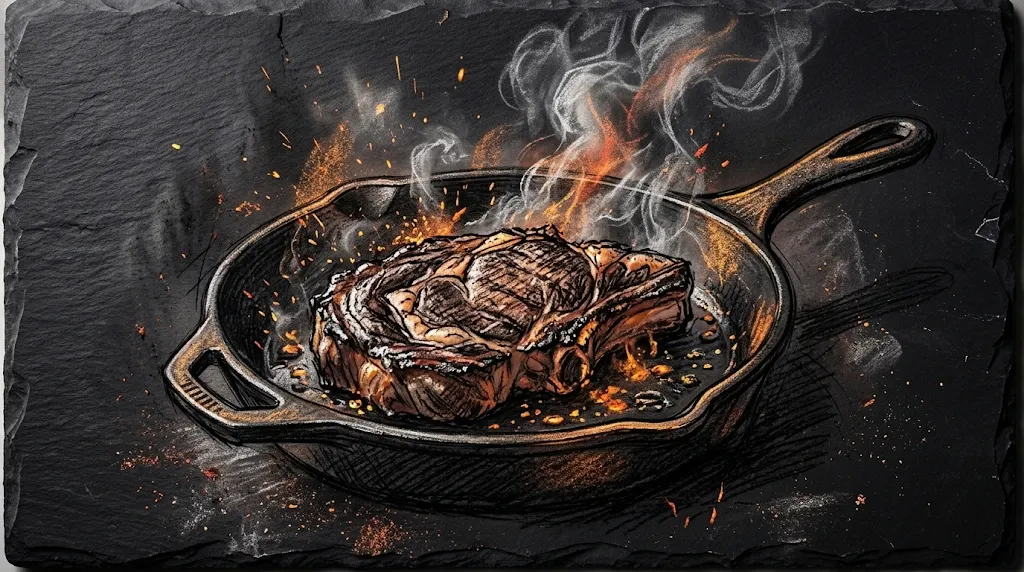
Listen closely the second a raw cut of meat hits smoking cast-iron: that violent, spitting hiss isn't the sound of juices being trapped inside. It is the sound of moisture desperately escaping into the air as steam.
For more than a century and a half, home cooks, grill masters, and professional culinary academies repeated the exact same piece of kitchen gospel: you must sear your meat at blazing heat to seal the pores and lock the juices within. It sounds intuitive, comforting, and scientific. It is also completely, indisputably false.
The Montreal Kitchen Scale Test
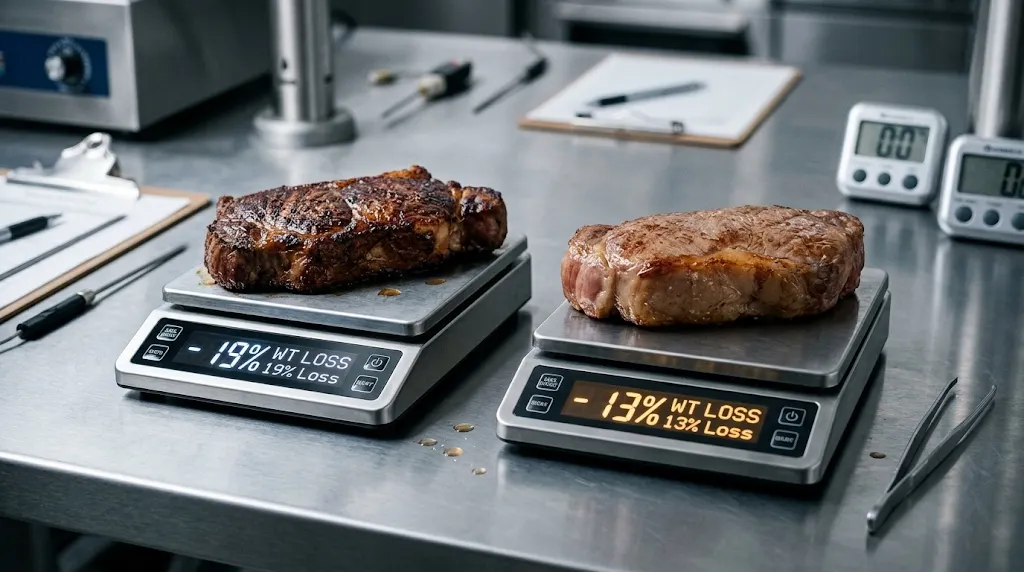
A veteran French-Canadian chef named Jean-Luc once demonstrated this reality in a Montreal bistro with brutal clarity. He pulled two identical 340-gram New York strip loins from the walk-in cooler, cut from the exact same sub-primal loin. The first steak was dropped straight into a smoking cast-iron skillet, seared hard on both sides until a charred mahogany crust formed, and then transferred to a hot oven to reach a 130-degree medium-rare.
Flavacol and Orange Coconut Oil: The Chemistry Behind That Movie Theater Popcorn Smell
When placed back on a precision digital scale, its weight had plummeted from 340 grams down to 278 grams. The high-heat sear had blasted over eighteen percent of its total weight into the exhaust hood as steam and rendered fat.
The second strip steak received the exact opposite treatment. It was placed on an elevated wire rack in a gentle, low-temperature 225-degree oven. Only after the interior reached a uniform 115 degrees was it flashed in a hot pan for sixty seconds just to color the surface. When that second steak hit the scale, it weighed 312 grams—having lost barely eight percent of its moisture.

The 1847 Origin of a Global Kitchen Myth
Where did every culinary textbook get this idea in the first place? The myth traces back to 1847 and a brilliant German chemist named Justus von Liebig. Liebig was one of the undisputed founders of modern organic chemistry, but his understanding of biological meat tissue was fatally flawed.
Liebig published a treatise claiming that animal muscle fibers behave like microscopic bundles of porous tubes. He theorized that exposing raw meat to searing heat instantly coagulates the surface albumen proteins into a waterproof, impenetrable jacket that prevents juices from leaking out. Because Liebig was a titan of science, cookbook authors across Europe and North America copied his claim word for word for generations without ever placing a seared steak on a scale.
"A steak is not a water balloon, and meat does not have pores. Muscle tissue is seventy-three percent water held inside delicate protein cables. High heat does not seal those cables—it wrings them out like a dry twisted sponge."
Thermal Physics: The Sponge Effect
A piece of steak is roughly seventy-three percent water by weight, suspended inside elongated myofibrillar protein filaments called actin and myosin. When meat hits a 450-degree pan, those protein filaments do not form a magical watertight shield. Instead, the sudden thermal shock causes the protein strands to rapidly denature, contract, and tighten violently.
As the proteins shrink, they mechanically squeeze water out of the intracellular matrix, forcing it to the surface where the intense heat vaporizes it immediately. The hotter the pan and the faster the temperature spike, the more aggressively the muscle fibers tighten—forcing precious juices out of the core.
| Cooking Method | Surface Temperature | Muscle Reaction | Weight Lost | Plate Tenderness |
|---|---|---|---|---|
| Traditional Hard Sear First | 450°F – 500°F Instant | Violent thermal contraction, surface moisture boils off | 18% – 22% Total Mass | Gray overcooked bullseye ring under crust |
| Gentle Oven Roast Only | 225°F Constant | Gradual protein relaxation, minimal cellular tension | 9% – 11% Total Mass | Extremely juicy, but lacks aromatic flavor crust |
| The Reverse Sear (Modern Science) | Low Heat First, Flash Sear Last | Core cooks evenly, dry exterior flash-browns in 60s | 8% – 10% Total Mass | Edge-to-edge perfect pink with paper-thin crisp crust |
The True Purpose of Searing: The Maillard Miracle
Does this mean searing is useless? Absolutely not. Searing is the single most important step in steak preparation—not because it traps moisture, but because of the Maillard reaction. Discovered by French scientist Louis-Camille Maillard in 1912, this complex chemical cascade occurs when amino acids and reducing sugars collide above 300 degrees Fahrenheit, creating hundreds of brand-new aromatic flavor compounds that give roasted meat its deep, savory, umami richness.
The goal is to achieve maximum Maillard browning with minimum internal moisture loss. And the secret to doing that is simple: surface dryness.
The Modern Scientific Solution: The Reverse Sear
When you drop a cold, wet raw steak directly into a smoking pan, the stove's heat does not go into browning the meat. It spends hundreds of BTUs of energy simply boiling away surface water. While that water is boiling off, the gray heat penetrates deep into the muscle, overcooking the interior and creating that dreaded gray, rubbery bullseye ring around the center.
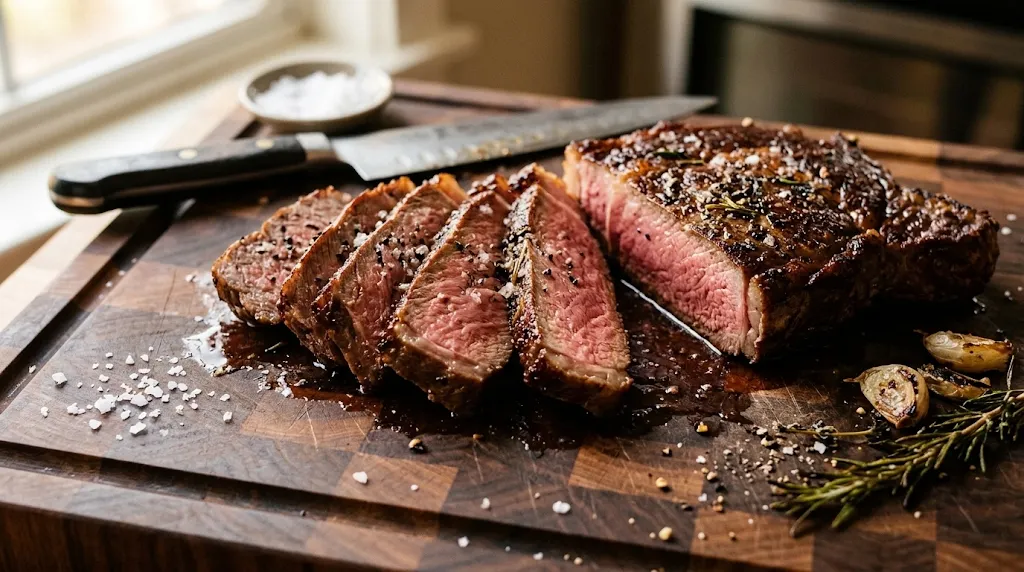
Food scientists and contemporary pitmasters solved this problem with the reverse sear. By placing an unseasoned steak on a wire rack in the refrigerator overnight, the cold air circulates around the meat, dehydrating the exterior into a dry, leathery surface. When that bone-dry steak is gently cooked at 225 degrees until the center reaches 115 degrees, the surface moisture is completely gone.
When you finally introduce that dry steak to screaming hot cast iron with a sliver of tallow, the Maillard reaction triggers in thirty to forty-five seconds flat. You produce a shattering, razor-thin mahogany crust without overcooking the meat or wringing out the internal juices.
The next time someone tells you to sear your meat on blazing heat to lock in the juices, smile and remember Justus von Liebig's 1847 blunder. Searing doesn't trap moisture—surface dryness and patient heat management do.