
The Silent Foot Soldiers Feeding the Next Era of AI
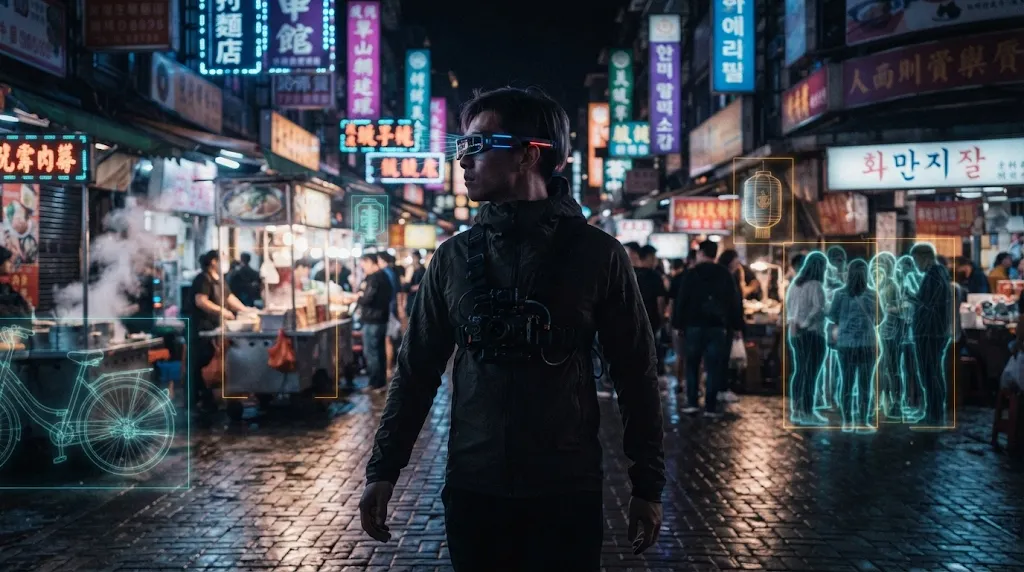
Every morning across bustling urban centers in Southeast Asia, Latin America, and Eastern Europe, thousands of young contract workers strap miniature 4K camera rigs to their chests and walk out into crowded street markets. They are not travel vloggers, and they are not filming videos for social media entertainment. Instead, these invisible foot soldiers are gathering the raw perceptual fuel needed to teach the next generation of artificial intelligence models how physical reality actually functions.
For the past five years, tech giants built large language models by vacuuming up trillions of sentences from public web pages, books, and discussion boards. But text alone cannot teach a humanoid robot how to pour a cup of tea without spilling, how to dodge a sudden swinging door, or how to navigate a slippery wet pavement. To bridge the gap between abstract computer code and physical action, major Silicon Valley labs are pouring hundreds of millions of dollars into an obscure underground data harvesting economy.
Key Highlights: The Physical AI Data Goldrush
- Physical Reality Shortage: Large language models have largely exhausted public text, forcing AI developers into lucrative commercial contracts for first-person real-world video.
- Rigorous Micro-Tasks: Filmers must capture precise physical manipulations under strict optical criteria including lighting variations, edge contrast, and micro-movements.
- Global Supply Chains: Foot soldiers on city streets feed footage directly to specialized overseas labeling hubs where every object is outlined frame by frame.
- Privacy Gray Zones: Thousands of bystanders are filmed continuously in public squares every day without knowing their faces and strides are training autonomous robots.
Inside this burgeoning industry, everyday human movement has been turned into a high-value commodity traded on international data exchanges. Workers receive precise daily task checklists instructing them to carry out repetitive physical tasks while filming from an exact first-person perspective. A single worker might spend four straight hours slicing lemons on different wooden cutting boards, dropping household keys onto various rug textures, or weaving through aggressive market traffic on an electric bicycle.
Every movement must be smooth and captured at precise frame rates with calibrated focal lengths so neural networks can learn depth perception and object physics. If a filmer jerks their camera too quickly or lets sunlight blow out the exposure on a table edge, the entire session is rejected by algorithmic quality filters without pay. The standard of visual fidelity required for spatial training is remarkably demanding.
From Chaotic Crowded Streets to Pixel-by-Pixel Labeling Factories
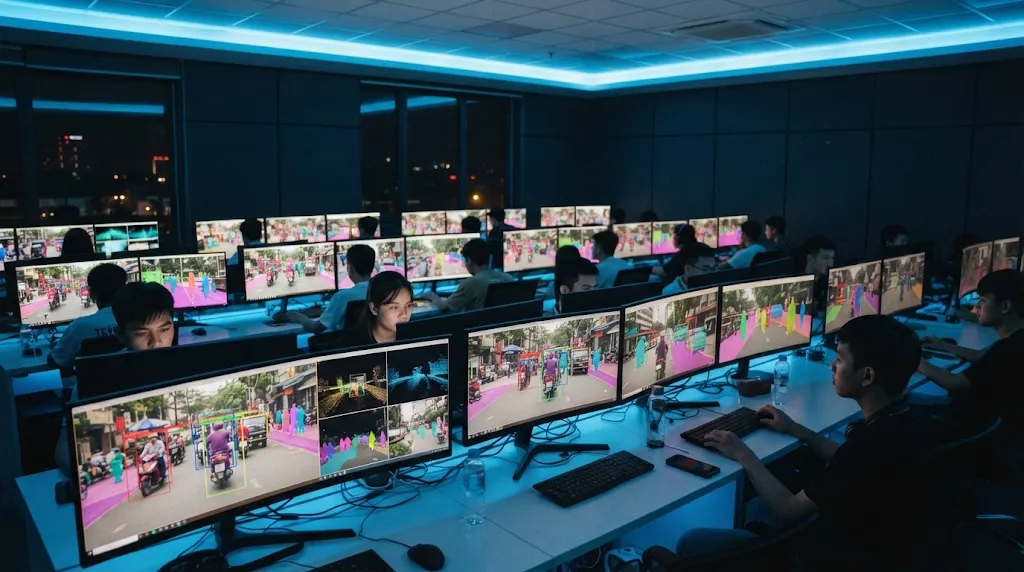
Once a street walker returns home and uploads fifty gigabytes of raw 4K video files, their footage enters the second phase of the pipeline: the annotation centers. In massive air-conditioned office buildings across Vietnam, Kenya, and the Philippines, rooms packed with hundreds of workers spend eight-hour shifts drawing digital bounding boxes around every identifiable object on wide monitors. They trace individual motorbikes, stray dogs, curbs, puddles, and pedestrian elbows frame by individual frame.
This painstaking process turns wild, unpredictable human life into clean mathematical matrices that artificial intelligence architectures can comprehend. A ten-second clip of an elderly woman negotiating a busy street corner can take three human annotators an entire afternoon to label completely. Every shadow, reflection, and change in walking speed must be tagged with accurate semantic metadata.
| Data Category | Capture Method | Average Payout Rate | End-Use Target |
|---|---|---|---|
| First-Person Dexterity | Chest-mounted cameras filming household hand chores | $12 - $25 per clean hour | Humanoid domestic robots & kitchen automation |
| Urban Crowd Navigation | Smart glasses walking through high-density night markets | $15 - $30 per verified hour | Autonomous delivery pods & sidewalk navigation |
| Extreme Lighting Scenarios | Walking through sudden glare, tunnels, and rainstorms | $20 - $40 per accepted hour | Self-driving vehicle camera sensor calibration |
| Micro-Object Segmentation | Pixel-by-pixel frame tagging by office annotators | $2.50 - $6.00 per hour | Spatial computer vision boundary engines |
The scale of this operation is staggering. Companies specializing in physical AI training sets boast catalogs featuring hundreds of thousands of hours of high-resolution human perspectives. Silicon Valley companies buy these datasets in multi-million-dollar bulk bundles to feed their visual-spatial foundational models.
The Moral and Privacy Gray Zone of Living in an Unwitting Training Set
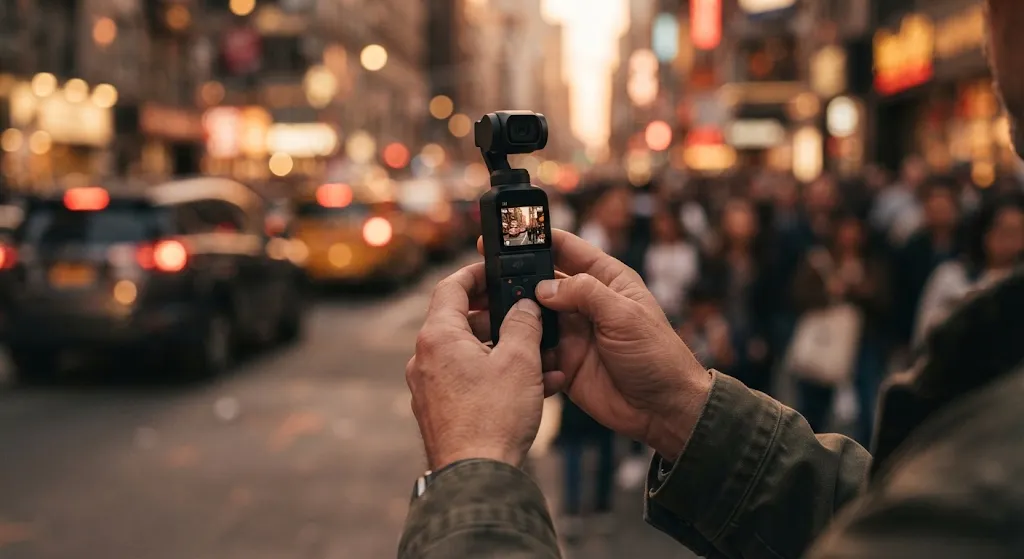
While the workers filming these streets view the gig as an accessible, flexible source of income, privacy advocates warn that the industry is quietly eroding the fundamental concept of public anonymity. When you walk to your local grocery store, grab lunch at an outdoor café, or talk with a friend on a sidewalk, you may unknowingly cross the lens of multiple contract workers whose footage will be permanently archived in neural network weights.
Unlike traditional film crews who are legally required to post notices or obtain commercial release forms from passersby, these independent video collectors blend completely into normal crowd flow. In most countries, recording in public spaces remains entirely legal, creating an open legal loophole that multinational tech corporations exploit without hesitation.
Technologists defend the practice by pointing out that state-of-the-art automated blur filters run over all video to obscure recognizable human faces and license plates before the clips reach neural networks. Yet privacy researchers argue that human gait, clothing patterns, body language, and voice inflections remain remarkably identifiable even after faces are obscured. The boundary between public observation and commercial biometric harvesting has never been thinner.
The Global AI Supply Chain Paradox
While executives in California give keynote presentations celebrating fully autonomous software that thinks and reasons on its own, the hidden machinery making those systems possible relies directly on millions of manual hours performed by low-wage workers walking streets with camera rigs strapped to their clothes.
As the race to deploy physical humanoid helpers and autonomous urban robots accelerates, the price of high-quality human video data continues to climb. What began as a scattered freelance experiment has crystallized into a permanent global shadow workforce. Millions of hours of our collective daily life are being transformed into algorithmic reflexes, ensuring that tomorrow's machines learn how to walk the earth by watching our every footstep.
Ultimately, this underground economy exposes the profound human reality behind modern artificial intelligence. Algorithms do not understand the physical world by magic or spontaneous computer reasoning. Every single time a machine learns how to grab a door handle or cross a wet crosswalk, it is doing so because an underpaid human walked through the exact same storm with a camera strapped to their chest to show it how.
The Future Economics of Embodied Data Collection
Looking forward over the next several years, the economics of human video capture are poised to undergo another massive transformation. Several robotics startups have begun testing decentralized incentive models where ordinary consumers receive cryptocurrency tokens or subscription discounts simply for wearing smart glasses during their daily commutes. Instead of contracting specialized video crews in developing countries, these companies envision turning billions of smartphone and wearable owners into passive data collectors who harvest the physical world continuously.
However, this crowdsourced vision faces steep regulatory roadblocks, particularly in the European Union where strict biometric data rules prohibit the unconsented recording of individuals in public. Until legal clarity is established, Silicon Valley will remain heavily reliant on centralized video farms and structured third-party labeling contractors. The humble video collector walking through night markets with a chest harness remains the true unsung pioneer powering the next generation of artificial physical intelligence.