

How many people follow Christianity, Islam, Hinduism, Buddhism, and other major religions? According to a comprehensive Pew Research Center analysis published in June 2025, Christians accounted for 28.8% of the world's population in 2020, followed by Muslims at 25.6% and Hindus at 14.9%. Meanwhile, 24.2% of the global population had no religious affiliation. These figures offer a closer look at how religion shapes the world's population—and how religious identity is changing.
What Percentage of the World Belongs to Each Religion?
Christianity is the world's largest religious group, followed by Islam and Hinduism. However, people who do not identify with any religion make up a substantial share of the global population, ranking third among the categories measured in the study.
The figures below come from Pew Research Center's analysis of more than 2,700 censuses, surveys, and other demographic sources. The report examines the religious composition of 201 countries and territories.
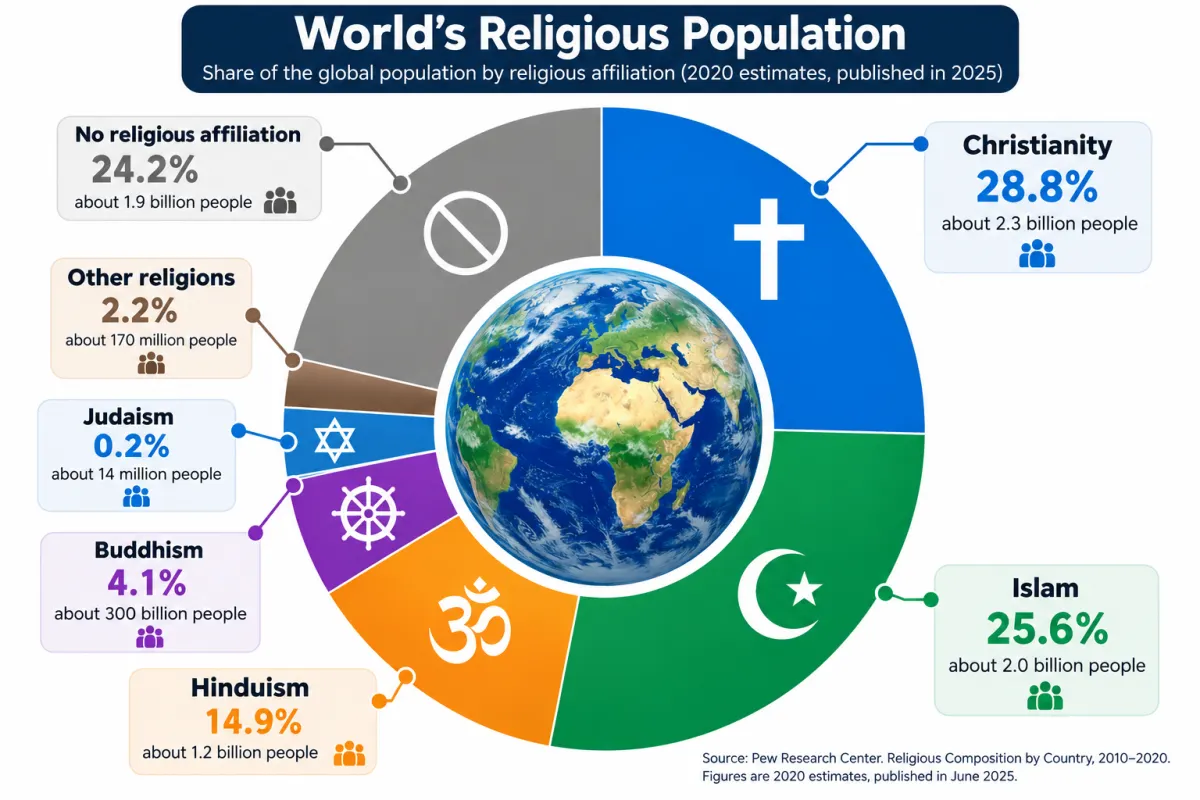
Global Religious Population by Percentage
| Religious group | Share of the world's population |
|---|---|
| Christianity | 28.8% |
| Islam | 25.6% |
| Hinduism | 14.9% |
| Buddhism | 4.1% |
| Judaism | 0.2% |
| Other religions | 2.2% |
| No religious affiliation | 24.2% |
Source: Pew Research Center, Religious Composition by Country, 2010–2020. Figures refer to 2020 estimates, published in June 2025.
Together, Christians, Muslims, Hindus, Buddhists, Jews, and followers of other religions accounted for approximately 75.8% of the world's population. The remaining 24.2% did not identify with a religious group.
It is important to note that religious affiliation does not necessarily reflect the depth of a person's faith. Someone may identify as Christian, Muslim, or Hindu because of their family background or cultural identity without following every teaching of that religion.
1. Christianity: 28.8% of the World's Population

Christianity is the largest religious group worldwide, accounting for approximately 28.8% of the global population in 2020. The religion is rooted in the life and teachings of Jesus Christ and includes several major traditions, such as Catholicism, Protestantism, and Eastern Orthodoxy.
Christian communities are found across Europe, the Americas, sub-Saharan Africa, and many other regions. Although the global number of Christians increased between 2010 and 2020, their share of the world's population declined from 30.6% to 28.8%.
According to Pew Research Center, religious disaffiliation—people who no longer identify with the religion in which they were raised—was one of the factors behind this decline in Christianity's global share.
2. Islam: 25.6% of the World's Population

Islam was the world's second-largest religious group in 2020, representing approximately 25.6% of the global population. Muslims believe in one God, Allah, and recognize Muhammad as the final prophet in Islam.
Islam has a strong presence across the Middle East and North Africa, as well as South Asia, Southeast Asia, and sub-Saharan Africa. Indonesia, Pakistan, India, and Bangladesh are among the countries with the world's largest Muslim populations.
Between 2010 and 2020, the Muslim share of the global population increased from 23.9% to 25.6%. Pew Research Center found that Muslims were the fastest-growing major religious group during this period, largely because of demographic factors, including a relatively young population and higher fertility rates.
Population growth, however, does not establish whether a religion's beliefs are true or false. It describes demographic change rather than the validity of religious teachings.
3. Hinduism: 14.9% of the World's Population
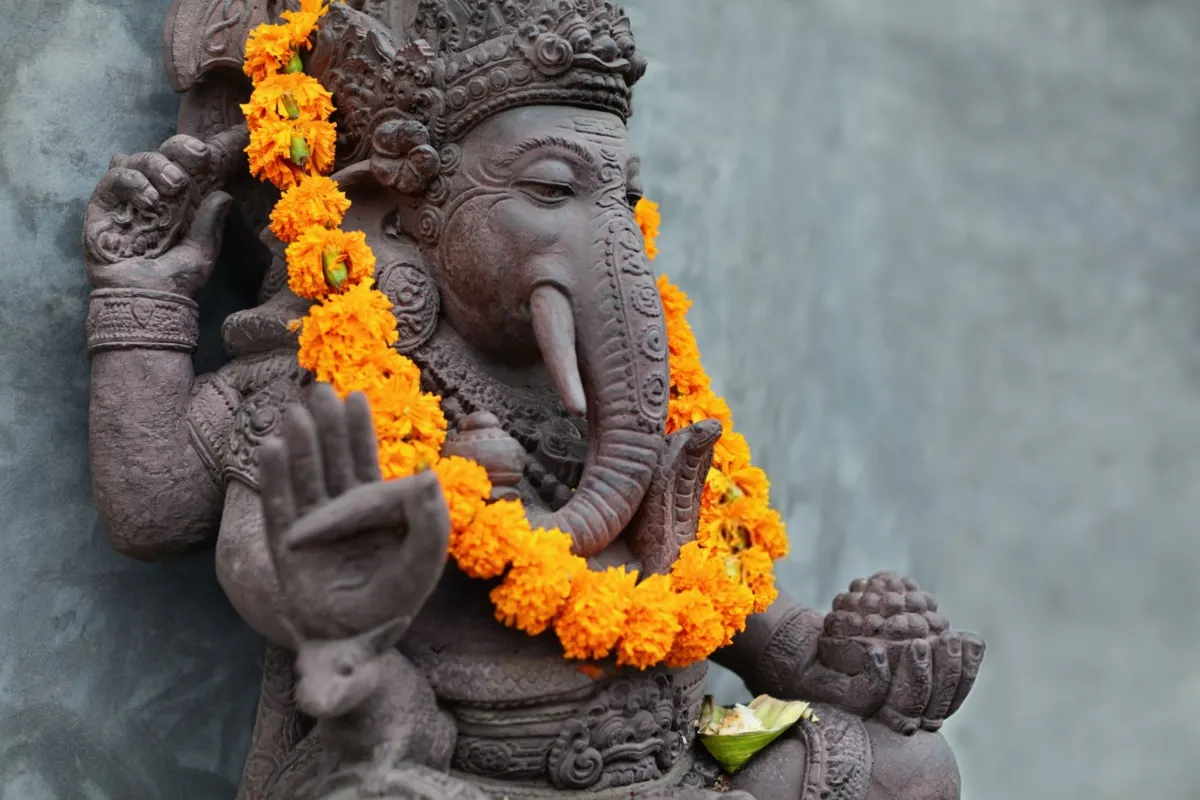
Hinduism accounted for approximately 14.9% of the world's population in 2020, making it the third-largest religious group among those affiliated with a religion.
Hinduism developed over thousands of years and encompasses a wide range of philosophical traditions, spiritual practices, and beliefs. Its traditions include different understandings of the divine, karma, reincarnation, and liberation from the cycle of rebirth.
India is home to the vast majority of the world's Hindus, with significant Hindu communities also found in Nepal, Bangladesh, and other countries.
Hinduism's share of the global population remained relatively stable between 2010 and 2020, moving from 15.0% to 14.9%.
4. Buddhism: 4.1% of the World's Population

Buddhism represented approximately 4.1% of the world's population in 2020. Originating in South Asia, Buddhism is associated with the teachings of Siddhartha Gautama, known as the Buddha.
Buddhist traditions emphasize subjects such as suffering, impermanence, ethical conduct, meditation, and the path toward liberation. Major traditions include Theravada, Mahayana, and Vajrayana Buddhism.
Buddhism has a substantial presence in countries such as Thailand, Myanmar, Sri Lanka, Cambodia, Japan, and China, although the way people identify with and practice Buddhism varies widely across regions.
Its share of the global population fell from 4.9% in 2010 to 4.1% in 2020. Pew Research Center attributed this decline to demographic factors and people leaving the religious category in which they were raised.
5. Judaism: Approximately 0.2% of the World's Population

Judaism accounted for approximately 0.2% of the global population in 2020. Despite its relatively small population, Judaism has had a profound influence on world history, ethics, philosophy, and the development of other major religious traditions.
Judaism is rooted in the covenant between God and the Jewish people, the Hebrew Bible, and a long tradition of religious interpretation and practice.
Jewish communities are concentrated primarily in Israel and the United States, with communities in Europe and other parts of the world.
The small percentage of the global population identifying as Jewish does not measure the historical or cultural influence of Judaism. Population size and historical significance are different measures.
6. Other Religions: 2.2% of the World's Population
Approximately 2.2% of the global population belonged to religious groups classified as other religions in the Pew Research Center study.
This category includes a diverse range of traditions, such as Sikhism, Jainism, the Bahá'í Faith, Shinto, Taoism, Zoroastrianism, and various Indigenous and folk religions.
These traditions differ considerably in their histories, beliefs, rituals, and understandings of the spiritual world. Some have millions of adherents, while others are practiced by relatively small communities.
The 2.2% figure represents the combined category rather than the individual share of each religion. It would therefore be misleading to treat all these traditions as one unified belief system.
7. No Religious Affiliation: 24.2% of the World's Population
One of the most notable findings is that 24.2% of the world's population did not identify with any religious group in 2020.
This category includes atheists, agnostics, and people who describe themselves as having no particular religion. However, not everyone without a religious affiliation rejects the existence of God or believes that life has no spiritual dimension.
Some people maintain personal spiritual beliefs without belonging to an organized religion. Others identify as atheist or agnostic, while some simply do not consider religion an important part of their identity.
The unaffiliated share of the world's population increased from 23.3% in 2010 to 24.2% in 2020. Pew Research Center found that people leaving religious affiliations, particularly Christianity, contributed to this change.
The growth of the unaffiliated population is especially significant because it shows that the global religious landscape is not defined only by competition among established religions. Changes in personal identity and the decision not to belong to a religion also play an important role.
How Has the Global Religious Landscape Changed?
Comparing the 2010 and 2020 estimates reveals several important demographic trends.
| Religious group | 2010 | 2020 | Change |
|---|---|---|---|
| Christianity | 30.6% | 28.8% | -1.8 percentage points |
| Islam | 23.9% | 25.6% | +1.7 percentage points |
| Hinduism | 15.0% | 14.9% | -0.1 percentage points |
| Buddhism | 4.9% | 4.1% | -0.8 percentage points |
| Judaism | 0.2% | 0.2% | Approximately stable |
| Other religions | 2.2% | 2.2% | Approximately stable |
| No religious affiliation | 23.3% | 24.2% | +0.9 percentage points |
Source: Pew Research Center. Changes are calculated from rounded published estimates.
The figures highlight three major developments.
Islam's share increased. Muslims experienced the largest increase in their share of the global population among the major religious groups studied.
Christianity's share declined. Although the number of Christians grew, it did not keep pace with the overall growth of the world's population.
Religious disaffiliation increased. More people identified as having no religious affiliation, reflecting a combination of changes in personal identity and demographic patterns.
These trends should be interpreted carefully. They describe changes over a specific decade and do not guarantee that the same rates of change will continue in the future.
Does the Number of Followers Determine Which Religion Is True?
The number of people who follow a religion is a demographic measure, not a test of its truth.
A religion may have billions of adherents because of historical developments, family traditions, cultural identity, missionary activity, population growth, and other factors. None of these factors, on its own, proves or disproves its central claims.
Evaluating religious truth requires a different approach. Historical research can examine the origins of religious texts and the lives of historical figures. Philosophy can explore arguments about God, morality, consciousness, and the meaning of life. Scientific evidence can assess claims about the natural world when those claims are testable.
Other questions, such as the existence of a supernatural reality or the ultimate meaning of human life, involve philosophical and theological arguments that cannot be settled simply by counting believers.
A careful comparison of religions should therefore distinguish between what people believe, why they believe it, what historical evidence supports particular claims, and which questions remain matters of philosophical debate.
Frequently Asked Questions
What is the largest religion in the world?
Christianity is the world's largest religious group, representing approximately 28.8% of the global population in 2020, according to Pew Research Center.
What percentage of the world is Muslim?
Approximately 25.6% of the world's population identified as Muslim in 2020, making Islam the world's second-largest religious group.
What percentage of people in the world have no religion?
Approximately 24.2% of the global population had no religious affiliation in 2020. This category includes atheists, agnostics, and people who do not identify with a particular religion, including some who still hold spiritual beliefs.
How many people follow Hinduism?
Hindus accounted for approximately 14.9% of the world's population in 2020, making Hinduism the third-largest religious group by population.
Is Buddhism growing or declining worldwide?
Buddhism's share of the global population declined from 4.9% in 2010 to 4.1% in 2020. Pew Research Center also found that the number of Buddhists worldwide decreased during this period.
Are religious affiliation and belief the same thing?
No. Religious affiliation describes the group with which a person identifies, while belief concerns what that person actually accepts as true. Someone may identify with a religion culturally without accepting all its teachings, while a person without religious affiliation may still believe in God or a spiritual reality.
What is the most reliable source for global religious statistics?
Pew Research Center's 2025 report, How the Global Religious Landscape Changed From 2010 to 2020, is a major source for these comparisons. It draws on more than 2,700 censuses, surveys, and other demographic sources and provides estimates for 201 countries and territories.