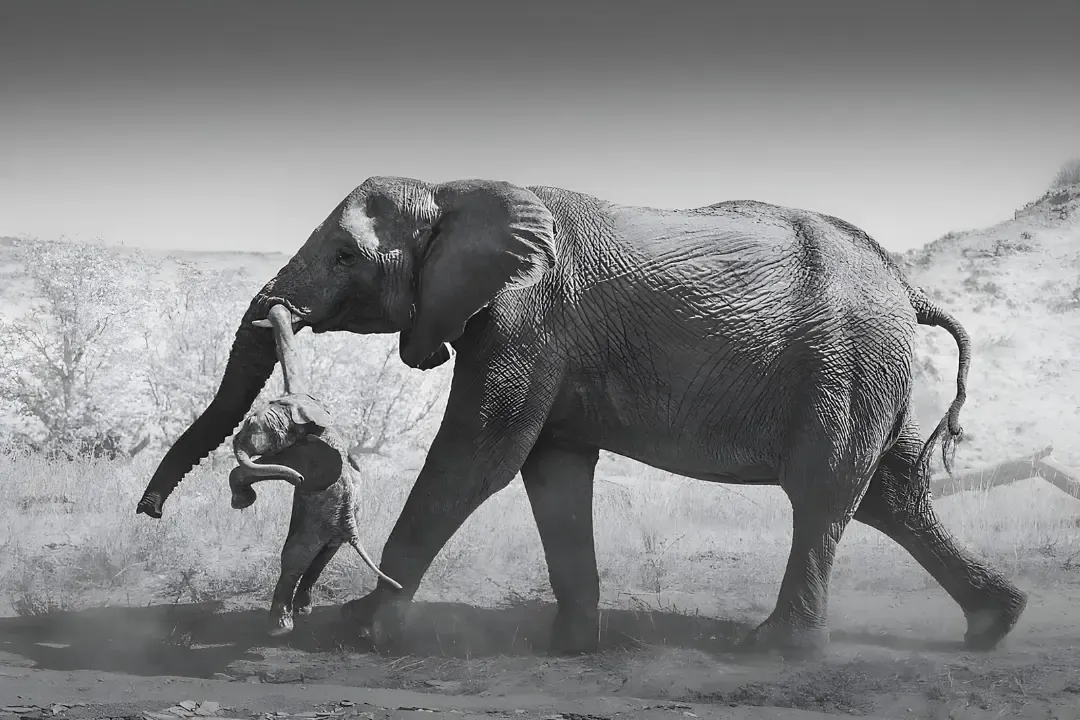

A female desert elephant carried a dead newborn calf with her trunk for hours in Namibia’s Namib Desert. The rare behavior has raised fascinating questions about elephant emotions, grief, and how animals cope with loss.
Wildlife photographer Federico Veronesi captured the extraordinary scene in September 2025 while following a herd of elephants through a dry riverbed in Namibia. The photograph later won the top prize in the 2026 Wildlife Photographer of the Year competition, organized by London’s Natural History Museum.
Read More

As the elephants moved along the dry riverbed, Veronesi noticed a female carrying a tiny, lifeless calf with her trunk. The newborn’s small legs were wrapped around the trunk, while its body hung suspended in the air.
Veronesi described the moment as deeply intimate, almost spiritual.
“The calf’s body was completely intact and still soft. It hadn’t stiffened yet, which suggested that the newborn had died the night before or perhaps just a few hours earlier,” he explained.
At first glance, the scene appeared to show a mother grieving for her lost baby. But as Veronesi continued observing the herd, he realized that the behavior held an even more surprising significance.
A Rare Behavior That Left a Wildlife Photographer Speechless
Veronesi followed the herd for several hours, capturing a series of remarkable photographs. Throughout that time, the female continued carrying the dead calf along the Huab River.
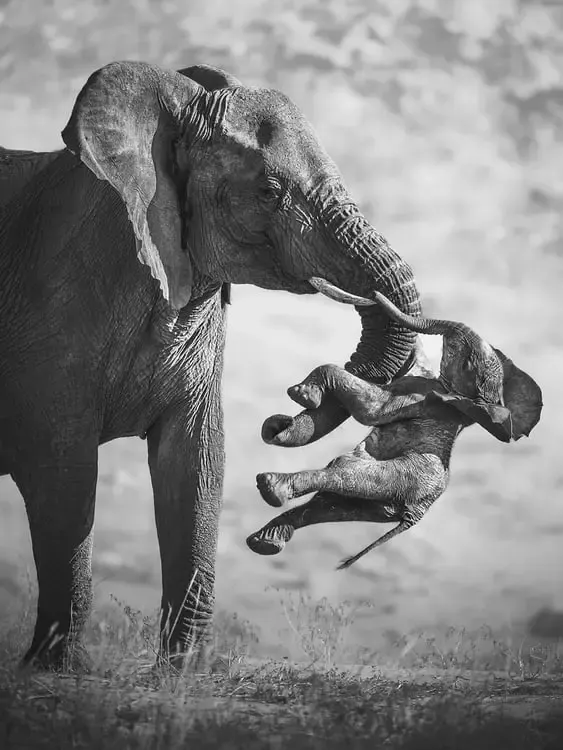
Occasionally, she placed the calf on the ground so she could eat or drink. Then she would pick it up again and continue moving along the riverbed.
The sight was both heartbreaking and difficult to look away from.
“I remember thinking how sad the scene was, but also that people needed to see it,” Veronesi said. “The photograph shows how much elephants can suffer and how complex their emotions may be — feelings that people don't always associate with animals.”
For the photographer, the encounter offered a rare glimpse into the emotional lives of elephants and challenged the way people think about animal behavior.
But there was another unexpected discovery that made the story even more poignant.
The Female Elephant Was Not the Calf’s Mother
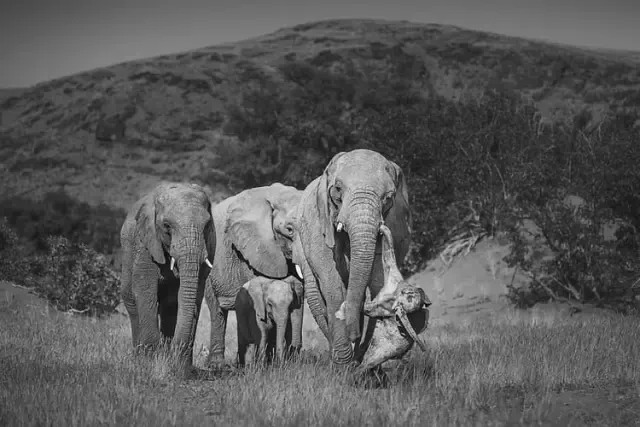
After the encounter, Veronesi learned that the female carrying the dead newborn was not its biological mother.
Christine Winter, conservation program manager at the nonprofit Elephant-Human Relations Aid (EHRA), which works to protect Namibia’s desert-adapted elephants, confirmed the discovery.
The female elephant is now 14 years old. Two years earlier, she had lost a calf of her own.
According to Winter, the elephant has since been observed carrying dead calves belonging to other females on four separate occasions. Researchers believe this is the first time the behavior has been documented in this region.
For Veronesi, that detail added another layer of sadness to an already emotional encounter.
“The fact that she started doing this after losing her own calf makes the story even more heartbreaking,” he said. “It almost seems as though she is trying to reconnect with her baby, as if she still hasn't been able to let go, even years later.”
Whether that interpretation reflects what the elephant is actually experiencing remains unknown. Still, her repeated behavior has prompted researchers to consider how past experiences might influence the way elephants respond to death.
Why Would an Elephant Carry a Dead Calf?
Scientists have documented elephants showing unusual interest in dead members of their species, but the reasons behind these behaviors are not fully understood.
Winter believes carrying a dead calf could be part of an emotional process that helps an elephant respond to loss.
“Perhaps this is a way for her to cope with death, or perhaps she simply cannot let go,” Winter suggested. “Losing her own calf may have affected her deeply, and that could be why she repeats this behavior whenever another calf dies.”
Another possibility is that the female is attempting to protect the dead calf’s body from predators.
Researchers cannot yet determine which explanation, if any, is correct. The behavior may have several causes, and scientists still have much to learn about how elephants perceive death and respond to it.
What makes this particular elephant remarkable is that she has displayed the same behavior repeatedly, rather than only during a single encounter.
Namibia’s Remarkable Desert Elephants
Veronesi’s photographs also offer a glimpse into the lives of Namibia’s desert-adapted elephants, a population of roughly 150 animals that survives in one of Africa’s harshest environments.
These elephants move across the Namib Desert, traveling long distances along five dry riverbeds in search of food and water. Their diet includes the seed pods of Faidherbia albida trees and grasses growing on floodplains.
Despite their unusual lifestyle, Namibia’s desert elephants are not considered a separate elephant species. Instead, they are a population of African savanna elephants that has adapted to extreme environmental conditions.
Much of this adaptation involves learned behavior, including knowledge passed between generations about where to find water and food in an arid landscape.
Namibia’s desert-adapted lions, which survive along the Skeleton Coast, provide another example of large mammals developing distinctive behaviors in response to challenging environmental conditions.
For these elephants, survival depends on more than physical strength. Experience, memory, and knowledge of the landscape can be essential to finding the resources they need.
Do Elephants Grieve for Their Dead?
The photograph also raises a bigger question: Do elephants experience grief?
Joyce Poole, a leading expert on African savanna elephants and co-founder of the nonprofit ElephantVoices, described Veronesi’s images as deeply moving.
Poole has witnessed similar behavior firsthand. In Kenya, she observed a mother elephant responding to the death of her own calf.
“The mother did not carry her baby, but she tried to lift it,” Poole recalled. “She then stood beside the body for two days, protecting it.”
Such observations are part of a growing body of evidence suggesting that elephants respond to death in ways that resemble mourning.
Researchers have observed elephants visiting the remains of deceased family members and even unfamiliar elephants. They may touch bones with their trunks, linger beside bodies, or repeatedly return to the remains.
These behaviors do not prove that elephants experience grief exactly as humans do. However, they suggest that death can trigger complex and lasting responses in these highly social animals.
Elephants live in close-knit family groups, maintain long-term social relationships, and rely on one another for protection and survival. Their strong social bonds may help explain why the death of another elephant can prompt such striking behavior.
Scientists are still working to understand what these actions mean from the animals’ perspective.
A Photograph That Challenges How We See Animals
For Veronesi, the female elephant’s behavior was striking because it seemed so familiar.
The image evokes the human experience of loss, even though researchers cannot know precisely what the elephant was feeling.
That emotional connection is part of what makes the photograph so powerful. It encourages viewers to look beyond the physical world of wildlife and consider the possibility that animals experience emotional states far more complex than we once assumed.
The photograph also highlights the importance of studying individual animals, rather than focusing exclusively on protecting entire species or populations.
Veronesi hopes his work will offer people a small window into the inner lives of elephants and encourage greater respect for these remarkable animals.
“Every elephant is a valuable individual who deserves to be understood and protected,” he emphasized. “We should not only protect the species as a whole, but also care about the well-being of every individual elephant.”
In the end, the photograph leaves viewers with a question that science has not yet fully answered: What does an elephant understand about death, and what does it mean when one refuses to leave a dead calf behind?
The answer may take years of research to uncover. But moments like this remind us that the lives of wild animals can hold far more complexity than we can see at first glance.