
The Flashing Red Warning at Serpukhov-15
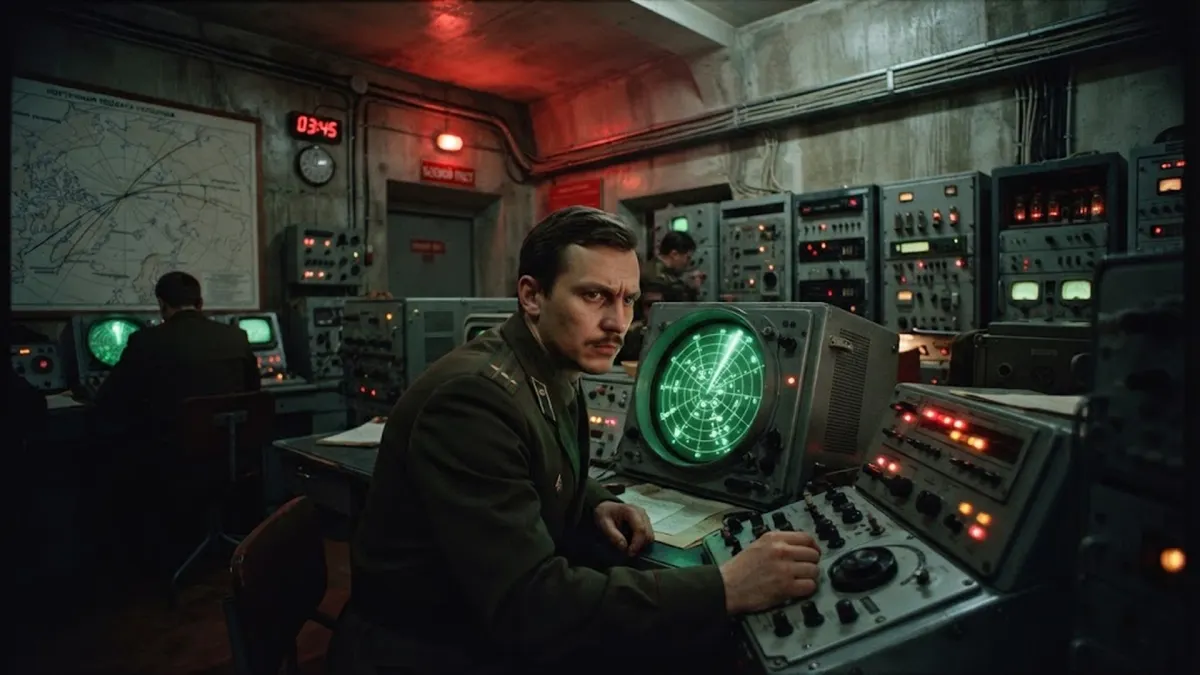
Just past midnight on September 26, 1983, forty-four-year-old Soviet Air Defence lieutenant colonel Stanislav Petrov sat in the commander's chair of a secret concrete bunker hidden in the pine forests outside Moscow. The command bunker, designated Serpukhov-15, monitored the Soviet Union's Oko early-warning satellites parked in Molniya orbits high above the Northern Hemisphere.
At 00:15, the bunker's main electronic wall display suddenly began pulsing blood red. Klaxons shrieked through the subterranean hallways. A massive backlit screen displayed a single Russian word: START (Missile Launch). According to the computerized telemetry, an American Minuteman intercontinental ballistic missile had launched from Malmstrom Air Force Base in Montana, arcing across the Arctic Circle toward the Soviet heartland.
Under Soviet military protocol, Petrov had less than fifteen minutes to authenticate the alert and telephone the General Staff of the Soviet Armed Forces, triggering a full-scale retaliatory nuclear strike. As his duty crew of over one hundred officers and computer technicians stared at him in paralyzed terror, the system flashed four more launches in rapid succession. Five American nuclear warheads were supposedly in flight across the polar ice cap.
The Vasa Disaster: Why Sweden's Mightiest Warship Capsized 20 Minutes into Its Maiden Voyage
The Cold Logic in the Bunker
Petrov held the receiver of the red telephone in his sweating right palm. Soviet military doctrine assumed any American surprise attack would involve a decapitating swarm of hundreds of missiles launched simultaneously to wipe out Soviet silos and command bunkers. A first strike consisting of merely five missiles defied strategic military logic.
"I had a chair, a phone, and twenty-eight different verification checklists," Petrov recounted years later in a declassified interview with military historians. "My subordinates were shouting that the computer had the highest reliability rating possible. But my gut told me that when people start a war, they do not launch five missiles. They launch everything they have."
Petrov picked up the phone, bypassed his immediate commanders, and reported to the duty general on the supreme staff line that the warning was a false alarm. Then, he sat in his chair and watched the bunker's master countdown clock tick down toward zero. If he was wrong, American nuclear warheads would obliterate Moscow in eighteen minutes.

| Warning Parameter | Oko Satellite Reading (1983) | Actual American First Strike Plan | Technical Anomaly |
|---|---|---|---|
| Launch Volume | 5 detected missiles | Over 500 ICBMs simultaneously | Isolated infrared flash points |
| Ground Radar Confirmation | Zero targets on horizon | Over the horizon radar clutter | Ground arrays saw clean empty skies |
| Satellite Sensor Angle | Glancing sun reflection off clouds | Rocket exhaust thermal plumes | High-altitude cloud tops mirrored sun at dawn |
| Decision Window | 12 to 15 minutes to confirm | Instant presidential launch code | Petrov classified alert as system failure |
The Optical Glint of Autumn Clouds
The digital wall clock clicked past zero. Silence hung in the room. No shockwave shook the ceiling tiles, and radar screens along the Arctic coast showed completely clear skies. Petrov slumped back in his chair and lit a cigarette with trembling fingers.
A subsequent high-level investigation revealed a bizarre astronomical coincidence. The Soviet Oko satellite's infrared sensors had aligned at an unprecedented angle with autumn clouds over Montana and the rising sun. Sunbeams bouncing off the tops of high-altitude clouds had struck the satellite's scanning telescope, perfectly mimicking the thermal heat signature of rocket booster engines.
When software engineers reviewed the code, they found that the satellite's filtering algorithms were never tested against high-altitude cloud glint. The satellite mistook sunlight scattering off ice crystals in cirrus clouds for the blazing exhaust plume of rocket motors. Had Petrov followed standard operating procedure, the automated nuclear machine would have carried the planet into World War Three.
The false alarm came at the height of Cold War tensions. Three weeks earlier, Soviet jets had shot down a Korean passenger airliner off Sakhalin Island, killing 269 people. President Reagan called the Soviet Union an evil empire on American television. Soviet intelligence genuinely feared an imminent American first strike, keeping silo commanders on edge.
The Declassified Soviet Inquest
Soviet military investigators acknowledged that Petrov's split-second judgment saved the world, but military officials refused to award him a medal because doing so would publicly expose the fatal engineering flaws in Moscow's prized nuclear satellite network.
The Human Factor in the Machine Age
Petrov was quietly reassigned to a less sensitive administrative post and took early retirement. His actions remained a closely guarded state secret until declassified Soviet military documents came to light in 1998.
"The computers were programmed to detect infrared energy, not human intentions," military intelligence analysts noted. "Had an obedient junior officer been on duty that night following orders by the book, nuclear retaliatory launches would have been authorized before the missiles could be proven fake."

Years later, living quietly on his pension in Fryazino outside Moscow, Petrov shrugged off the praise of Western journalists. He always maintained he was simply an engineer doing his shift. He knew machines fail, and that a computer should never be given the authority to destroy the world.
He lived out his retirement on a pension of two hundred dollars a month, growing potatoes on a small plot of land and receiving visits from foreign documentary crews who tracked him down after his story was published in the West. He passed away quietly in May 2017 at the age of seventy-seven, remembered by historians as the man who saved the world by doing nothing.
Cold War Takeaway
Stanislav Petrov's refusal to push the button remains the starkest reminder in history that no automated defense algorithm can replace human skepticism and moral restraint.