
What Luxury Perfume Is Really Made Of (and the $10,000 Floating Ocean Secret)
Every morning on my walk past the cosmetics counters at Saks Fifth Avenue in Chicago, you can smell the mist from thirty feet away. Sales reps in black blazers spray test strips of Chanel and Dior, sending clouds of bergamot, orange blossom, and vanilla drifting through the revolving doors. Women happily drop two hundred and fifty bucks for three ounces of scented liquid without blinking.
Most folks figure perfume is just crushed rose petals steeped in alcohol with a fancy French label stuck on the glass. But step into a formulation workshop and ask an experienced nose what actually goes into that bottle, and you get an eye-opening answer. Real perfume making is a gritty collision of old French farming traditions, high-end organic chemistry, and bizarre animal biology that costs more per pound than pure gold.
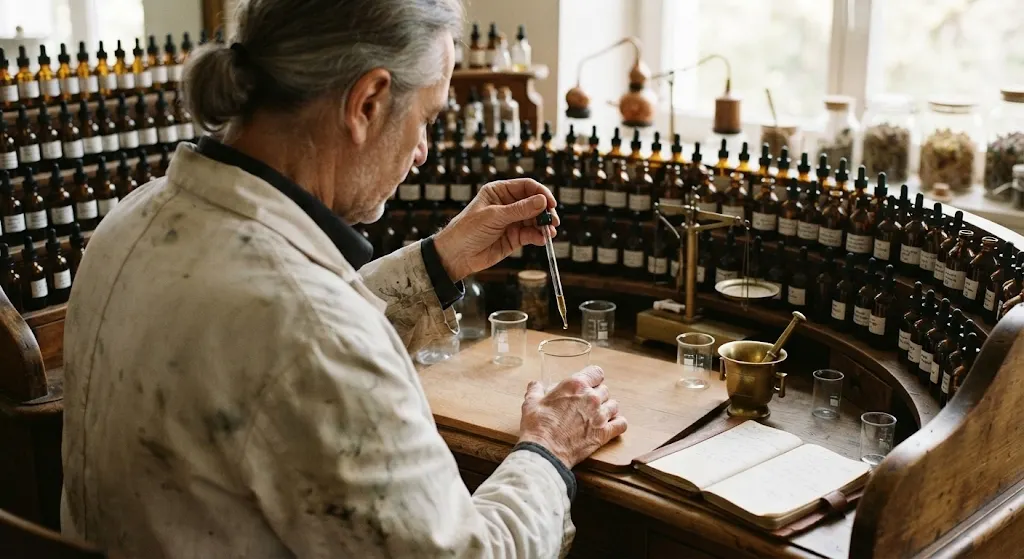
A veteran fragrance chemist named Marc Laurent, who spent thirty-one years formulating scents between Grasse and Manhattan, showed me his workbench on a rainy Thursday afternoon. Marc sat in front of what perfumers call their organ: a curved wooden desk packed with eight hundred amber glass dropper bottles filled with essential oils, floral absolutes, and thick plant gums.
"People buy fantasy, memory, and romance," Marc told me while unscrewing a tiny glass vial. "Commercials show glamorous actresses running through fields in evening gowns. But real perfumery is hardcore organic chemistry and painstaking manual labor. That little bottle sitting on your dresser required tons of hand-harvested petals and ingredients from the bottom of the ocean."
What Is Lipstick Made Of? The Key Ingredients Behind Your Favorite Lip Color
The 5:00 AM Flower Pickers in Grasse
Marc tapped a half-ounce vial of dark honey-colored oil labeled Jasmine Grandiflorum. That little bottle alone cost fourteen hundred dollars to produce.
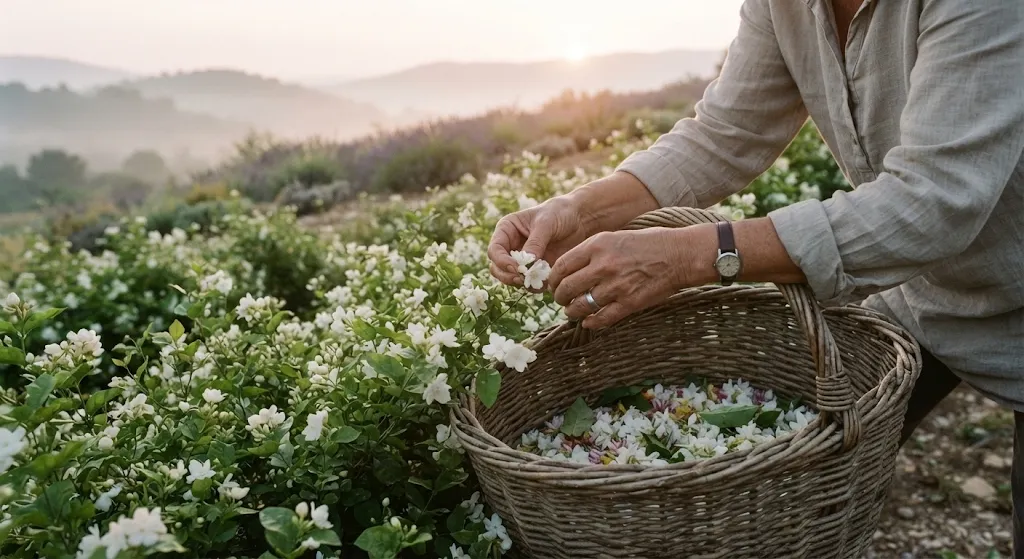
"Delicate flowers don't yield oil through simple boiling," Marc told me. "Take jasmine grown in the valleys around Grasse in southern France. Pickers have to bend over every bush by hand between five in the morning and nine sharp. As soon as the morning sun climbs over the hills and heats up the petals, the volatile aromatic oils burn right off into the air."
Centuries ago, French perfumers extracted those delicate flower oils using enfleurage. Workers coated wooden-framed glass panes with sheets of purified animal fat, pressed hundreds of fresh jasmine blossoms into the grease by hand, and swapped the wilted petals for fresh ones every single day for three months until the fat smelled like pure flower gardens.
"Today, we wash the petals with volatile chemical solvents in giant stainless steel vats," Marc explained. "The solvent evaporates away, leaving behind a waxy floral paste called concrete. We wash that paste with pure alcohol to get the absolute. It takes eight thousand hand-plucked jasmine blossoms just to make one tiny drop of pure absolute."
The Floating Gold Born in a Whale Gut
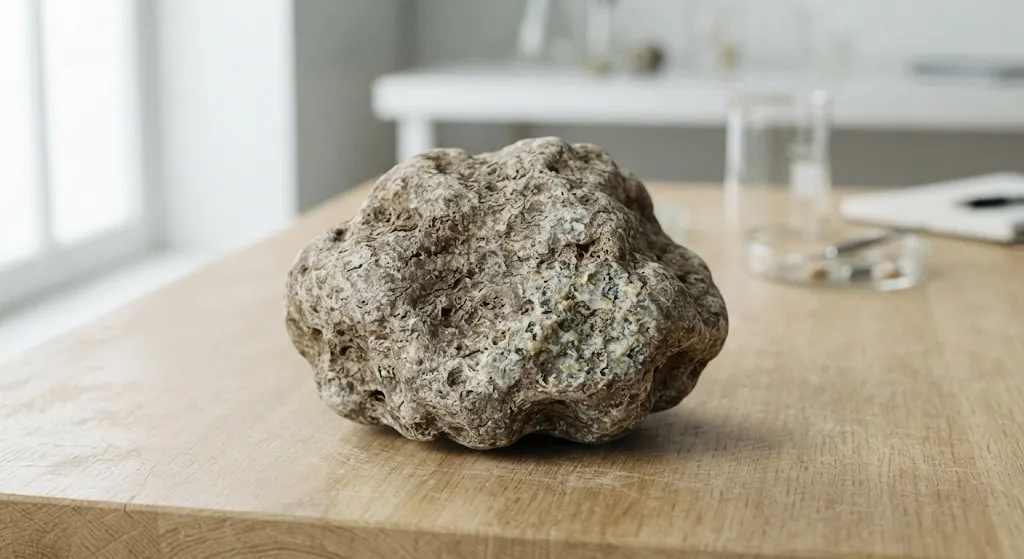
Marc reached into a locked metal cabinet under his sink, brought out an old wooden cigar box, and placed a dry, greyish-white lump on the table. It looked like a crusty piece of dried pumice stone you might find on a beach, but the smell coming off it was extraordinary. It smelled like warm musk, sweet tobacco, damp earth, and ocean salt all rolled into one.
"This is authentic ocean ambergris," Marc said quietly. "In the trade, people call it floating gold. This five-pound rock right here would easily fetch twenty-five thousand dollars at an auction house."
Ambergris starts its life thousands of feet under the sea inside the stomach of a sperm whale. Whales dive deep to hunt giant squid, gobbling up hundreds of pounds of squid every single day. While the fleshy meat digests easily, squid have sharp, hard parrot-like beaks that can slice right through the whale's stomach lining. To stop internal bleeding, the whale's digestive tract secretes a thick, waxy, cholesterol-loaded bile to wrap around the sharp beaks like a soft protective blanket.
"Eventually, the whale passes the waxy lump out into the sea," Marc said. "Fresh out of the whale, it is black, soft, and smells awful. But the lump floats. For ten, twenty, sometimes thirty years, that ball of whale bile drifts across the open ocean, getting baked by blistering equatorial sun and cured by salt spray."
Decades of sun and salt oxidize the fatty chemicals, turning the foul bile into a rock-hard, silver-grey substance that perfumers have fought over for five hundred years.
| Perfume Category | Pure Fragrance Oil | Alcohol Solvent Base | Real Skin Wear Time |
|---|---|---|---|
| Eau de Cologne | 2% to 4% pure oil | High alcohol (96%) | 1 to 2 hours |
| Eau de Toilette (EDT) | 5% to 15% pure oil | Medium alcohol (85%) | 3 to 5 hours |
| Eau de Parfum (EDP) | 15% to 20% pure oil | Balanced alcohol (80%) | 6 to 8 hours |
| Pure Parfum / Extrait | 20% to 30% pure oil | Low alcohol (70%) | 10 to 14+ hours |
Why Cheap Scents Vanish in Forty Minutes
I asked Marc why expensive perfume brands bother hunting down crazy marine secretions when fresh flowers already smell gorgeous on their own.
"Because pure flower oils have a massive physical flaw," Marc told me. "Floral scents are made of tiny, lightweight molecules called terpenes. When you spray pure rose or orange blossom on warm skin, your ninety-eight-degree body heat literally boils those light molecules away within forty minutes. Poof, your scent is gone."
To keep the fragrance on skin all day, perfumers need what the industry calls a fixative. A fixative is a heavy, dense chemical molecule that acts like an invisible fishing net. It grabs onto the light, flighty flower molecules and holds them against your skin oils, forcing them to evaporate slowly over ten or twelve hours.
"Ambergris contains an active compound called ambrein," Marc pointed out. "When ambrein ages in the ocean, it breaks down into ambroxan. Ambroxan clings to skin like glue. Today, because sperm whales are rightfully protected from hunting, chemical labs synthesize ambroxan from clary sage plants. It gives expensive modern fragrances that warm, skin-like glow that still clings to your wool sweater three days after a party."
The Three-Act Play on Your Wrist
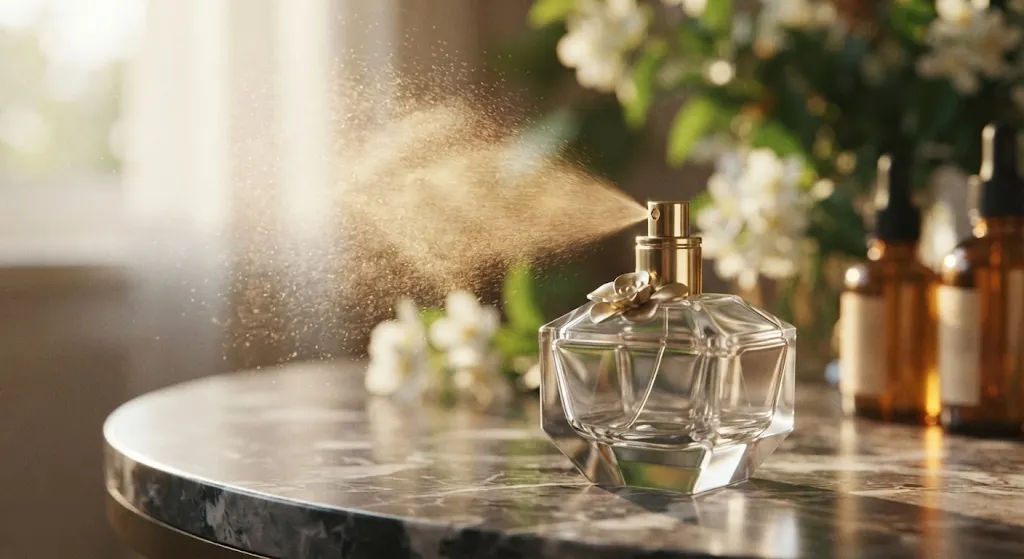
Marc picked up an atomizer bottle, sprayed a strip of white blotter paper, and waved it through the air before handing it to me.
"Every high-end fragrance is constructed like a three-act theater play," Marc explained. "Act one is the top note. These are tiny, hyper-volatile molecules like lemon peel, pink pepper, or green apple. They burst out of the spray nozzle to give you an instant rush of brightness at the department store counter. But fifteen minutes later, they are completely gone."
"Act two is the heart note," Marc continued. "This is the real soul of the perfume: lavender, geranium, cinnamon, or rose. It takes twenty minutes to wake up as your body warmth activates the oil, and it carries the scent through your afternoon work meetings."
"Act three is the base note. These are the heaviest, slowest-moving molecules in the formula: vanilla beans, smoky vetiver grass, cedarwood, and musks. They stick to your skin until bedtime."
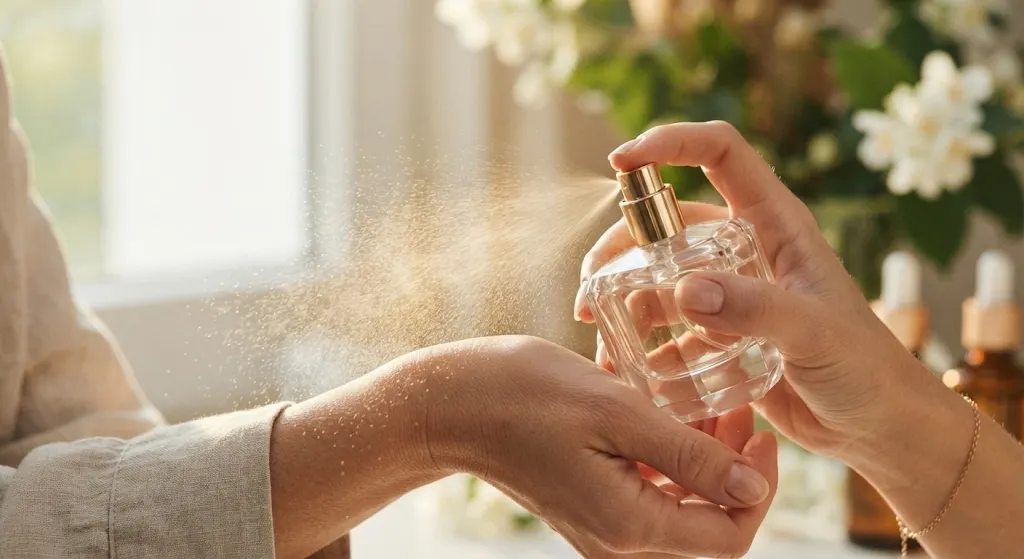
Master Perfumer's Golden Rule: Always spray fine fragrance onto hydrated, lotion-free pulse points and let it air-dry naturally. Friction from rubbing your wrists generates instantaneous heat that physically crushes and shears delicate floral top notes, stripping away the brightest fifteen minutes of the scent profile.
The Common Habit That Ruins Your Scent
As I packed up my notebook to leave the lab, Marc stopped me and pointed to his wrists with a grin.
"Here is the single biggest mistake people make every single day," Marc warned. "People spray their wrists and immediately rub them together furiously. Never rub your wrists. Rubbing generates instant friction heat that literally shears and crushes the delicate top-note molecules before they have a chance to bloom naturally in the air."
"Just spray your pulse points—the warm spots on your neck, your chest, and your inner wrists—and let the mist air-dry on its own," Marc said. "Your natural pulse radiates gentle body heat that lets the fragrance pyramid open up layer by layer, exactly the way the perfumer designed it."
The next time you spray on a cloud of your favorite perfume before walking out the front door, remember what is in that glass bottle. You are wearing centuries of French flower harvests, brilliant chemical physics, and a pinch of floating treasure from the deep blue sea.