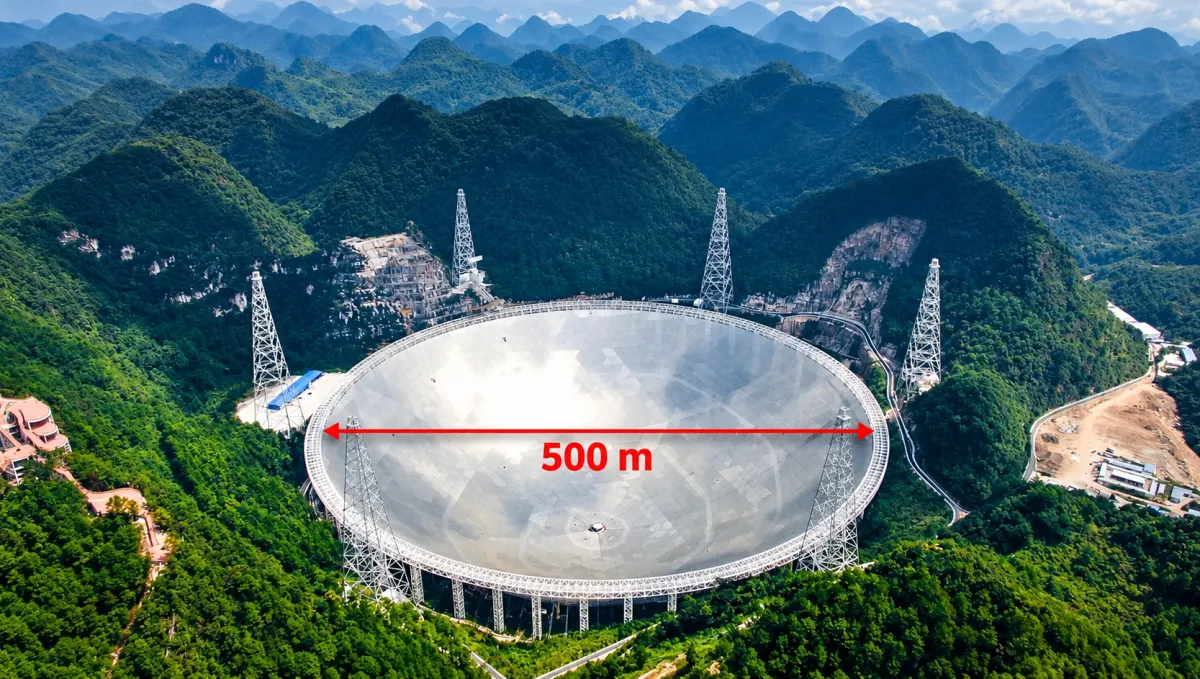

Deep inside the forest-covered mountains of southwestern China, an enormous silver dish stretches across a natural valley. Measuring 500 meters in diameter, it is so large that its construction required years of geological surveys, extensive road building, and thousands of carefully installed components.
This is the Five-hundred-meter Aperture Spherical Telescope, better known as FAST. Often called the Eye of Heaven, it is one of the most remarkable scientific engineering projects ever built.
Read More

But FAST is not designed to take ordinary photographs of distant galaxies. Instead, it listens to the universe, collecting faint radio signals from objects millions or even billions of light-years away. Those signals help astronomers investigate some of the most mysterious objects and processes in space.
How did China build such an enormous instrument in a remote mountain valley? Why was choosing its location so difficult? And what can a giant metal dish tell us about the universe?
The answers reveal a story that began decades before the telescope detected its first signals.
Why Scientists Needed a Giant Radio Telescope
In 1993, scientists and astronomers gathered in Kyoto, Japan, to discuss a growing challenge in astronomy: radio interference caused by the increasing use of radio communications around the world.
Radio telescopes collect extremely weak signals from space. As human-made radio transmissions become more widespread, distinguishing these signals from interference becomes increasingly challenging.
Chinese scientists attending the meeting recognized the importance of protecting the ability to study the radio universe. The idea of building an exceptionally powerful radio telescope became an ambitious scientific goal.
China wanted to create an observatory capable of detecting signals that smaller instruments might struggle to observe. The project also offered an opportunity to develop advanced engineering capabilities and establish the country as a major contributor to astronomical research.
The proposal eventually led to FAST, a radio telescope designed around an extraordinary concept: instead of building a conventional dish that measures tens of meters across, why not construct one measuring 500 meters?
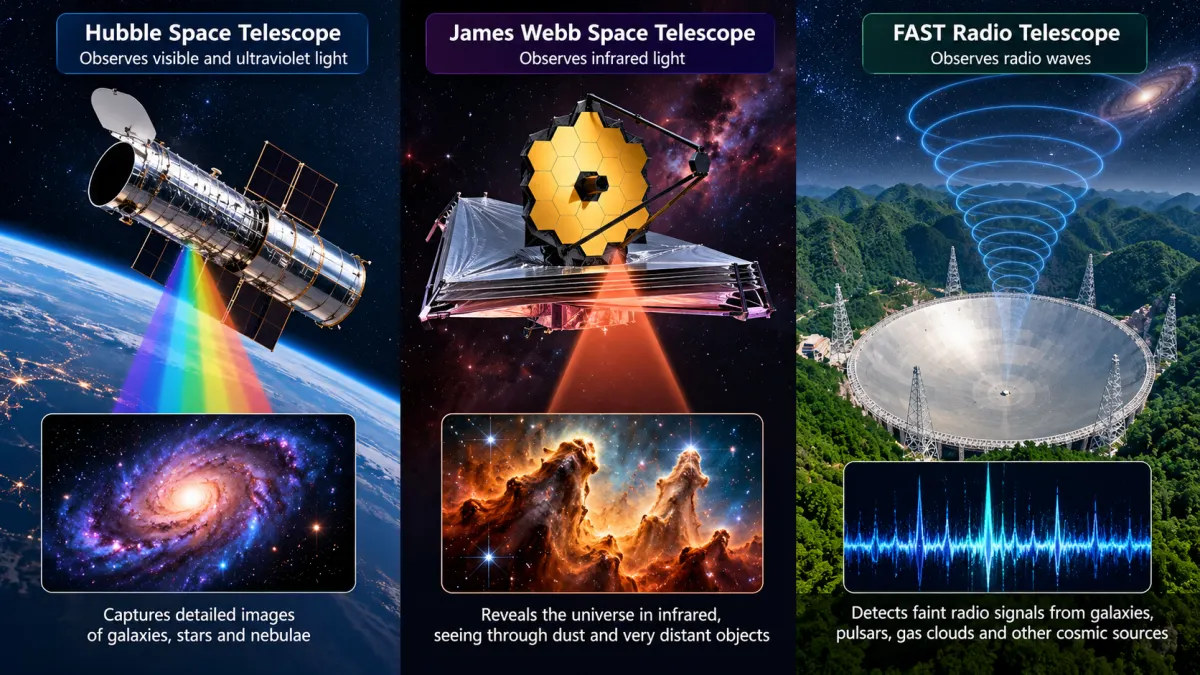
When people hear the word telescope, they often imagine an instrument that captures detailed images of stars, planets, and distant galaxies. Space observatories such as the Hubble Space Telescope and the James Webb Space Telescope use different techniques to observe light from the universe.
Radio telescopes work differently.
Rather than primarily collecting visible light or infrared radiation to create images, they detect radio waves emitted by astronomical objects. These signals carry information about the physical conditions, composition, and behavior of objects that may be difficult to study through visible light alone.
Radio waves can originate from pulsars, gas clouds, galaxies, and other celestial sources. By analyzing them, astronomers can investigate processes that would otherwise remain hidden.
Radio telescopes also have a practical advantage: they can operate during both day and night, provided observing conditions and instrument requirements are suitable. They do not need darkness in the same way that many optical observations do, although radio interference and atmospheric conditions can still affect observations.
FAST was designed to collect exceptionally faint radio signals. Its enormous collecting area gives astronomers a powerful tool for exploring the universe.
Why China Spent Years Searching for the Perfect Location
Building a 500-meter telescope is not simply a matter of choosing an empty piece of land. The surrounding environment, geological stability, accessibility, and radio interference all matter.
Engineers needed a location far enough from major population centers to reduce human-made radio noise. At the same time, the site had to remain accessible to construction crews, equipment, and researchers.
The terrain also had to support an enormous structure without creating unacceptable engineering risks.
A natural valley offered a promising solution. If a suitable depression could be found among the mountains, its shape could accommodate the telescope's enormous dish while reducing the amount of earthmoving required.
But finding the right valley was extraordinarily difficult.
According to the project's development history described in the source material, researchers examined more than 100 potential locations. Some had unstable ground, others presented drainage problems, and some were surrounded by unsuitable terrain.
The search took years because a location that looked promising on a map could prove unsuitable after geological inspection.
Eventually, the team selected a site in Guizhou Province in southwestern China, in a region near the village of Dawodang. The natural depression there provided an unusually suitable setting for the giant observatory.
The surrounding mountains helped separate the telescope from sources of radio interference, while the underlying geology offered a strong foundation for construction.
The choice of location became one of the project's most important engineering decisions.
How Do You Build a 500-Meter Telescope?
The scale of FAST makes its construction difficult to imagine. Its dish spans half a kilometer, yet the structure had to be assembled with sufficient precision to collect and focus radio waves.
The project required substantial groundwork before the telescope itself could take shape.
1. Preparing the Mountain Valley
The construction team first had to prepare the site and establish a stable foundation. Roads were also essential because workers needed to transport construction materials, machinery, and structural components into a remote mountainous region.
Building these access routes was a major undertaking in its own right. The surrounding terrain made transportation difficult, and the project required extensive preparation before the main structure could be assembled.
2. Building the Supporting Structure
The telescope required a strong framework capable of supporting its enormous reflecting surface.
A circular arrangement of support columns and structural components formed the basis of the installation. Engineers then assembled the framework that would hold the dish panels in position.
Every component had to be designed to withstand the demands of a large outdoor scientific instrument.
3. Installing Hundreds of Reflecting Panels
FAST's reflecting surface consists of thousands of triangular panels arranged to form its enormous dish.
These panels work together to collect incoming radio waves and direct them toward the telescope's receiving system. Their positions can be adjusted so that different sections of the reflecting surface contribute to observations.
This is one of the project's most impressive engineering features. FAST does not rely on a single, rigid, perfectly shaped metal plate. Instead, its active reflecting surface can change shape to support different observing configurations.
The installation demanded careful alignment because small errors could affect the telescope's performance.
4. Adding the Receiving System
The dish alone cannot detect radio waves. FAST also needs a system that receives and processes the collected signals.
A sophisticated suspension and support arrangement positions the receiving equipment above the reflecting surface. The system enables the telescope to observe different regions of the sky by changing the configuration of the active surface and receiver.
Together, these systems turn an enormous mountain installation into a highly sensitive scientific instrument.
When Did FAST Begin Operating?
FAST's construction progressed over many years, moving from planning and site selection to groundwork, structural assembly, and the installation of its reflecting surface.
The telescope achieved a major milestone on September 25, 2016, when it was officially completed and began its initial operation phase. It detected its first signals during the commissioning period, marking the beginning of a new chapter in China's astronomical research.
The observatory subsequently entered scientific operations, allowing researchers to use its capabilities to study the radio universe.
Its name, FAST, comes from Five-hundred-meter Aperture Spherical Telescope. In Chinese, the telescope is known as Tianyan, commonly translated as Eye of Heaven.
The name captures the project's central ambition: to extend humanity's ability to observe phenomena that cannot be seen with the naked eye.
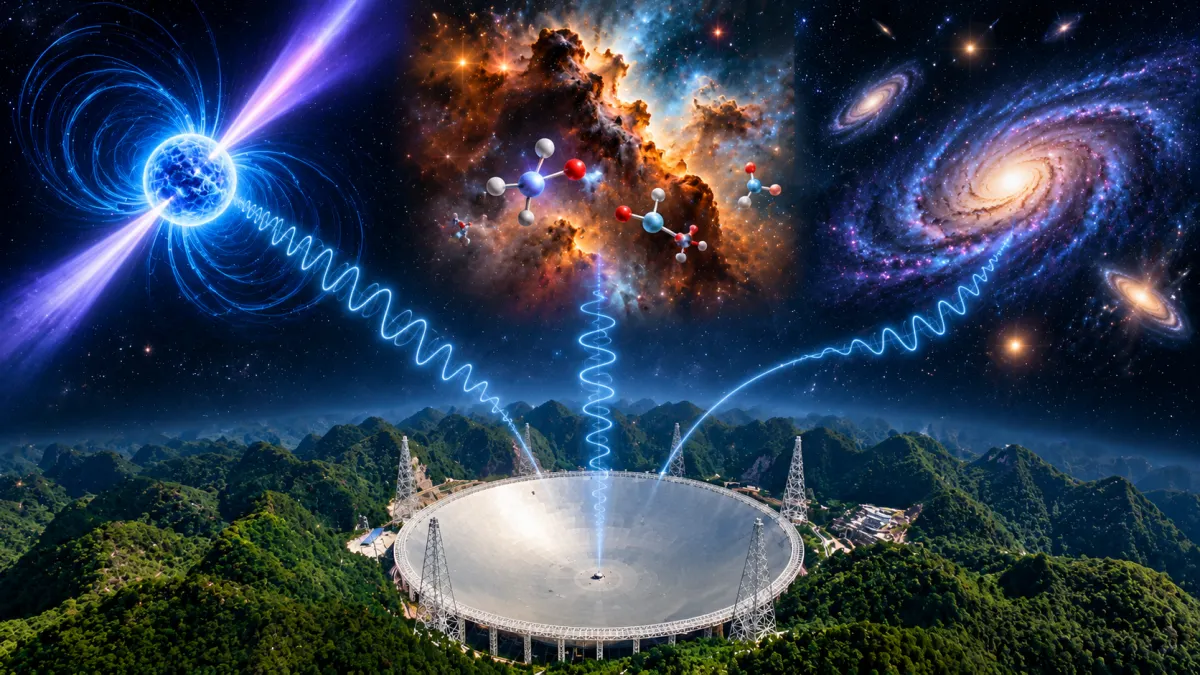
A telescope's importance is not determined by its size alone. What matters is what scientists can learn from the data it collects.
FAST's sensitivity makes it particularly valuable for studying faint radio sources, including pulsars and neutral hydrogen in the universe.
Pulsars: The Remarkable Remains of Dead Stars
Pulsars are rapidly rotating neutron stars that emit beams of radiation. They often form when massive stars reach the end of their lives and explode as supernovae.
When a pulsar's radiation beam sweeps across Earth, astronomers can detect regular pulses of radio emission. Some pulsars rotate extraordinarily quickly, making their signals useful for studying extreme physics.
Because FAST can detect weak radio signals with great sensitivity, it helps astronomers identify and investigate these objects.
Pulsars can also serve as precise cosmic clocks. Studying their timing allows scientists to test theories of gravity, investigate the properties of neutron stars, and explore the behavior of matter under extreme conditions.
Discovering Molecules Between the Stars
Space is not completely empty. Between stars, enormous clouds of gas and dust contain a variety of atoms and molecules.
Radio astronomy allows scientists to detect characteristic signals from certain molecules, providing clues about the chemical composition of these distant environments.
FAST has contributed to research involving interstellar gas and molecular clouds. Such observations help scientists investigate the ingredients from which stars and planetary systems form.
The study of molecules in space is especially important because it reveals how chemical complexity develops under conditions very different from those found on Earth.
Exploring the Structure of the Universe
Radio signals can also reveal the distribution and behavior of matter across vast distances.
By observing hydrogen and other radio-emitting sources, astronomers can study galaxies, gas clouds, and the processes that shape cosmic structures.
These observations contribute to a broader understanding of how galaxies evolve and how the universe has changed over time.
FAST is therefore more than a giant piece of engineering. It is a research instrument that helps scientists investigate fundamental questions about the cosmos.
Is FAST Searching for Aliens?
The idea of a giant telescope listening for signals from space naturally raises a familiar question: Is it searching for extraterrestrial life?
The answer requires an important distinction.
FAST can be used in research related to the search for extraterrestrial intelligence, often called SETI. Such research looks for radio signals that might have characteristics consistent with an artificial origin.
However, detecting radio waves does not automatically mean detecting an alien civilization. Most astronomical radio signals come from natural processes, and researchers must carefully investigate any unusual signal before drawing conclusions.
FAST's main scientific value extends far beyond the search for extraterrestrial intelligence. Its ability to study pulsars, hydrogen, and other radio sources makes it useful for a wide range of astronomical research.
For now, its most important contribution is helping scientists examine the universe with unprecedented sensitivity.
Why FAST Matters Beyond Its Enormous Size
FAST demonstrates how geography, engineering, and scientific ambition can come together to create a major research facility.
Its location in a natural mountain depression made it possible to build a reflecting surface on a scale that would be difficult to accommodate in many other environments. Its active dish design allows scientists to adapt the reflecting surface for observations, while its sensitive receiving equipment helps capture faint signals from distant objects.
The project also illustrates how modern astronomy depends on international scientific collaboration. Researchers from different countries can contribute to observations and studies, helping turn the data collected by a single instrument into a broader body of scientific knowledge.
Most importantly, FAST allows astronomers to investigate questions that cannot be answered by looking at visible light alone.
The universe contains phenomena that reveal themselves through radio waves, from rapidly rotating neutron stars to vast clouds of interstellar gas. By collecting these signals, FAST expands the range of evidence scientists can use to understand the cosmos.
The Future of the World's Giant Radio Telescope
The universe continues to produce signals that astronomers have yet to fully understand. Every improvement in sensitivity gives researchers another opportunity to investigate faint or previously undetected objects.
FAST is particularly well suited to this task because of its enormous collecting area and adaptable reflecting surface.
As researchers develop better observing techniques and data-processing methods, the telescope can continue contributing to studies of pulsars, interstellar matter, and the large-scale structure of the universe.
Its greatest achievement may not be any single discovery. Instead, it is the creation of a powerful scientific tool that enables many different discoveries over time.
Hidden among the mountains of southwestern China, FAST offers a striking reminder that some of the most ambitious efforts to understand the universe begin with a simple idea: listen carefully to what space is trying to tell us.