
The Drumming Salt Flats Along the Diamantina
I was camping with my brother Mark in an old canvas wall tent on the dry salt flats near the mouth of the Diamantina River back in August 2004. Out in the Simpson Desert, when the late afternoon sun slips beneath the red spinifex dunes, the temperature drops from thirty degrees down to near freezing before you can finish boiling a kettle of water on eucalyptus coals.
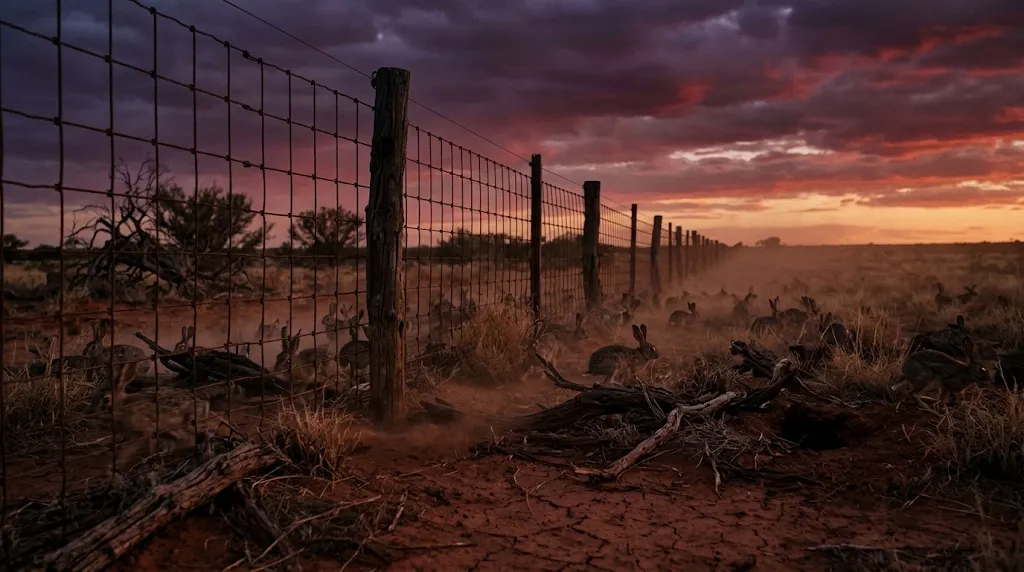
Around ten o'clock at night, while sitting on folding camp stools wrapped in wool blankets, I felt a faint, steady shudder through the soles of my leather boots. It was not a tremor in the earth crust. The stars overhead were steady and clear, and our tin mugs on the wooden camp table did not rattle. It was a rapid, muffled drumming against the hard claypan, sounding like hundreds of little felt mallets striking the hard ground in steady rhythm.
Tiny Bleed Holes and Oval Panes: How a 1954 Jet Crash Changed Commercial Flight
The Fatal October Morning at Barwon Park
I switched on a six-volt halogen flashlight and walked forty paces out past our guy ropes into the dark saltbush scrub. When the yellow beam cut across the red claypan, the ground seemed to ripple like running water.
Thousands of wild grey rabbits were streaming across the desert plain. They were moving steadily northwest, slipping through the saltbush clumps and dry acacia scrub toward an artesian cattle bore eight miles away. Anyone who has worked livestock or driven cattle trucks through rural Australia knows that sight. For over one hundred and sixty years, the European wild rabbit has been the most destructive, expensive pest to ever set foot on the continent.
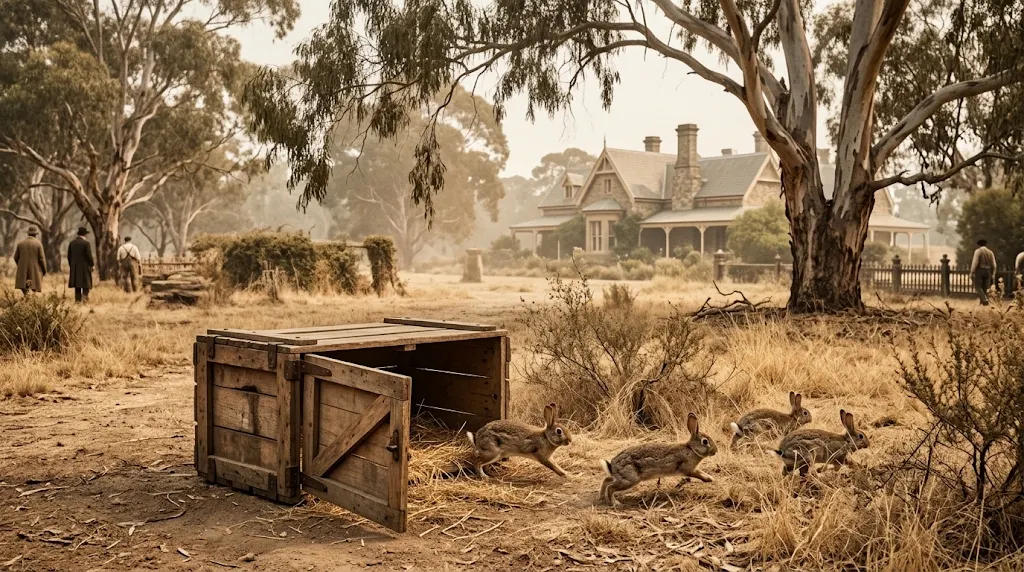
The story started on an overcast Tuesday morning in October 1859, when an English immigrant named Thomas Austin stood on the manicured lawn of his estate at Barwon Park near Geelong, Victoria. Austin was a wealthy landowner who spent his boyhood hunting hares and partridges on the rolling green chalk hills of Somerset. Finding the quiet eucalyptus bush dull and lacking sporting game, he asked his nephew William in England to buy wild grey rabbits from local gamekeepers and send them out on the clipper ship Lightning.
When the wooden crates were carried onto the estate lawn, Austin took out his pocketknife, cut the hemp bindings, and watched twenty-four wild rabbits hop out onto the lush clover. Austin turned to his estate overseer with a double-barrel shotgun resting in the crook of his arm. "The introduction of a few rabbits could do little harm," Austin remarked cheerfully, "and might provide a touch of home, in addition to a spot of hunting on the weekend."
That casual remark became the most expensive sporting mistake in human history. Within a decade of Austin opening those crates, rabbits had colonized every sheep paddock in Victoria. By 1880, they crossed the Murray River into New South Wales. By 1895, they had swept across the red sands of the Nullarbor into Western Australia, advancing across the continent at more than seventy miles each year. It remains the fastest territorial conquest by any colonizing mammal ever measured by science.
| Era & Milestone | Estimated Population | Control Intervention Applied | Long-Term Environmental Consequence |
|---|---|---|---|
| 1859 (Barwon Estate) | 24 initial breeding hares | Recreational hunting & estate gamekeepers | Explosive invasion across Victorian grasslands |
| 1901–1907 (Outback) | Over 100 million individuals | 1,139-mile No. 1 Rabbit-Proof Netting Fence | Rabbits breached barriers before construction finished |
| 1950 (CSIRO trials) | Hundreds of millions | Mosquito-vectored Myxoma viral release | Initial 99% reduction followed by genetic resistance |
Why Australia Was an Evolutionary Eden
Why did Australia surrender so quickly to an animal that had lived harmlessly in European woods for thousands of years?
In Great Britain, rabbits had to dodge an army of native predators. Foxes, stoats, weasels, martens, owls, and hunting eagles hunted them around the clock. More importantly, wet, freezing British winters killed off nearly half of every autumn litter before the young rabbits were old enough to dig burrows.
Australia, by contrast, had none of those natural brakes. The red inland soils were soft and easy to dig. Winters were mild, and perennial grasses grew thick after summer rains. Aside from wedge-tailed eagles and dingoes, nothing in the Australian wilderness was equipped to keep up with the reproductive speed of a European doe.
A doe can conceive at five months of age. She carries her litter for thirty days, gives birth to five or six kittens inside an underground nest, and can mate again the very same afternoon. In the warm sun of the southern hemisphere, a single breeding pair can produce over one hundred and eighty descendants in a single season.
"A single gentleman wanted to shoot game on a Sunday afternoon, and his wooden crate of twenty-four pets permanently changed the geography of an entire continent."
The Destruction of Ancient Topsoil and Native Marsupials
The resulting damage was brutal. Rabbits did not simply graze on grass tips. When the summer heat dried up pasture feed, starving rabbits used their chisel-like front teeth to strip the green bark and living sapwood off young trees.
They dug deep craters into the red dirt to chew the underground root crowns of saltbush and spear grass, completely destroying the living anchor that kept the dry topsoil in place. When hot northerly gales blew across the inland plains, millions of tons of ancient topsoil were lifted into the sky and dumped out into the Pacific Ocean, turning rich grazing properties into barren claypans.
Native wildlife stood no chance. Ground-dwelling marsupials like the greater bilby, the burrowing bettong, and the pig-footed bandicoot were evicted from their burrow networks and starved out of their feeding territories.
Thirteen Hundred Miles of Desert Wire Netting
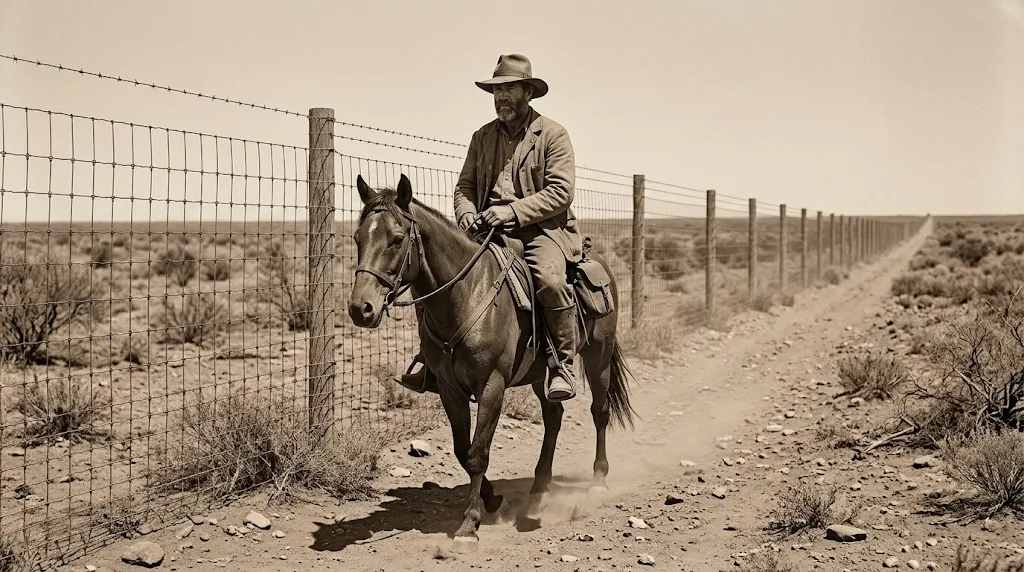
By the turn of the century, pastoralists and colonial governments were panicked. In 1901, the government of Western Australia began constructing the world's longest unbroken fence. Over five grueling years, boundary riders riding camels hauled jarrah posts and galvanized wire netting through more than eleven hundred miles of virgin scrub, stretching from the Southern Ocean to the Indian Ocean in the north.
Yet before the final gates were hung, hungry rabbits had already burrowed beneath the wire netting and appeared on the other side.
Pastoralists fought back with everything they could buy. Trappers set lines of iron gin traps along creek beds. Teams of bullocks dragged heavy steel spikes through rabbit warrens to collapse the underground chambers. Farmers pumped pressurized chloropicrin gas down burrow entrances and threw burning sulfur into holes. They distributed thousands of tons of apple cubes soaked in deadly strychnine.
None of it worked. Wiping out five thousand rabbits on a river flat only opened up fresh pasture for ten thousand more hopping in from the desert the following spring.
The Biological Warfare Experiment
In 1950, government scientists in Melbourne released the Myxoma virus, a mosquito-borne illness that affected only European rabbits. In the first twelve months, the virus was ninety-nine percent fatal, killing hundreds of millions of rabbits and rescuing Australia's wool industry from ruin. But within two decades, surviving rabbits bred genetic immunity, and the rabbit population rebounded once again.
Standing out on that Diamantina claypan with the desert wind rustling the dry saltbush, watching the grey shadows hop across the dunes, you can still see the permanent scars left on the earth. A single gentleman wanted to shoot game on a Sunday afternoon, and his wooden crate of twenty-four pets permanently changed the geography of an entire continent.