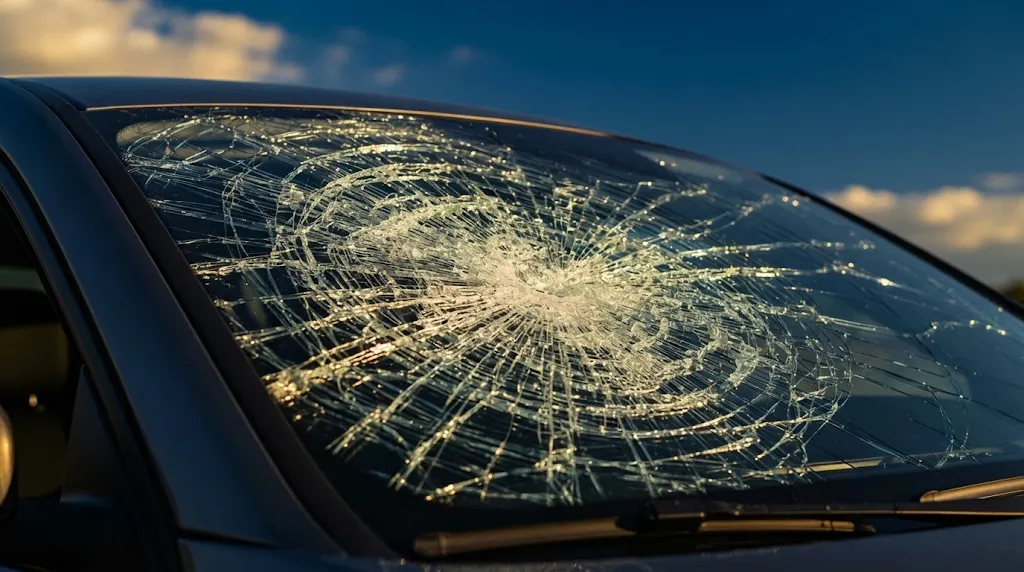

In the earliest days of motoring, collisions routinely turned plate glass windshields into deadly guillotine blades. That changed in November 1903 when a French chemist accidentally knocked a glass flask off a high laboratory shelf—only to watch it shatter into thousands of cracks without losing a single piece.
The Broken Flask That Refused to Fall Apart
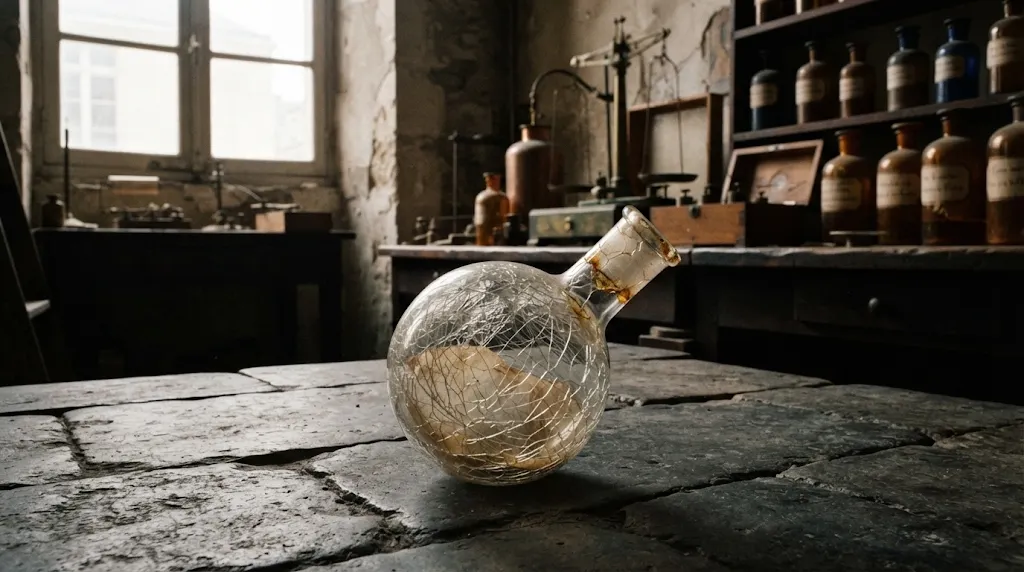
In the autumn of 1903, a French chemist named Edouard Benedictus climbed a wooden library ladder in his Paris laboratory to grab a bottle of reagents off a top shelf. As he reached up with one hand, his elbow accidentally clipped a glass flask sitting on the edge of the shelf. The heavy glass container tumbled fifteen feet down to the hard stone floor below. Benedictus flinched and looked down, expecting to find shattered shards of glass scattered across the entire room. Instead, he found the flask sitting upright on the flagstones. The glass had shattered into thousands of tiny spiderweb cracks, but every single piece was still locked firmly in place. The bottle had completely kept its hollow shape, like an intact transparent eggshell.The Supermarket Vegetable Spritz: Why Grocery Aisles Make Produce Rot Faster on Purpose
The Forgotten Laboratory Curiosity
Benedictus climbed down the ladder and picked up the broken flask in his bare hands. He rubbed his fingers along the cracked surface without getting a single scratch. He soon remembered that fifteen days earlier, he had mixed a solution of liquid cellulose nitrate inside that very container. The volatile solvent had slowly evaporated over two weeks, leaving behind an invisible, feather-light plastic enamel film bonded to the interior glass wall. Benedictus grabbed a label, wrote 'Broken Flask Laboratory Curiosity,' and set it back on a shelf, forgetting about it for several months. Then, during a freezing week in Paris that winter, Benedictus read a series of graphic front-page newspaper articles about motor car accidents along the Champs-Elysees. In the early 1900s, automobiles had windshields made of plain window glass. Whenever a car bumped into a carriage or stopped abruptly, the fragile glass shattered into heavy daggers that flew into drivers' faces, causing horrific injuries and blindness. Benedictus remembered his dropped flask. He locked himself in his workshop for three straight days with a manual bookbinding press, sheets of gelatin, and celluloid plastic. By laminating a thin, elastic sheet of clear plastic between two outer layers of glass under high mechanical pressure, he created the world's very first sheet of shatterproof safety glass. When struck by a hammer, the glass cracked into spiderwebs, but the flexible plastic core held the sharp fragments together, stopping shards from flying through the air. At first, European automobile makers refused to buy his invention because safety glass cost three times as much as ordinary plate glass. Car companies considered passenger safety a luxury rather than a necessity. The turning point came during World War I, when the French military began fitting Benedictus's laminated glass into the eyepiece lenses of gas masks and the windscreens of early biplanes, saving thousands of soldiers from flying shrapnel. By 1919, American automaker Henry Ford saw the technology and made laminated safety glass standard equipment on every Ford Model A, effectively wiping out flying glass injuries on American roads overnight.| Glass Type | Manufacturing Process | Fracture Behavior | Primary Automotive Role |
|---|---|---|---|
| Standard Plate Glass | Single-layer annealed float | Shatters into jagged dagger shards | Outlawed in motor vehicles since 1920s |
| Tempered Side Glass | Rapid thermal air quenching | Crumples into blunt granular pebbles | Driver and passenger door windows |
| Laminated Windshield | Glass-PVB-Glass autoclave sandwich | Cracks into spiderweb, holds shape | Front windshield & rollover roof support |