Venturi Effect and 300-Pound Shear Valves: The Hidden Engineering of Gas Stations
The Sharp Metallic Clunk on Route 6
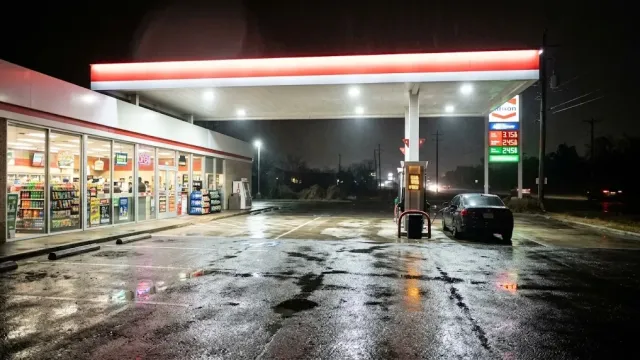
I was standing on the concrete island of an old Sinclair service station along Route 6 outside Lincoln, Nebraska on a hot Friday afternoon with my uncle's mechanic friend, Dave. I had shoved the aluminum nozzle into the filler neck of my rusty Ford pickup and squeezed the black plastic lever until gasoline came gushing out of the underground pipes.
Just as the fuel neared the top of the tank, the handle gave a sharp metallic kick in my palm and snapped shut with a loud clunk. Not a single drop spilled over my rear fender. When I bent over to inspect the dark aluminum nozzle tip with a pocket flashlight, searching for an electric wire, optical sensor, or floating cork, Dave leaned against the tire of his flatbed truck, spit a sunflower seed onto the gravel, and laughed.
Gas Stations Barely Make Money on Gas. The Real Profit Engine Is the Snack Aisle
The Physics Magic Behind the Automatic Click
"You can look in there until sunrise, kid," Dave told me, tapping the aluminum casting with the brass bolster of his pocketknife. "There isn't a wire, battery, circuit board, or sensor anywhere inside that nozzle. If a tornado knocked the town power grid flat while you were pumping, that handle would still click shut at the exact same fraction of a second. It is powered completely by air."
Most drivers grab that cold handle twice a week on their way to work, never realizing that it hides one of the cleverest mechanical inventions of the twentieth century: the Venturi automatic shut-off valve.
Back in 1910, filling a motorcar was a messy chore that ruined work clothes. A driver pulled up beside a curb outside a general store where a shopkeeper hand-cranked gasoline out of a wooden barrel into a five-gallon tin watering can. You had to shove a tin funnel lined with chamois leather into your fuel tank and pour the fuel by hand, praying that nobody dropped a lit pipe or struck a match nearby.
Dave's grandfather ran a curb pump in the 1920s that used tall glass cylinders on top of iron pedestals. Customers demanded to look right through the glass jar to see if the fuel looked clear or cloudy with kerosene. The attendant had to grab a long iron crank handle and pump five gallons up into the jar by hand. Then he turned a brass petcock, letting gravity drain the liquid down a canvas-covered rubber hose into the car's gas tank.
If the kid running the pump looked away to holler at a neighbor across the street, raw fuel flooded the fenders, soaked the wooden running boards, and dripped onto red-hot exhaust pipes. Main Street fires were a constant dread.
How Moving Fuel Does All the Thinking
The modern nozzle solved that terror by making the flowing gasoline do all the thinking.
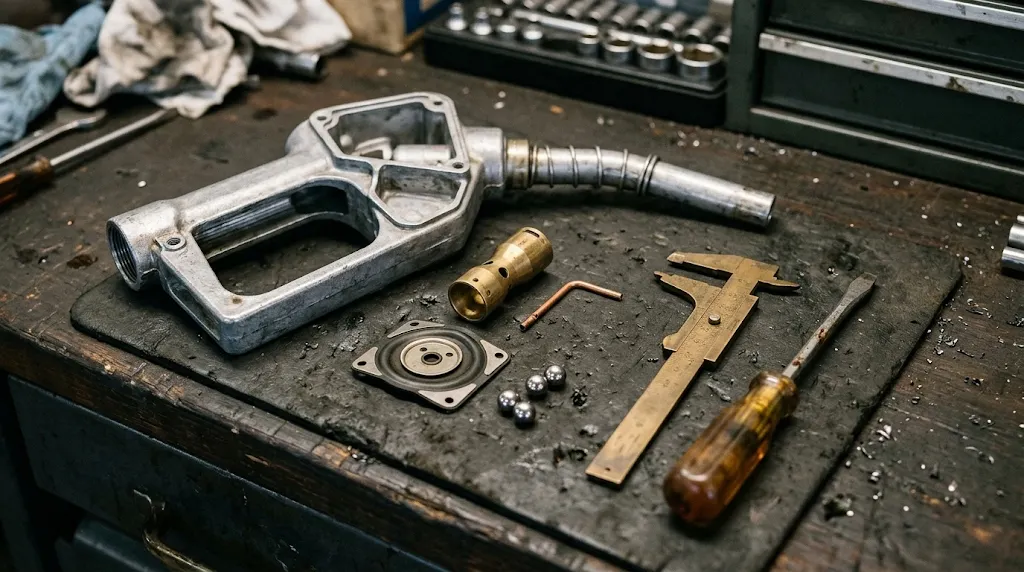
Dave took a spare nozzle apart on his wooden workbench to show me the internals. Right behind the trigger sits a brass venturi collar where the fuel path pinches down like an hourglass. When gasoline squeezes through that tight pinch, it speeds up, creating a natural vacuum suction.
Dave showed me a tiny copper straw running from that pinch all the way out to a pinhole drilled near the lip of the spout. As long as the tank is taking fuel, the vacuum breathes easy, sipping air through that straw. The second fuel sloshes up and plugs that pinhole, the straw chokes. The vacuum has nowhere to breathe, so suction jerks violently backward against a thin rubber diaphragm inside the handle.
That rubber diaphragm flexes upward, popping three little chrome steel ball bearings out of their brass grooves. A heavy coiled spring instantly slams the main poppet gate shut in less than a tenth of a second. It happens so fast your hand only feels a quick metallic thump.
| Gas Station Component | Engineering Mechanism | Primary Safety Hazard Prevented | Failsafe Trigger Method |
|---|---|---|---|
| Dispenser Nozzle | Venturi tube & sensing port | Overfilling and fuel tank overflow | Vacuum spike dislodges ball bearings |
| Underground Storage Tank | Double-wall fiberglass with brine gap | Groundwater aquifer fuel contamination | Hydrostatic pressure change sensor |
| Hose Breakaway Coupling | Spring-loaded magnetic shear detents | Drive-off dispenser cabinet rollover | Separates cleanly at 300 lbs pulling force |
| Island Base Shear Valve | Cast-iron pre-grooved impact neck | Vehicle collision high-pressure fuel fire | Mechanical impact snaps internal spring poppet |
The Forty-Thousand-Gallon Lake Under Your Boots
Dave kicked the dirt with the steel toe of his work boot and pointed down at the concrete. "Most people think the magic is in this little handle," he said, wiping sweat off his forehead with an oily shop rag. "The scary part is what is resting right below our shoe soles. There are three forty-thousand-gallon tanks sleeping twelve feet down in this clay."
Back when Dave was an apprentice in the 1960s, crews dug holes with backhoes and dropped bare welded steel tanks right into wet mud. After fifteen years in the damp ground, rust ate holes right through the iron plates. Gasoline leaked into underground water streams, poisoning neighborhood drinking wells and filling basements with toxic fumes that blew up when water heaters clicked on.
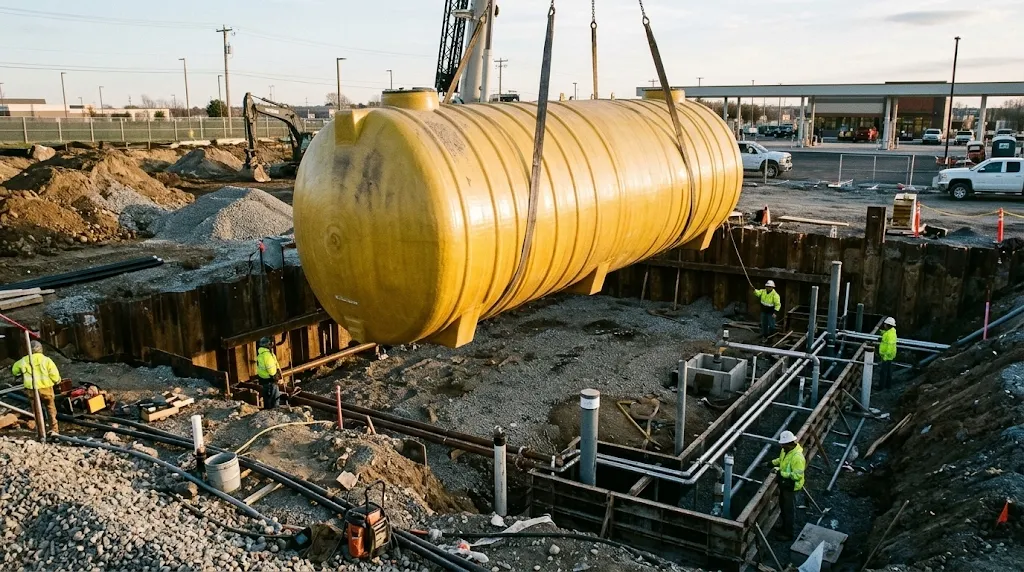
Today, federal inspectors make stations bury massive double-wall fiberglass tanks that look like yellow submarine hulls. The inner tank holds the fuel, wrapped inside an outer fiberglass jacket with a two-inch hollow gap between them called the interstitial space.
Workers pump that hollow gap full of bright green salt brine and hook it to digital pressure dials. If a hairline crack opens on the inside, gasoline leaks into the brine, changing the liquid weight and ringing an emergency bell on the cashier's counter. If a careless backhoe operator digs into the outside shell, mud water leaks in, warning technicians months before a single drop of fuel ever touches the soil.
"Gasoline cannot burn without oxygen. Inside a sealed underground storage tank, the air space is packed solid with pure fuel vapor. An electric motor can run submerged in twelve feet of cold gasoline for thirty years without ever throwing a single spark."
Drowning Electric Motors in High-Octane Fuel
Dave walked me over to the red emergency shutoff button on the brick station wall. "Look at how the fuel gets up here," he pointed out. "People think there is a little electric motor inside this metal cabinet. But if you put an electric pump up here on the concrete, it would have to suck gasoline through three hundred feet of pipe. That causes vapor lock in hot July weather."
Instead, oil companies drop an electric turbine pump straight down to the bottom of the underground storage tank, submerging the motor in twelve feet of cold gasoline.
Putting an electric motor inside high-test gasoline sounds completely insane to anyone with common sense. But Dave shook his head. "Gasoline can't burn without oxygen," he explained. "Inside that sealed tank, the air space is packed solid with pure fuel vapor. There isn't enough free oxygen to light a kitchen match. The liquid gasoline actually cools the electric motor windings, letting that pump run for thirty years without ever throwing a single spark."
The 300-Pound Drive-Off Disaster Valve
Right under the dispenser cabinet, bolted to the concrete island with four thick steel bolts, sits a cast-iron emergency shear valve. Dave knelt down and showed me the machined groove cut into the iron neck. "If an eighteen-wheeler or a drunk driver wipes this pump right off the island," Dave said, "the pipe snaps clean at that pre-cut groove. A spring-loaded flapper slams shut in one millisecond, locking forty thousand gallons of fuel safely underground before a single coffee cup of gasoline can spill onto the hot blacktop."
Dave pointed up at the black rubber hose looping down from the canopy arm. "Look right there, halfway between the cabinet and your nozzle," he said. Right in the middle of the flexible black hose was a heavy brass cylinder about the size of an apple.
"That is a magnetic breakaway coupling," Dave explained, unscrewing a spare brass fitting from his parts drawer. "At least once a month in every town in America, someone pays for their gas, climbs back into their warm car, and drives away with the nozzle still stuck in their gas tank."
Without that brass cylinder, the car would pull the entire dispenser cabinet off its concrete foundation, tearing open fuel lines and pulling down the overhead canopy. Instead, the breakaway coupling is held together by three spring-loaded detent pins calibrated to snap apart under exactly three hundred pounds of pulling force. When a distracted driver drives off, the coupling pops cleanly in half with a loud crack.
Internal spring valves on both severed ends slam shut in three milliseconds. The car drives down the street with a two-foot whip of hose dragging behind it, but not a single thimble of fuel spills onto the concrete apron.
Dave packed his wrenches back into his metal cantilever toolbox and clicked the steel latches shut. "People pull in here at night, gripe about the price of regular unleaded on the digital sign, and drive away without a thought," he smiled. "They have no idea they just walked across a minefield of liquid dynamite that is held in check by the simplest, prettiest laws of physics ever discovered."
The next time you pull up to a pump island, grab the cold nozzle, and hear that mechanical clunk in your palm, take a look around. You are operating a brilliant mechanical computer powered by vacuum and gravity, standing on top of forty thousand gallons of fuel safely contained by pure human ingenuity.
 Alex Mandela 26 October 2026
- Petroleum Equipment Institute & Primal Space