 09 November 2026
Leather is one of the most commonly misrepresented materials in the consumer market. Walk into any store and you'll find products labeled «leather» that are, in fact, made from polyurethane (PU) or polyvinyl chloride (PVC) — synthetic materials that look the part but behave nothing like the real thing. Knowing the difference can save you money, help you make smarter buying decisions, and ensure you get the quality you're paying for.
This guide breaks down everything you need to know: what distinguishes genuine leather from its synthetic counterparts, how to identify each type using simple tests, and why the difference matters over time.
What Is Real Leather?
Real leather is made from animal hide — most commonly cowhide, though goat, lamb, pig, and exotic leathers also exist. The hide goes through a tanning process (vegetable tanning, chrome tanning, or combination methods) that transforms the raw skin into a durable, flexible material.
Types of Genuine Leather
| Grade | Description | Durability |
|---|---|---|
| Full-Grain Leather | Top layer of hide, natural markings intact | Highest — ages beautifully |
| Top-Grain Leather | Sanded to remove imperfections, more uniform look | High |
| Genuine Leather | Lower layers, often corrected with coating | Medium |
| Bonded Leather | Scraps bound with adhesive and polyurethane | Low — similar to faux |
Full-grain leather is the gold standard. It retains the natural grain pattern of the animal's hide, develops a rich patina over decades, and becomes more beautiful with age — not less.
What Is Fake Leather?
Fake leather (also called faux leather, synthetic leather, vegan leather, PU leather, or pleather) is a man-made material designed to mimic the appearance of real leather. The two most common types are:
- PU (Polyurethane) Leather — A fabric base coated with polyurethane. More flexible and softer than PVC.
- PVC (Polyvinyl Chloride) Leather — Plastic-based, more rigid and less breathable than PU.
Newer generations of faux leather include bio-based alternatives made from mushrooms (Mylo), cactus (Desserto), and apple waste — though these remain niche and expensive.
Real Leather vs Fake Leather: Key Differences
Aging and Durability Over Time
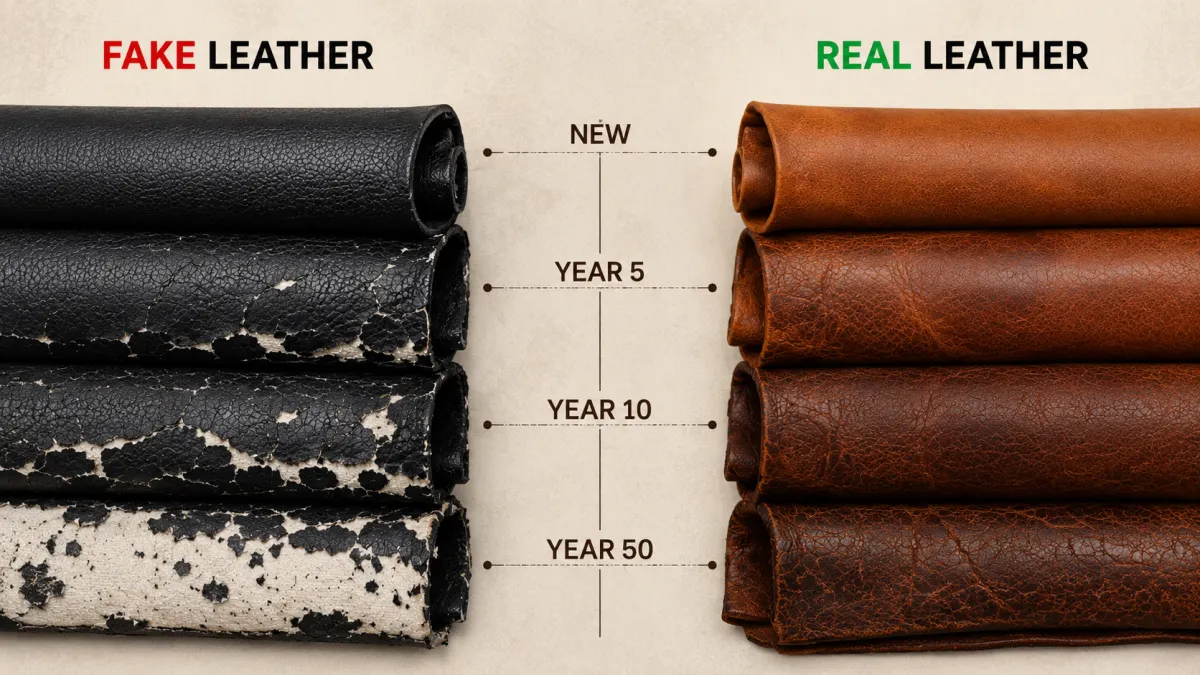
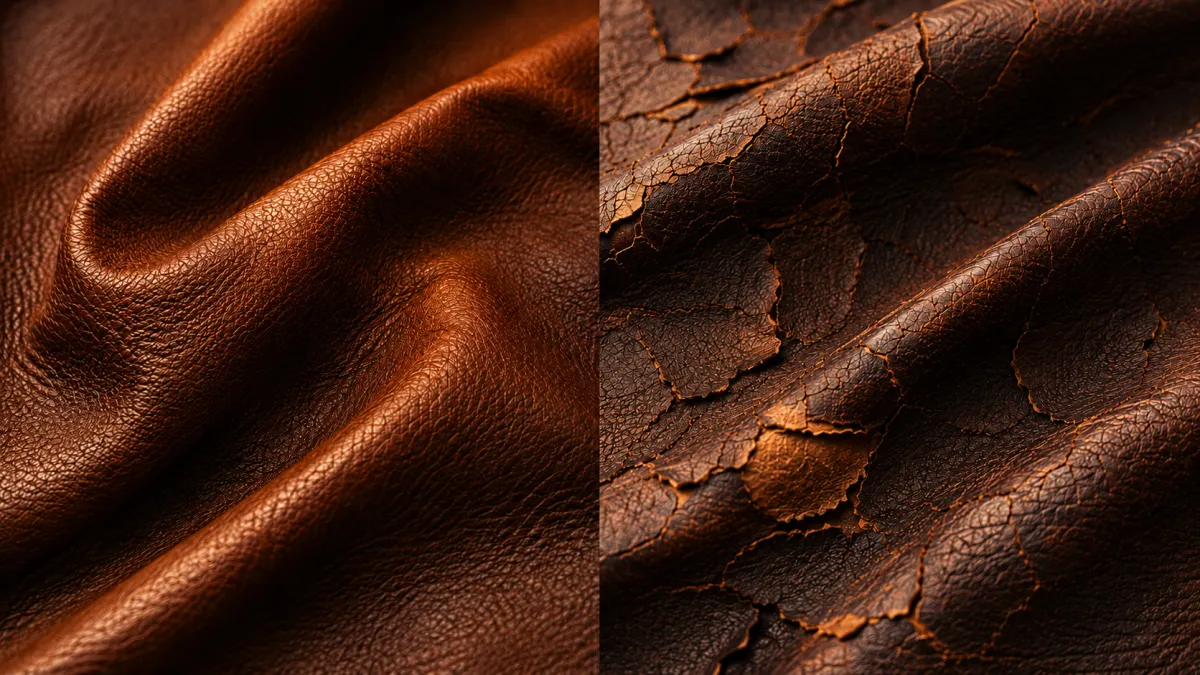
Perhaps the most striking difference between real and fake leather is how they age. As illustrated in the material timeline comparison:
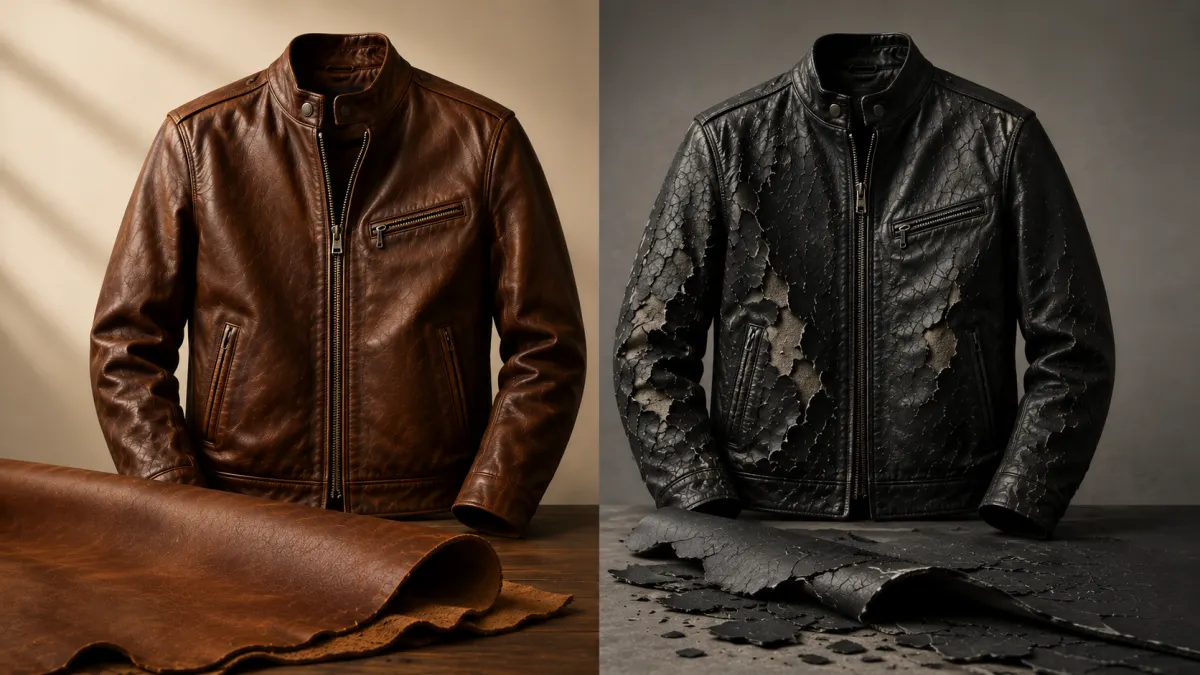
- Fake leather looks great when new but begins cracking, peeling, and flaking after roughly 3–5 years. By Year 10, the coating separates from the base fabric. By Year 50, the material has completely degraded — often fragmenting into an unrecognizable flaky mess.
- Real leather develops a natural patina over time. The surface darkens, becomes richer in color, and softens in all the right ways. A well-maintained genuine leather product can last 50 years or more and often looks better at Year 50 than it did when new.
Breathability
Real leather is a natural material with pores. It breathes, adjusting to body temperature and humidity. Fake leather is essentially a plastic surface — it does not breathe, traps heat, and can feel sweaty or uncomfortable in warm conditions.
Texture and Feel
Genuine leather has an irregular, organic texture. Run your finger across it and you'll feel subtle variations — natural grain patterns, slight imperfections, and a supple give. Faux leather tends to have a very uniform, embossed pattern that is perfectly repeated across the entire surface. It also tends to feel slightly plastic or stiff.
Edge and Back Appearance
The back (flesh) side of real leather looks like suede or has a fibrous texture. Cut edges are rough and fibrous. Faux leather, when cut or examined on the back, reveals a fabric or mesh backing, and edges are clean and uniform.
The 10-Year Test: Why Fake Leather and Real Leather End Up Looking Completely Different
When people buy a leather jacket, sofa, wallet, or bag, both real leather and faux leather often look nearly identical on day one. The biggest difference doesn't appear in the store — it appears years later.
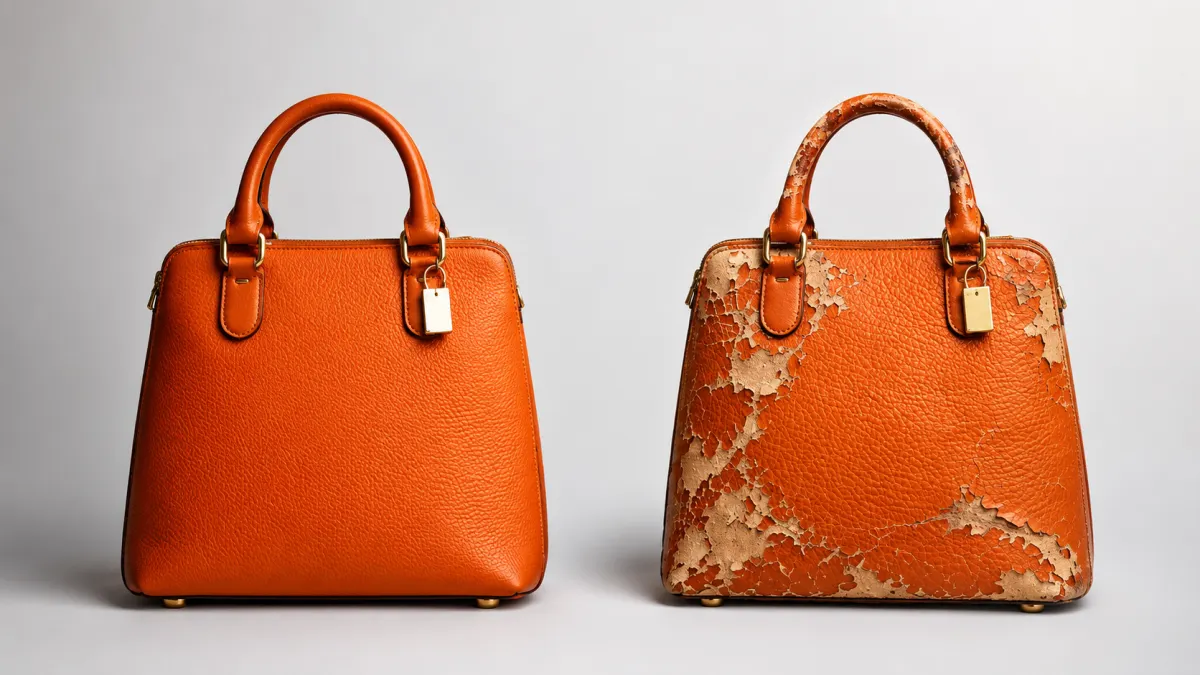
Imagine two identical bags purchased today. One is made from full-grain leather, while the other uses polyurethane (PU) faux leather.
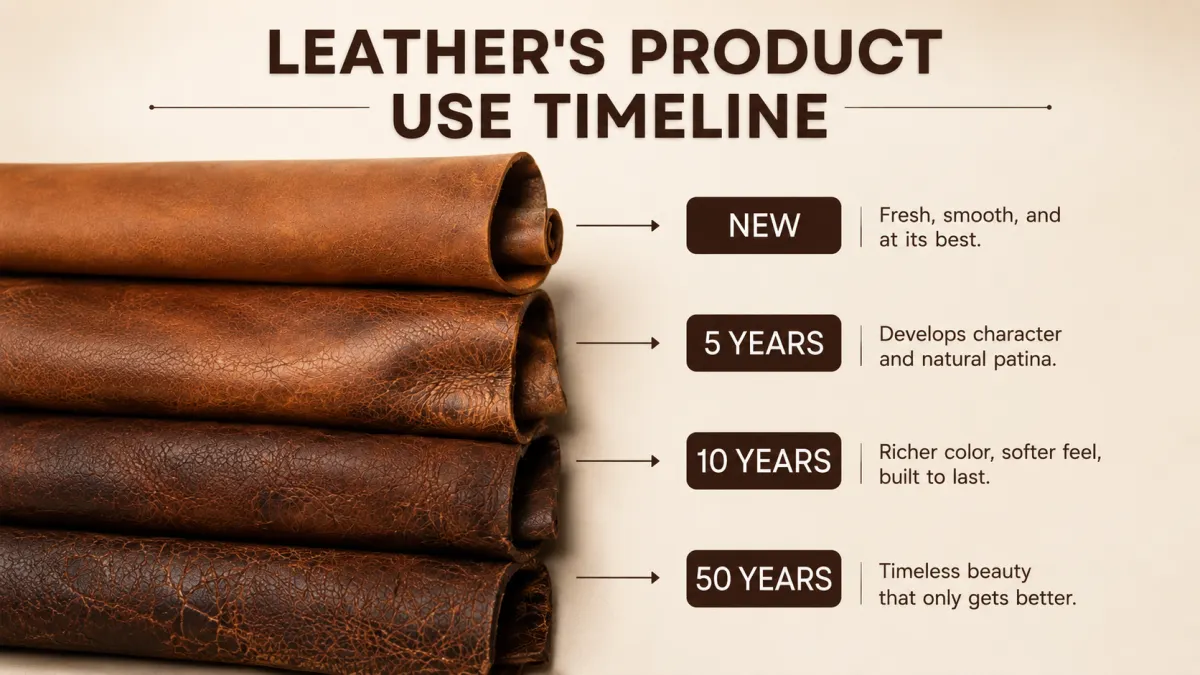
Year 1
Both products still look attractive. Most consumers would struggle to tell them apart without a close inspection.
Year 3
The faux leather begins showing the first signs of wear. Areas exposed to sunlight, body oils, friction, and temperature changes may start developing small cracks or surface peeling. Real leather, meanwhile, begins developing a richer texture and deeper color.
Year 5
The difference becomes obvious. Faux leather often starts flaking around edges, handles, and high-contact areas. Once peeling begins, repair options are limited. Real leather becomes softer, more comfortable, and develops a natural patina that many owners consider desirable.
Year 10
Many faux leather products have already been replaced by this point. The synthetic coating may separate from the fabric backing, leaving visible damage. A well-maintained full-grain leather item, however, often looks better than it did when new and can continue serving its owner for decades.
Quick Comparison
| Age | Real Leather | Fake Leather |
|---|---|---|
| New | Natural appearance | Nearly identical appearance |
| 3 Years | Softer, richer color | Early cracking possible |
| 5 Years | Patina develops | Peeling and flaking common |
| 10 Years | Often still excellent | Significant deterioration likely |
| 20+ Years | Can remain usable | Rarely survives intact |
This long-term aging behavior is one of the biggest reasons premium brands continue to use genuine leather despite the higher upfront cost. While faux leather may be cheaper initially, real leather often delivers a lower cost per year of use over its lifetime.
How to Tell Real Leather from Fake: 7 Practical Tests
1. The Water Drop Test
Place a small drop of water on the surface. Real leather absorbs moisture slowly — you'll see the surface darken slightly. Fake leather repels the water; it beads and rolls off.
2. The Smell Test
Real leather has a distinctive, natural earthy or musky smell. Fake leather smells like plastic or chemicals. This is one of the most reliable quick tests and is difficult to fake with perfumes or treatments.
3. The Texture and Grain Test
Examine the grain pattern closely. On real leather, the grain is irregular and unique — no two areas look exactly alike. On faux leather, the embossed pattern is perfectly repeated and machine-uniform. The more «perfect» the grain, the more suspicious you should be.
4. The Edge Test
Look at the edges of the material (on a bag strap, belt, or shoe sole). Real leather edges are rough, fibrous, and slightly uneven. Fake leather edges are clean, smooth, and reveal a textile or plastic backing.
5. The Back Test
Flip the product over or look inside. Real leather shows a natural suede-like back. Fake leather typically has a woven fabric or smooth plastic backing.
6. The Heat/Pressure Test
Apply gentle pressure with a finger for a few seconds. Real leather will warm slightly and recover slowly. Fake leather tends to feel cool like plastic and responds differently to sustained pressure.
7. The Fire Test (Use Caution)
This is a last resort and should only be done on a hidden area or scrap. Real leather singes and smells like burning hair. Fake leather melts, drips, and emits a chemical or plastic odor. Do not use this test on finished products.
Why Labels Can Be Misleading
The term «genuine leather» is widely misunderstood. Consumers naturally assume it means high-quality leather — but in industry terminology, it is actually one of the lowest grades of real leather. It comes from the innermost layers of the hide, is often heavily processed, and may be coated with synthetic finishes that make it perform similarly to faux leather.
Label Glossary
| Label | What It Actually Means |
|---|---|
| Full-Grain Leather | Highest quality genuine leather |
| Top-Grain Leather | High quality, slightly processed |
| Genuine Leather | Low-grade real leather, heavily processed |
| Bonded Leather | Mostly synthetic with minimal leather content |
| PU Leather / Faux Leather | Fully synthetic, no real leather |
| Vegan Leather | Marketing term for synthetic/faux leather |
Real Leather vs Fake Leather: Which Should You Choose?
Choose Real Leather If:
- You want a product that improves with age and lasts decades
- You're buying high-use items (wallets, belts, bags, shoes, furniture)
- You're willing to invest in care (conditioning, polishing)
- Long-term value matters more than upfront cost
Choose Faux Leather If:
- Budget is the primary concern
- You prefer animal-free materials for ethical or environmental reasons
- The item will see limited or light use
- You plan to update the product every few years anyway
Environmental Considerations
This is a complex debate. Real leather is a byproduct of the meat industry, but its production involves heavy chemical use (especially chrome tanning). Faux leather avoids animal products but is typically petroleum-based, non-biodegradable, and contributes to microplastic pollution as it degrades.
Newer bio-based leathers (from cactus, mushroom, or fruit waste) aim to address both concerns, though they have not yet achieved mass-market scale or comparable durability.
Is «genuine leather» the same as real leather?
Technically yes, but it is one of the lowest quality grades of real leather. The term can be misleading — always look for «full-grain» or «top-grain» when buying quality goods.
How long does fake leather last?
Faux leather typically begins to crack and peel within 3–5 years under regular use. By 10 years, significant degradation is common. Real leather, properly maintained, can last 30–50+ years.
Can fake leather look as good as real leather?
When new, high-quality faux leather can closely resemble real leather. The difference becomes clear after a few years, as fake leather deteriorates while real leather develops a rich patina.
What is the best way to identify real leather in a store?
The smell test and edge test are the most reliable. Real leather smells earthy and organic; fake leather smells like plastic. Real leather edges are fibrous; fake leather edges are clean with visible backing.
Is vegan leather durable?
Most vegan leathers (PU/PVC) are less durable than genuine leather. However, newer bio-based alternatives such as Mylo (mushroom leather) and Desserto (cactus leather) are improving in performance and longevity.
Does real leather require special care?
Yes. Real leather benefits from regular conditioning with leather cream or oil, protection from prolonged water exposure, and avoiding direct sunlight. With proper care, it will outlast virtually any synthetic alternative.