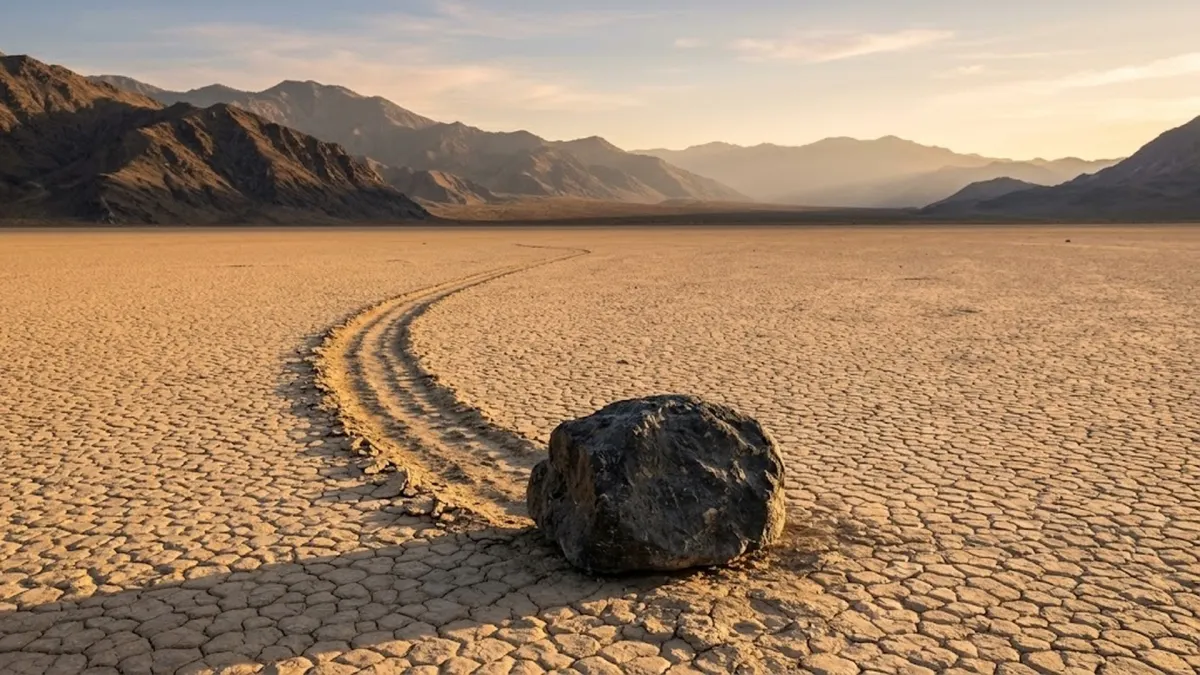

The Boulders That Walk Across the Desert
Back in the autumn of 2012, a park ranger at Death Valley told me about a tourist who drove twenty-eight miles over bone-shaking washboard gravel in an all-wheel-drive Subaru just to sit by a rock. The guy pitched a folding chair on the edge of Racetrack Playa with a thermos of black coffee, dead set on watching a five-hundred-pound slab of dolomite slide across the mud. He sat there for fourteen hours in the freezing desert wind and went home empty-handed. Not a single pebble budged.
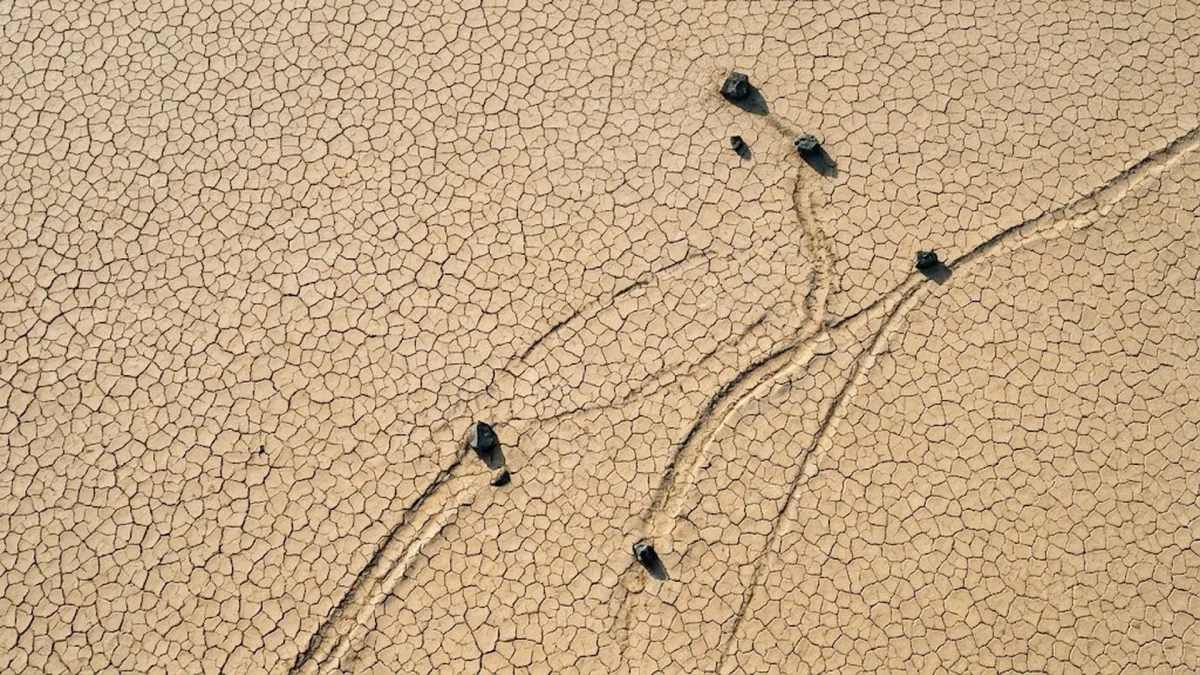
For more than seventy years, that was the running joke of the Racetrack. You hike out onto this dried prehistoric lakebed surrounded by sheer desert peaks, and you find massive boulders resting at the ends of long, clean furrows carved straight into the sunbaked clay. Some tracks run for two football fields in dead-straight lines; others make weird ninety-degree doglegs or loop around like someone steering a go-kart. But whenever humans were looking, the rocks stayed completely still.
Because nobody ever caught them moving in real time, the stories got wilder by the decade. People talked about hurricane-force gales, underground magnetic vortices, earthquake harmonics, slick algae mats, and the usual alien pranksters. The true explanation didn't come out until late 2013, when two cousins with a bunch of customized GPS instruments and a stroke of wild weather luck finally cracked the whole mystery wide open.
Read also: Why Ice Cream Gives You Brain Freeze and the 5-Second Roof-of-Mouth Reset
The 70-Year Puzzle: Why Wind Alone Couldn't Do It
The Racetrack Playa is an unforgiving stretch of desert sitting nearly four thousand feet up in the mountains between the Cottonwood and Last Chance ranges. It is blindingly flat: about three miles long, and the northern end sits barely two inches higher than the south. When rain sweeps down off the slopes in winter, fine silt settles into a flat bed that bakes into cracked puzzle tiles every summer.
The rocks themselves break off a towering rock cliff called the Grandstand at the south end of the lake. Once they tumble onto the flat playa floor, they start their slow, silent travels. Early geologists in the 1940s figured desert gales were shoving them along wet mud. But when engineers ran the drag numbers on a three-hundred-pound jagged boulder, the math completely broke down: it would take sustained winds over two hundred and fifty miles per hour to budge those stones across sticky desert clay. Wind speeds like that have never been recorded anywhere in California.
| Proposed Theory | What People Thought Moved the Rocks | Why Field Data Disproved It | First Proposed |
|---|---|---|---|
| Desert Hurricane Gales | Fierce wind gusts pushing dry stones | Would require 250 mph winds; rocks often move in opposite directions | 1948 (McAllister & Agnew) |
| Deep Ice Rafts | Thick winter ice sheets locking rocks into floating rafts | Thick ice leaves wide scrape marks, not clean narrow furrows | 1976 (Sharp & Carey) |
| Slick Algal Mud | Microscopic bacteria making mud slippery as Teflon | Fails to explain why one rock moves while another sits ten feet away | 1995 (Kuntz et al.) |
| Windowpane Ice Shoving | Ultra-thin floating ice panels driven by gentle morning breezes | Proven by time-lapse video, weather stations, and GPS tracking | 2014 (Norris et al.) |
Even weirder, rocks sitting only fifteen feet apart would often head off in wildly different directions. One stone would skate due north for fifty yards, while its neighbor took a sharp turn east or carved an S-curve. If a single desert gale was shoving the playa, every boulder should have traveled in the exact same direction.
The Slithering Stones Research Initiative
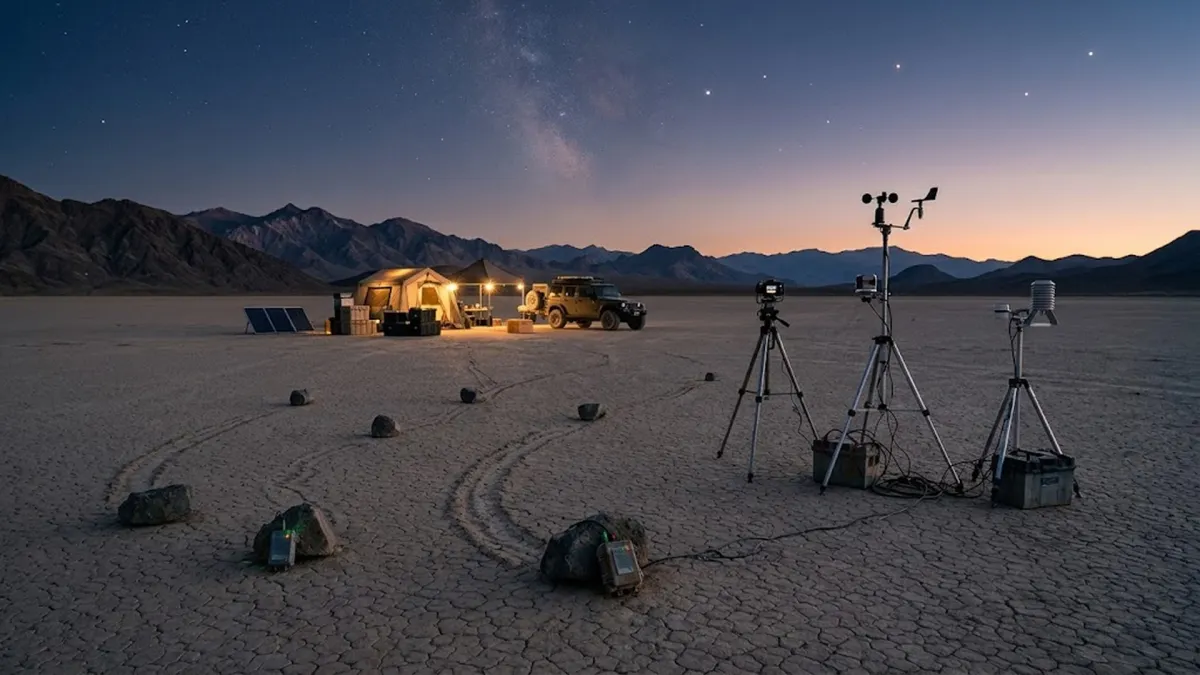
Tired of armchair theories, paleobiologist Richard Norris and his engineer cousin James Norris decided to settle the debate with actual hardware in 2011. National Park rules strictly forbid drilling into native Death Valley boulders, so the cousins imported fifteen matching limestone rocks from outside the park, drilled small cavities in each, and installed custom GPS tracking units designed to record movement down to the centimeter.
They placed their instrumented rocks on the southern playa and set up a solar-powered weather station nearby to track wind velocity, moisture, and temperatures round the clock. They braced themselves for a long, dull wait: some scientists estimated the rocks moved only once or twice a decade during freak winter storms.
Then, in November 2013, an uncharacteristic winter storm dumped inches of rain and snow over the surrounding mountains, pooling a shallow pond across the playa. In late December, the cousins drove out to inspect their batteries. To their utter disbelief, they walked right into the middle of the exact phenomenon science had been hunting for seventy years.
The Windowpane Ice Discovery
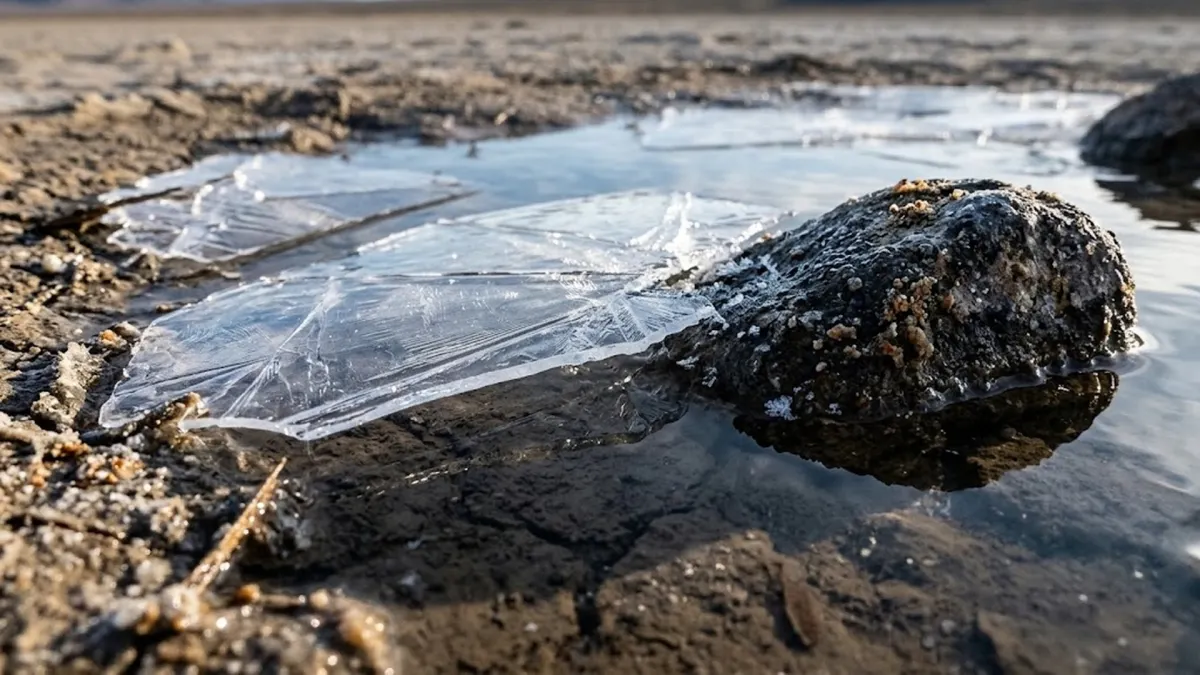
Standing on the edge of the playa on the crisp morning of December 20, 2013, the researchers saw the whole puzzle click together. The rocks don't move during terrifying storms; they move under gentle, sunny winter mornings when four separate conditions happen to line up at the exact same hour:
- A Shallow Water Pool: Rain must pool across the playa roughly two to three inches deep—deep enough to float ice, but shallow enough that the tops of the boulders stick up into the open air.
- Freezing Desert Nights: Clear nighttime skies send desert temperatures tumbling below freezing, forming a thin sheet of clear "windowpane" ice about four to five millimeters thick across the shallow lake.
- Morning Sun Fractures: When the desert sun comes up, the sheet of ice starts to crack and break apart into large floating sheets dozens of feet across.
- A Gentle Breeze: A light mid-morning wind blowing at just eight to twelve miles per hour pushes the broad sheets of floating ice. Because the ice panels cover thousands of square feet, even a mild breeze creates enormous mechanical shoving force against any rock poking through the sheet.
The floating ice sheets behaved like slow-motion bulldozers, nudging the boulders across the slick, wet mud underneath. The rocks moved at an imperceptible crawl: roughly two to six inches per second. Because the silt below was thoroughly saturated with water, the stones plowed smooth, narrow trenches without tumbling over.
Why Nobody Saw It for Three Quarters of a Century
Why did it take until the twenty-first century to figure out something happening in a world-famous American national park? The answer is pure timing. Racetrack Playa stays bone-dry for years on end. For stones to move, heavy rain has to hit right before a hard winter freeze, followed immediately by a sunny morning with a light breeze.
On top of that, the movement only lasts for a few hours on cold winter mornings when almost nobody is out there hiking. By lunchtime, the thin ice sheets melt away into plain water. Weeks later, the desert sun bakes the standing puddle dry, leaving behind hard, cracked mud tiles with mysterious stone tracks carved into them—with zero ice or water left behind to explain how it happened.
Visiting the Racetrack Playa Responsibly
If you want to see the sailing stones yourself, prepare for an unforgiving drive: reaching Racetrack Playa requires a high-clearance 4WD vehicle with tough off-road tires to survive twenty-eight miles of jagged, tire-shredding gravel from Ubehebe Crater. Never drive onto the lakebed itself—vehicle tracks permanently scar the delicate mud for decades. When the playa is damp after rain, hiking across the mud is strictly banned by park rangers to keep foot impressions from destroying the ancient tracks.